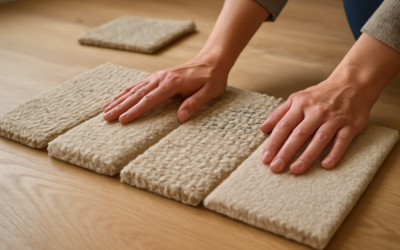
If you are carpeting a single room, there is a good reason the 12-by-12-foot size comes up again and again. A 12×12 carpet covers 144 square feet, which happens to match the footprint of a typical bedroom, home office, or small living room almost exactly. Just as important, broadloom carpet comes off the roll in a standard 12-foot width, so a 12-foot run lays down in one continuous piece with no seams. For a homeowner doing a single room, that seamless coverage is the difference between a clean, professional look and a patchy one. I steer people toward this approach whenever a room fits, because it simplifies everything.
This guide covers why the size matters, how to measure, what it costs, carpet types, and installation options.
Why the 12-Foot Width Matters
Most wall-to-wall carpet is manufactured in a 12-foot-wide roll, called broadloom. That width is the key to seamless installation. When your room is 12 feet wide or less, a single pull of carpet covers it edge to edge with no joints. A 12×12 room is the ideal case, since one square piece fits the whole floor. Once a room exceeds 12 feet in either direction, the installer has to seam two pieces together, which adds labor and a line that can show in certain light. That is why so many bedrooms are built right around this dimension.
What a 12×12 Carpet Suits
This size fits a surprising number of common spaces.
- Standard bedrooms: many secondary bedrooms land near 12 by 12 feet
- Home offices: a single seamless piece reduces wear lines at a desk chair
- Small living or family rooms: cozy spaces that fit within the 12-foot width
- Bonus rooms and dens: compact upstairs spaces
- Large area rug substitute: a 12×12 remnant can be bound into an oversized room rug
How to Measure Your Room
Never buy carpet off your guess of the room size. Measure carefully, because a few inches short means a seam or a reorder.
- Measure length and width. Measure the longest and widest points of the room in feet, wall to wall.
- Measure into closets and doorways. Account for closet floors and where the carpet runs into doorways, since those add to the total.
- Add a few inches for trimming. Order slightly larger than the exact dimensions so the installer can trim for a tight fit against the walls.
- Check for square. Old rooms are rarely perfectly square, so measure both ends; if a wall bows out past 12 feet, you may need a wider cut or a seam.
If your room measures, say, 12 feet 4 inches in one direction, you will need either a wider roll or a small seam, so confirm the true dimensions before ordering.
What It Costs
For a 144-square-foot room, carpet cost scales with the quality you choose. Budget polyester or olefin carpet often runs $1 to $3 per square foot for material, putting a basic 12×12 piece around $150 to $450 in carpet alone. Mid-range nylon lands higher, and premium or wool carpet higher still. Add padding at roughly $0.50 to $1.50 per square foot, plus installation labor commonly running $0.50 to $2 per square foot. All in, a complete 12×12 carpet job frequently falls somewhere in the few-hundred to roughly $1,000-plus range depending on materials. Buying a remnant or roll end can cut the carpet cost significantly for a room this size.
Choosing the Right Carpet Type
Match the fiber and style to how the room is used.
Fiber
Nylon is the most durable and resilient, good for a busy room or office. Polyester is soft and stain-resistant at a lower price, fine for bedrooms. Olefin is budget-friendly and moisture-resistant but flattens faster, suited to lighter-use spaces.
Style and Pile
Plush and saxony give a soft, formal look that shows footprints. Textured cut pile hides marks and wears well, a versatile everyday choice. Berber and loop styles are tough and hide dirt, good for offices and higher traffic. For a bedroom, comfort underfoot usually wins; for an office, durability matters more.
Installation Options
You have two real paths for a single room. Professional installation is the reliable choice for wall-to-wall broadloom, since the installer stretches the carpet over tack strips and pad for a tight, lasting fit, and it includes seam and edge work. For a DIY-minded homeowner, a 12×12 piece is manageable to install over pad with a knee kicker and a few tools, though stretching it properly takes practice. Alternatively, you can have a 12×12 piece bound around the edges and use it as a large finished area rug, which needs no installation at all and can move with you.
Don’t Forget the Padding
The carpet gets the attention, but the pad underneath does more for comfort and lifespan than most homeowners realize. A good cushion absorbs foot traffic, keeps the carpet from matting and crushing, and makes even a mid-grade carpet feel plush. For a 12×12 bedroom, a 7/16-inch to 1/2-inch pad in the 6 to 8 pound density range is a solid all-around choice. Skip the thin builder pad, since it wears out fast and lets the carpet flatten in traffic lanes. In a moisture-prone room you might choose a moisture-barrier pad. The pad adds only a modest cost over the 144 square feet, and it directly affects how long the carpet lasts, so it is not the place to cut corners. Match the pad to the carpet warranty too, since some manufacturers specify a minimum pad to keep the warranty valid.
The Bottom Line
A 12×12 carpet hits a sweet spot for single-room projects, covering a standard 144-square-foot bedroom or office in one seamless piece thanks to the 12-foot broadloom width. Measure your room carefully, including closets and doorways, before ordering, and confirm the room does not exceed 12 feet in a way that would force a seam. Choose a fiber and pile that match how the room is used, budget for pad and labor on top of the carpet, and decide between professional wall-to-wall installation or a simpler bound area rug. Get the measurements right and you will have a clean, comfortable floor with no visible seams.