
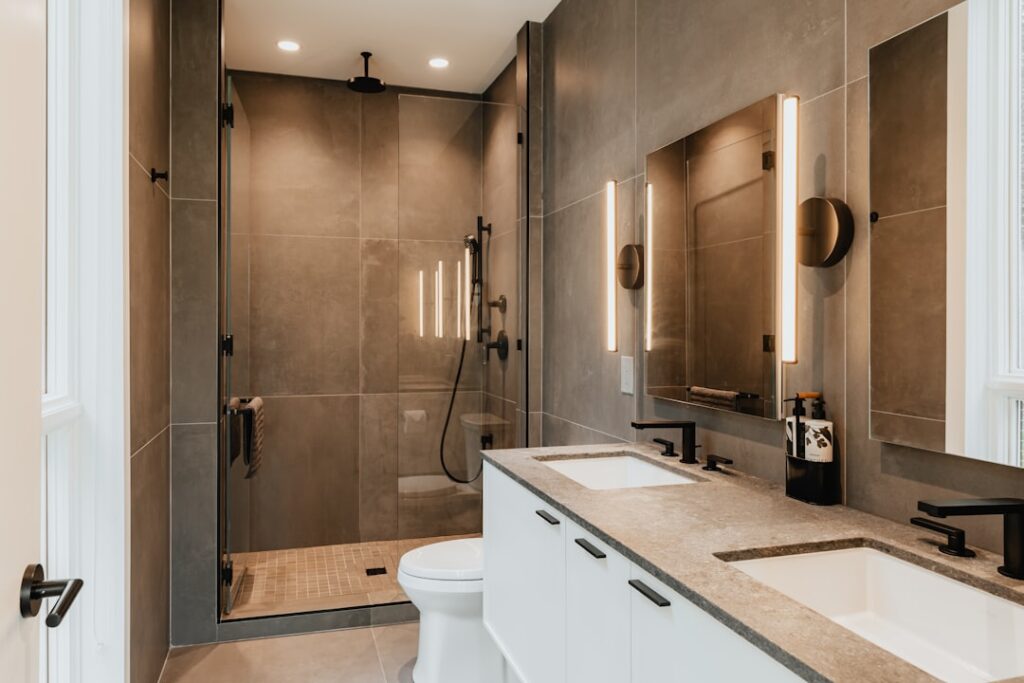
A 2 person shower sounds like a small upgrade until you start measuring. Two adults using a shower simultaneously need at least 36 square feet of bathroom footprint, two separate control valves, planned drainage with twin or linear drains, and enough hot water capacity to supply two showerheads without losing temperature. Get any of those details wrong and you end up with a fancy single-person shower with two heads, not a true shared space. Done right, it is one of the best primary-suite upgrades you can add and consistently shows up on luxury home appraisals as a value driver.
Minimum Dimensions That Actually Work
The smallest shower that two adults can use comfortably is 48 by 60 inches of interior floor space — 20 square feet inside the enclosure. That gives each person a 24-inch zone and just enough room to move without bumping elbows. Anything smaller is a single shower with a guest spot, not a true two-person space.
Better dimensions for a real two-person experience:
- Comfortable minimum: 60 by 60 inches (25 sq ft interior)
- Standard luxury build: 60 by 72 inches (30 sq ft interior)
- Spa-grade design: 72 by 84 inches (42 sq ft interior)
- Ceiling height minimum: 8 feet to accommodate rain heads
Remember that interior dimensions are smaller than rough opening dimensions. After tile, backer board, and waterproofing membranes, plan on losing 1.5 to 2 inches from each wall surface. Frame the rough opening accordingly.
Layout Configurations
The layout dictates the entire user experience. Three options cover most situations.
Twin parallel showerheads on opposite walls. Each user stands under their own head with the other at their back. This works well for narrow showers between 60 and 84 inches long. It is the simplest plumbing arrangement but means you cannot face your partner during the shower.
Adjacent showerheads on a single wall. Both showerheads mount on the same wall with 36 to 48 inches of separation. Users stand side-by-side facing the wall. This layout uses less floor space but creates wet zones across the entire opposite wall and benefits from a linear drain along that wall.
Center-island rain head with side body sprays. The luxury approach uses a ceiling-mounted rainfall showerhead between users with optional body sprays on the side walls for each person. Requires significant ceiling height and complex plumbing routing through the ceiling joists.
Plumbing and Hot Water Requirements
This is where most DIY two-person shower projects fail. A standard residential water heater holds 40 to 50 gallons. Two showerheads at 2.0 GPM each consume 4 gallons of mixed hot and cold water per minute. A 15-minute shared shower draws 60 gallons of mixed water — and the hot side of that exceeds what a standard tank can recover during use.
Plan one of these upgrades:
- Tankless water heater: Rinnai RU199iN or Navien NPE-240A2 deliver 9 to 11 GPM at a 70°F temperature rise — enough for two showers with capacity to spare. Installation runs $3,500 to $5,500 including gas line and venting upgrades.
- Larger tank water heater: 75 to 80 gallon high-recovery gas tank. Lower upfront cost than tankless at $2,000 to $3,000 installed but takes a 30 by 30 inch footprint.
- Twin water heaters: Two standard 50-gallon tanks plumbed in series. Most flexible but uses 6 square feet of utility space.
Each showerhead needs its own thermostatic mixing valve with separate volume and temperature controls. Hansgrohe ShowerSelect, Kohler Statement, and Delta Stryke all offer modular valves that make this straightforward. Budget $400 to $800 per valve plus $200 to $400 per showerhead.
Drainage Done Right
A 36 by 36 inch shower works with a single center drain. A 60 by 72 inch shower with two flowing showerheads needs more than that. Linear drains along one wall handle higher water volumes and allow large-format tile to slope to a single edge rather than four-way pitch toward a center point.
Schluter Kerdi-Line and Infinity Drain make linear drain kits ranging from 24 to 60 inches in length. Cost runs $300 to $800 for the drain itself plus another $300 to $500 in installation. The result is much easier to clean than a center drain and accommodates 12-inch or larger floor tiles with minimal cuts.
Waterproofing the Right Way
Two people produce double the water volume and double the splash zone. Cement board with painted-on Redgard barely passes for a single shower; for a two-person space, you need a full bonded membrane system. Schluter Kerdi sheet membrane and Wedi Building Panel are the two systems professional tile setters trust for high-use showers.
Run the waterproofing up to ceiling height on all walls, across the ceiling itself if you have a rain head, and out onto the bathroom floor through the curb. Skipping ceiling waterproofing in a shower with a rain head causes drywall failure and mold within two years.
Glass and Enclosure Options
Two-person showers benefit from frameless glass enclosures that maximize the sense of space. Heavy 3/8-inch tempered glass with brushed nickel or matte black hardware is the standard. Cost for custom frameless glass on a 60 by 72 inch shower runs $1,500 to $3,500 depending on configuration and glass treatment.
For larger walk-in designs, a single fixed glass panel with no door (often called a “wet room” configuration) eliminates the door cost entirely. This works only if the shower is sized large enough that splash never reaches the open side — typically 8 feet of separation between the showerheads and the opening minimum.
Tile and Finish Choices
Floor tile must be slip-rated to a minimum of 0.42 dynamic coefficient of friction (DCOF) per ANSI A137.1. Most matte porcelain and natural stone tiles in the 2 to 4 inch range pass easily. Avoid large polished tiles on the floor — they look great dry but are dangerous when soapy.
Wall tile choice is more flexible. Large-format porcelain in 24 by 48 inch sizes minimizes grout lines and looks luxurious. Natural stone like marble and travertine requires sealing every 6 to 12 months. Glass mosaic accents work as feature strips but increase total grout area, which means more cleaning.
Ventilation Capacity
Two simultaneous showers produce significant humidity. Standard bathroom fans rated at 50 to 80 CFM cannot keep up. For a master bath with a 2 person shower, install a fan rated at 110 to 150 CFM minimum. Better yet, use two separate fans or a Panasonic WhisperGreen Select with built-in humidity sensors that ramp up automatically.
Run the fan during the shower and for 20 to 30 minutes afterward. A timer switch or humidity sensor handles this automatically and prevents the long-term moisture damage that destroys bathrooms.
Total Cost Range
A genuine two-person shower built into an existing bathroom renovation runs $8,000 to $25,000 depending on size, finishes, and plumbing complexity. The price breakdown typically lands around:
- Demo and rough plumbing: $1,500 to $3,500
- Waterproofing and substrate: $1,200 to $2,500
- Tile and stone (materials and labor): $3,000 to $9,000
- Glass enclosure: $1,500 to $3,500
- Fixtures, valves, and trim: $1,500 to $4,000
- Water heater upgrade if needed: $2,000 to $5,500
When to Skip This Project
A two-person shower needs at least a 60 by 60 inch interior space to be worth the cost. Smaller bathrooms benefit more from a single luxury shower with a bench than from cramming two heads into an undersized space. If your bathroom cannot give up the footprint, focus the remodel budget elsewhere. Done right, this is a beautiful upgrade. Done wrong in a too-small space, it is an expensive lesson in why dimensions matter.


