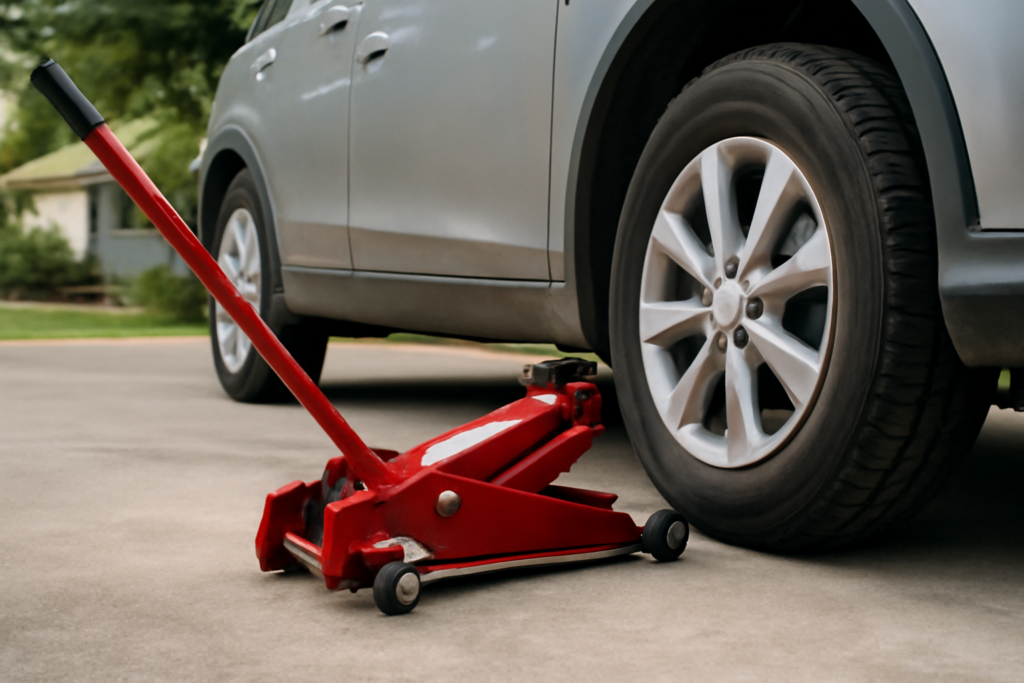
Changing a tire or doing your own brakes starts with safely getting a car off the ground, and the most popular tool for the job is the hydraulic floor jack. A 2 ton floor jack is a rolling hydraulic lift rated to raise up to 4,000 pounds of load, which covers most sedans, small SUVs, and compact trucks for routine maintenance. This guide explains what the rating really means, what features to look for, how much to spend, and, most importantly, how to use one without putting yourself in danger.
What the 2 Ton Rating Means
A 2 ton rating equals 4,000 pounds of lifting capacity. That number refers to the load on the jack at the lift point, not the total weight of the vehicle. Because you only lift one corner or one end at a time, a 2 ton jack handles many vehicles that weigh more than two tons overall. Even so, always check your vehicle’s weight and never push a jack to its limit. For heavier trucks and full-size SUVs, step up to a 3 ton jack for a safety margin.
Key Features to Compare
Not all 2 ton jacks are equal. A few specs make a real difference in daily use.
- Lift range: The minimum and maximum height. A low minimum, around 3 to 5 inches, fits under lowered cars, while a tall maximum lift gives more working room.
- Build material: Steel jacks are heavy and durable. Aluminum and hybrid jacks are lighter and easier to carry, which matters if you store one in your trunk.
- Saddle: The pad that contacts the vehicle. A rubber pad protects the frame and pinch welds.
- Speed: Some jacks feature a dual-pump or rapid-lift design that reaches the vehicle in fewer pumps.
- Caster wheels: Smooth, sturdy wheels let the jack roll forward as it lifts, which is normal hydraulic geometry.
Typical Costs
A basic steel 2 ton floor jack often runs about 30 to 70 dollars. Lightweight aluminum and low-profile models with faster lift typically cost 80 to 200 dollars. Professional-grade jacks climb higher. For most homeowners doing occasional tire rotations and brake jobs, a mid-range steel or hybrid jack offers the best balance of price and reliability. Budget for a pair of matching jack stands too, since they are not optional safety gear.
How to Use a Floor Jack Safely
This is the part that matters most. A floor jack lifts a vehicle, but it is never meant to hold it while you work underneath.
- Park on level, solid ground. Asphalt or concrete only. Never lift on dirt, gravel, or a slope.
- Set the parking brake and put the transmission in park or in gear.
- Chock the wheels that stay on the ground, on both sides, so the car cannot roll.
- Find the correct lift point. Check your owner’s manual for the factory jack points. Lifting on the wrong spot can crush the floor pan or bend a panel.
- Pump slowly and watch that the saddle stays centered as the car rises.
- Place jack stands under the manufacturer’s support points and lower the vehicle onto the stands. Confirm the stands are locked and stable.
The Jack Stand Rule
Make this non-negotiable: never get any part of your body under a vehicle supported only by a floor jack. Hydraulic seals can fail, the jack can tip, or the saddle can slip, and the car will drop. Always lower the vehicle onto rated jack stands and give the car a firm shake to confirm it is stable before sliding underneath. Use stands rated for the load, and use a matching pair, not a single stand and a stack of bricks or wood. Every year, people are seriously hurt because they skipped the jack stands. Do not be one of them.
Maintenance and Storage
A floor jack is a hydraulic tool that rewards a little care. Keep it clean and free of grit that can score the seals. Store it with the saddle lowered to relieve pressure. Check periodically for hydraulic fluid leaks and a spongy feel when pumping, which can signal trapped air or low fluid. Many jacks can be bled and topped off with the correct hydraulic jack oil following the manual. Keep the caster wheels rolling freely so the jack tracks properly during lifts.
Low-Profile Versus Standard Jacks
Vehicle clearance dictates which jack you need. A standard floor jack has a minimum saddle height around 5 to 6 inches, which fits most stock sedans, SUVs, and trucks. Lowered cars, sports cars, and vehicles with body kits often have too little ground clearance for a standard jack to slide under, so a low-profile jack with a minimum height around 3 inches becomes necessary. Low-profile aluminum jacks are also lighter and easier to carry, though they typically cost more than basic steel models. If you own a tall truck or SUV, prioritize a tall maximum lift instead, so you get enough working room once the wheel is off.
Troubleshooting a Floor Jack
When a jack stops performing, the cause is usually simple. If it lifts but slowly sinks under load, the seals or a valve may be worn, which is a clear sign to stop using it until repaired, since a sinking jack is dangerous. If pumping feels spongy or the jack will not reach full height, there may be air trapped in the hydraulic system, which you can often bleed by opening the release valve and pumping the handle several times. Low hydraulic fluid causes weak lifting and can be topped off with the correct jack oil per the manual. Never ignore a jack that drifts down on its own; retire it and use a reliable one.
Choosing the Right Jack for You
Match the jack to your vehicle and your habits. For a typical car or small SUV and occasional driveway maintenance, a 2 ton floor jack is the sweet spot of capacity, price, and weight. If you own a heavy truck or lift vehicles often, move up to 3 tons. Whatever you choose, pair it with quality jack stands, learn your vehicle’s lift points, and follow the safety steps every single time. Done right, a floor jack turns intimidating maintenance into a safe, money-saving weekend task.
Prefer to explore on your own?
See how new flooring looks in your actual room in seconds — free, no signup.
Try the free Floor Studio →