
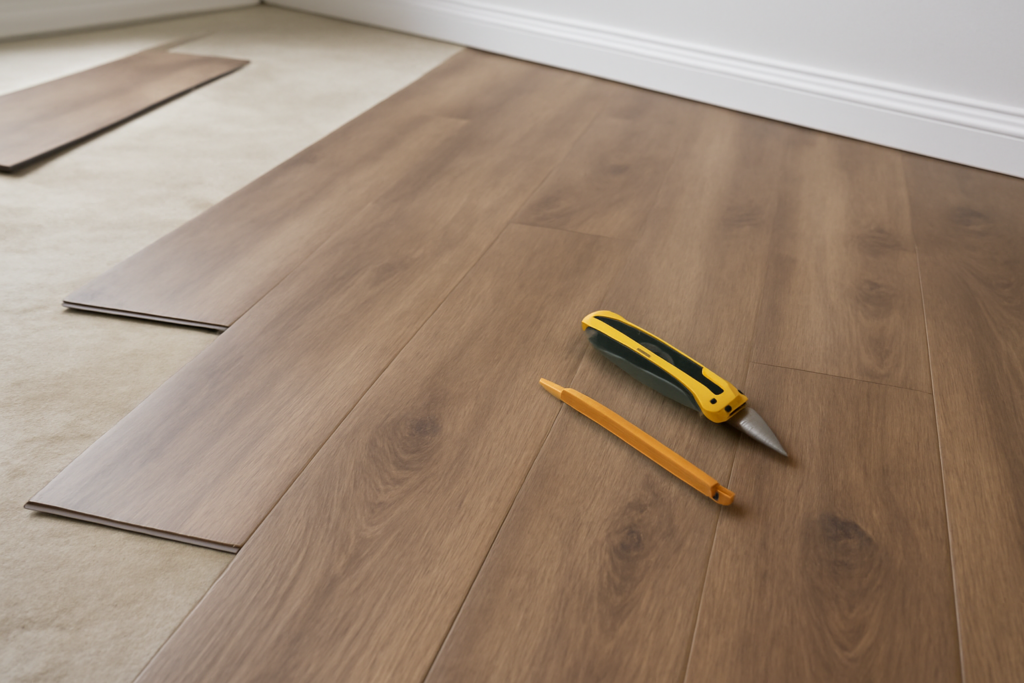
The single spec that predicts how long a vinyl floor survives isn’t the price or the brand, it’s the wear layer thickness, and 20 mil is the number that separates a home floor from a commercial-grade one. 20 mil vinyl plank flooring has a clear protective top layer twice as thick as the common 12 mil products, which is why it carries the heaviest residential warranties and often qualifies for light commercial use. If you have kids, dogs, or a busy household that runs everything ragged, this is the tier worth understanding.
Thicker isn’t automatically better for every situation, though. Here’s what 20 mil actually buys you and when it’s overkill.
What “20 Mil” Actually Means
A mil is one-thousandth of an inch, and the mil rating refers only to the clear wear layer on top of the plank, not the total plank thickness. That wear layer is the transparent, protective coating that takes all the abuse: foot traffic, pet claws, dragged furniture, and grit. At 20 mil (0.020 inch), it’s roughly twice as thick as a 12-mil layer, so it resists scratches and wears through far more slowly.
Don’t confuse wear layer with overall thickness. A plank can be 6mm thick overall but have only a 12-mil wear layer, or 5mm thick with a 20-mil layer. The wear layer is what protects the printed design; the core provides rigidity and dent resistance.
The Pros
- Exceptional durability. The thick wear layer shrugs off scratches, scuffs, and heavy traffic that thins out lesser floors.
- Pet and kid friendly. Dog nails and dragged toys barely register. This is the go-to for busy family homes.
- Longer warranties. 20-mil products typically carry lifetime residential and often 5-to-15-year light commercial warranties.
- Commercial-capable. Suitable for home offices, rentals, and low-to-moderate commercial spaces.
- Still waterproof. Like all quality LVP, it handles bathrooms, kitchens, and basements.
- Better long-term value. Lasts 20 to 30 years, spreading the cost over more time.
The Cons
- Costs more. Expect to pay $1 to $2 more per square foot than a 12-mil equivalent.
- Overkill for light use. A rarely-used guest room doesn’t need commercial-grade protection.
- Still dents under point loads. Wear layer thickness doesn’t prevent denting; core density does. Use felt pads.
- Not automatically thicker overall. A high wear layer doesn’t guarantee a rigid, dent-resistant core, so check both specs.
20 Mil vs 12 Mil vs 6 Mil
Wear layer thickness maps directly to intended use:
- 6-8 mil: Light residential. Bedrooms, closets, low-traffic rooms. Budget tier.
- 12 mil: Standard residential. Handles most homes and moderate traffic well.
- 20 mil: Heavy residential and light commercial. Busy families, pets, entryways, rentals.
- 28-40 mil: Full commercial. Retail and offices with constant foot traffic.
For a typical family home, 20 mil is the sweet spot in high-traffic zones like kitchens, hallways, and entries. You can save with 12 mil in bedrooms if you’re budgeting tightly.
Prices to Expect
- 20-mil LVP material: $3.50 to $7 per sq ft
- Premium 20-mil (thick rigid core, realistic visuals): $5 to $8 per sq ft
- Professional installation: add $1 to $4 per sq ft, or DIY for free
For a 300-square-foot room, budget $1,050 to $2,400 in materials for a solid 20-mil product.
Popular 20 Mil Products
- Shaw Paragon Tile Plus / Floorté Pro: 20-mil lines around $4 to $5 per sq ft
- COREtec Pro Plus: commercial-capable 20-mil, roughly $4 to $6 per sq ft
- Karndean LooseLay: heavy-duty 20-mil options, $5 to $8 per sq ft
- Mohawk commercial-grade LVP: 20-mil lines near $4 to $6 per sq ft
Is 20 Mil Right for You?
Choose 20 mil if your floor takes real abuse: multiple pets, active kids, a mudroom or entry that catches grit, a rental you don’t want to redo in five years, or a home office with a rolling chair. The extra dollar or two per square foot pays for itself in years of added life and a stronger warranty. Step down to 12 mil only in genuinely low-traffic rooms where the commercial-grade protection would go unused.
When you shop, verify both numbers: the wear layer (aim for 20 mil in busy areas) and the core (rigid SPC or WPC at 5mm or thicker for dent resistance). Get both right and 20 mil vinyl plank flooring gives you a floor that survives everything a busy household throws at it, looks good doing it, and lasts two to three decades.
Wear Layer vs Total Thickness: Don’t Confuse Them
The most common shopping mistake is treating wear layer and overall plank thickness as the same thing. They aren’t, and they do different jobs. The wear layer, measured in mils, is the clear top coating that resists scratches and abrasion, and it protects the printed design. The overall thickness, measured in millimeters, is the whole plank including the core, and it determines rigidity, dent resistance, and how well the floor hides subfloor imperfections. A plank can be a thick 7mm overall with only a thin 12-mil wear layer, or a thinner 5mm with a robust 20-mil layer. For a durable floor, you want both a thick wear layer and a solid rigid core, so always ask for both numbers separately.
Warranty Coverage on 20 Mil Products
One practical benefit of stepping up to 20 mil is the warranty that usually comes with it. Because the thick wear layer resists surface wear so well, manufacturers back these products with their longest terms, often a lifetime residential warranty plus a 5-to-15-year light commercial warranty. That commercial coverage is meaningful even in a home, since it signals the product is built to a higher standard of durability. Just read the fine print: warranties typically require proper installation over an approved subfloor, use of felt pads under furniture, and correct cleaning, no steam mops. Follow those conditions and the warranty backs up the durability the wear layer promises.
Prefer to explore on your own?
See how new flooring looks in your actual room in seconds — free, no signup.
Try the free Floor Studio →

