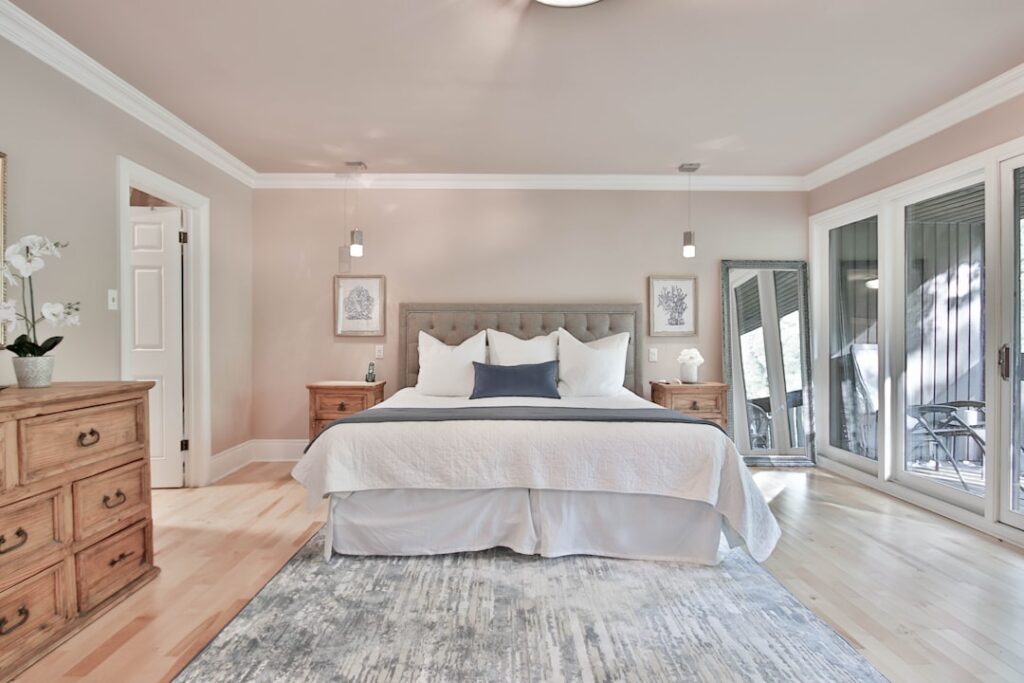
You bought a beautiful 5×7 rug, carried it into the bedroom, and now it’s swimming under your king bed like a postage stamp on a package. Don’t panic. A 5×7 rug under king bed can absolutely look intentional and polished, but only if you place it the right way. The mismatch is real, a king mattress is 76 inches wide by 80 inches long, and a 5×7 rug is just 60 by 84 inches, so it can’t fully frame the bed the way a large rug does.
The good news is that designers use small rugs under big beds on purpose all the time. The trick is understanding placement. Let me walk you through the options that work, the ones that don’t, and when it’s genuinely worth sizing up.
Why a 5×7 Feels Small Under a King
A king bed with nightstands typically spans about 100 to 120 inches wide once you add the frame and side tables. A 5×7 rug is only 60 inches across. Center it under the bed and the rug basically disappears, you get a thin sliver poking out at the foot, which reads as an accident rather than a design choice.
The classic “rug frames the bed” look, where 18 to 24 inches of rug show on three sides, requires an 8×10 at minimum and usually a 9×12 for a king. So a 5×7 simply can’t do that job. Instead, we play to its strengths with alternative placements.
It helps to think in inches rather than the marketing size. A “5×7” is really about 60 by 84 inches, and once you subtract the 76-inch bed width, there’s almost nothing left to peek out the sides if you center it. That’s the math behind why centering fails and why the placements below all shift the rug toward the foot of the bed, where the extra length actually shows.
Option 1: Under the Lower Two-Thirds of the Bed
This is the most reliable way to make a 5×7 work. Slide the rug under the bed so it starts partway down, roughly at the level of your nightstands or just below them, and extends out past the foot of the bed. The top third of the mattress sits on bare floor (hidden by the bed anyway), while the bottom two-thirds anchors the rug.
You’ll get a generous band of rug at the foot of the bed, usually 18 to 30 inches, exactly where you step out in the morning. Orient the 7-foot length running the same direction as the bed’s length. From the doorway it looks deliberate and grounded, and your feet land on softness instead of cold floor.
Option 2: Horizontal Runner at the Foot of the Bed
If you don’t want to tuck the rug under the mattress at all, turn it sideways and place it horizontally across the foot of the bed. Run the 7-foot dimension parallel to the footboard so it spans most of the bed’s 76-inch width, and let the 5-foot depth create a soft landing zone.
This works especially well if you have a bench or ottoman at the foot of the bed, the rug defines that little seating vignette. It also keeps the rug fully visible instead of hiding half of it under the bed, so a rug you truly love gets to show off its full pattern.
One caution with this layout: leave a few inches of clearance between the footboard and the rug so the two don’t visually crowd each other, and make sure the rug is centered on the bed’s width, not the room’s width. An off-center rug at the foot is the fastest way to make an otherwise good layout look sloppy from the doorway.
Option 3: Two Runners Instead of One Rug
Skip the single rug entirely and place a runner (typically 2.5×8) on each side of the bed. This is a smart move if your 5×7 isn’t cutting it and you’d rather redirect the budget. Runners give you soft footing exactly where you step out on both sides, they photograph beautifully, and they cost less than one large area rug.
You can even add a third short runner across the foot for a hotel-suite feel. The downside is you’re now buying two or three pieces, so this only makes sense if you haven’t committed to the 5×7 or want a layered, textured look.
When a 5×7 Genuinely Works
Small rugs aren’t always a compromise. A 5×7 under a king can be the right call when:
- The bedroom is small and a 9×12 would eat the entire floor wall-to-wall.
- You have gorgeous hardwood or tile you want to keep visible around the edges.
- You’re layering the 5×7 on top of a larger natural-fiber rug (more on that below).
- You want a defined soft zone at the foot rather than a fully framed bed.
- Budget matters, a quality 5×7 costs far less than a quality 9×12.
In these cases the smaller rug is a feature, not a flaw. Placement and intention are what sell the look.
When You Should Size Up
If your goal is that magazine-style framed bed with rug showing evenly on both sides and the foot, a 5×7 will always look undersized, and you should size up. For a king bed, aim for:
- 8×10 rug: the practical minimum for a king. Set the bed so the top edge starts about a foot onto the rug, leaving rug exposed on the sides and foot.
- 9×12 rug: the ideal. This gives you a full 24-plus inches of rug showing on three sides and truly frames the bed and nightstands.
If you can swing it, 9×12 is the size that makes a king bedroom feel finished. Reserve the 5×7 for a reading corner, the foot of the bed, or another room.
Layering Tips to Make It Look Intentional
One of the best fixes for a too-small rug is layering. Put down a large, inexpensive jute or sisal rug (say 8×10 or 9×12) as the base, then center your 5×7 on top so the neutral fiber shows around the edges. This gives you the scale of a big rug with the pattern and softness of your favorite piece, and it’s a designer trick you’ll see all over Instagram.
A few more pointers: always use a rug pad to keep the rug from sliding and to add cushion underfoot. Make sure whatever placement you choose leaves the rug flat, no curled edges to trip on. And step back to the doorway to check the view, that’s the angle you and your guests will see most. Get the placement right and a 5×7 rug under a king bed stops looking like a mistake and starts looking like a choice.
Finally, consider the whole room’s proportion, not just the bed. If the 5×7 is your only rug and the room feels visually unbalanced, echo the rug’s colors elsewhere, in a throw at the foot of the bed or in the drapes, so the small rug reads as part of a deliberate scheme rather than a lonely island of pattern. Scale problems in a bedroom are almost always solved by either repositioning or by tying the piece into the rest of the decor, and both are cheaper than replacing a rug you already own.