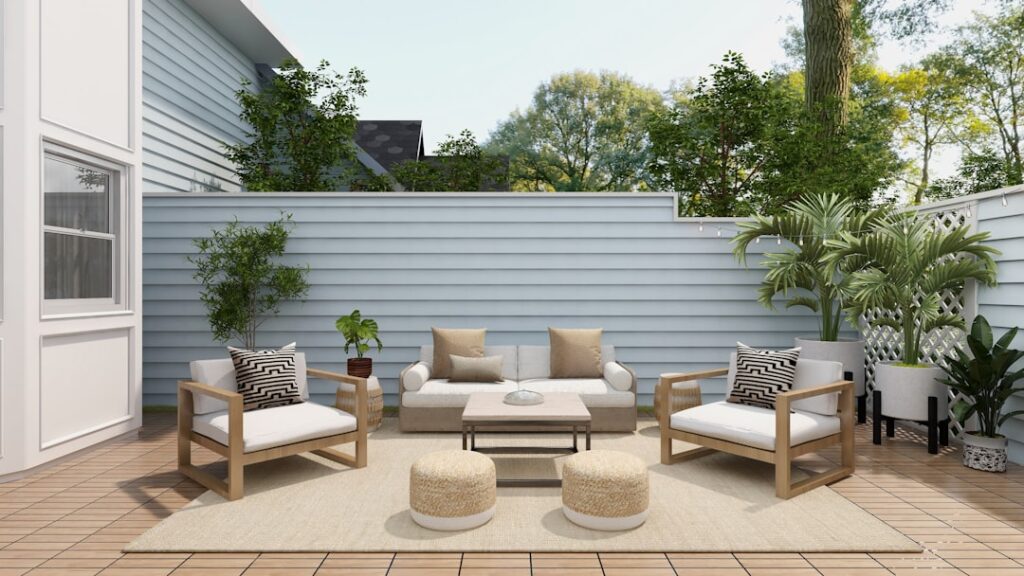
Most homeowners guess at patio rug dimensions and end up with a rug that floats awkwardly under the furniture or crowds the walkway. A 9×11 outdoor rug hits a sweet spot that a surprising number of decks and patios share: big enough to define a full seating group, yet compact enough to leave a clean border of decking or pavers around the edge. Get the size right and the whole space reads as an outdoor room. Get it wrong and the furniture looks like it’s standing on a placemat.
This guide walks through exactly when a 9-by-11-foot rug is the correct call, what materials survive real weather, how to position furniture on it, and how to keep it from turning into a mildew farm by August.
What a 9×11 Outdoor Rug Actually Covers
A 9×11 rug gives you 99 square feet of coverage. That footprint is genuinely versatile. It comfortably anchors a standard outdoor sofa paired with two lounge chairs and a coffee table, or a six-seat patio dining set with room to slide chairs back without a leg dropping off the edge.
Here is how the 99 square feet plays out in common outdoor layouts:
- Conversation set: An outdoor loveseat or sofa (roughly 6 to 7 feet wide) plus two accent chairs fits with the front legs of every piece resting on the rug.
- Dining set: A rectangular table up to 72 inches long with six chairs works well. You want at least 24 inches of rug beyond the table edge on each side so chairs stay on the rug when pulled out.
- Sectional: A small-to-mid outdoor sectional sits nicely with the rug filling the open interior of the L.
Because 9×11 is slightly longer on one side than a 9×12, it suits patios that are a touch shorter front-to-back. If your usable patio measures roughly 12 to 14 feet in one direction and 11 to 13 feet in the other, a 9×11 rug leaves an even 18-to-24-inch reveal of hardscape on all sides, which is the look designers aim for.
How a 9×11 Compares to Neighboring Sizes
Outdoor rugs jump in fixed increments, and the gaps matter. Knowing what sits on either side of 9×11 helps you confirm you’re not one size off.
- 8×10 (80 sq ft): Roughly 20 percent smaller. Best for a compact seating group or a small table for four. On a larger patio it can look undersized.
- 9×11 (99 sq ft): The middle ground. Full seating or dining group with a clean border on a mid-size patio.
- 9×12 (108 sq ft): Just one foot longer. Choose this if your patio runs long and you want to fully seat all furniture legs on a large sectional.
- 10×14 (140 sq ft): Oversized. Reserved for large covered patios, outdoor great rooms, and pool decks.
If you’re deciding between 9×11 and 9×12, measure the longer wall of your patio. When the difference between rug and open space would drop below 12 inches, size down to 9×11 so the rug never crowds the perimeter or curls up against a wall or planter.
Best Materials for an Outdoor Rug
Outdoor rugs live or die by their fiber. The overwhelming majority of quality outdoor rugs are woven from polypropylene (also sold as olefin), and for good reason. It resists moisture, sheds water, doesn’t absorb spills, and holds up to UV fading far better than natural fibers.
Your realistic material choices:
- Polypropylene: The default. Fade-resistant, mildew-resistant, and easy to hose off. Expect $80 to $200 for a 9×11 flatweave.
- Recycled PET (plastic): Often woven from recycled bottles. Soft underfoot, quick-drying, and eco-friendly. Frequently reversible so you get two looks. Typically $100 to $250.
- Polyester: Plusher and softer than polypropylene, with richer color. Slightly less UV-stable, so better under a covered porch. Around $120 to $280.
- Natural fibers (jute, sisal, bamboo): Look great but only belong on covered, dry porches. Real jute rots when it stays wet. Skip these for an exposed patio.
For a fully exposed deck or patio that gets sun and rain, polypropylene or recycled PET is the safe answer. Save the plush polyester and any natural-fiber look for a roofed porch.
Placement Rules That Make the Space Look Designed
A rug the right size still looks wrong if the furniture sits on it wrong. Follow a few simple placement rules and a 9×11 rug will pull the whole patio together.
The front-legs-on rule. For seating groups, position the rug so the front legs of every sofa and chair rest on it while the back legs may sit off. This visually ties the pieces together without requiring an enormous rug. For dining sets, all four legs of each chair should stay on the rug even when pulled out.
Center on the focal point. If your patio has an obvious anchor, such as a fireplace, an outdoor kitchen, or a set of French doors, center the 9×11 rug on that axis rather than on the geometric center of the slab.
Leave an even border. Aim for 18 to 24 inches of exposed hardscape between the rug edge and any wall, railing, or step. That reveal is what makes the rug look intentional instead of like wall-to-wall carpet.
Choosing a 9×11 Outdoor Rug for Your Climate
Where you live changes what matters most. A 9×11 outdoor rug in Phoenix faces relentless UV, while the same rug in Seattle battles constant damp. Match the rug to your biggest threat.
- High-sun regions: Prioritize UV-stabilized polypropylene and lighter colors, which fade less visibly. Dark navy and charcoal show sun-fade streaks faster.
- Wet, humid regions: Choose an open flatweave that drains and dries quickly, and lift the rug periodically so the deck underneath doesn’t stay damp.
- Windy or coastal spots: A heavier low-pile rug plus a rug pad or corner weights keeps it from lifting in gusts.
Care and Cleaning
The good news: a synthetic outdoor rug is close to maintenance-free if you handle three things.
- Rinse it monthly. Hose the rug down, use a soft brush with mild dish soap for stains, and rinse clean. Never use bleach on colored polypropylene.
- Dry both sides. After rain or washing, drape the rug over a railing so air reaches both faces. Trapped moisture between the rug and deck is what breeds mildew and can discolor wood.
- Use a rug pad. A breathable outdoor-rated pad improves airflow, prevents slipping, and keeps the rug from staining the surface beneath it.
For winter, roll the rug loosely, store it dry indoors or in a sealed bin, and it will look fresh again in spring. Left outside under snow, even the best synthetic rug degrades faster.
Common Mistakes to Avoid
A few errors show up again and again with patio rugs. Sidestep them:
- Buying too small. The single most common regret. When in doubt between two sizes on an open patio, size up, not down.
- Skipping the rug pad. Corners curl and the rug slides. A pad fixes both and extends the rug’s life.
- Choosing natural fiber for an exposed space. Jute and sisal look beautiful for exactly one rainy season before they rot.
- Ignoring the border. Wall-to-wall coverage makes a patio feel smaller, not bigger.
The Bottom Line
A 9×11 outdoor rug is one of the most useful sizes you can buy for a mid-size deck or patio, defining a full seating or dining group while leaving that clean 18-to-24-inch border that signals a designed space. Stick with UV-stable polypropylene or recycled PET for exposed areas, follow the front-legs-on placement rule, add a breathable rug pad, and rinse it monthly. Do that and your rug will anchor the patio for many seasons instead of curling and fading by the end of one summer.