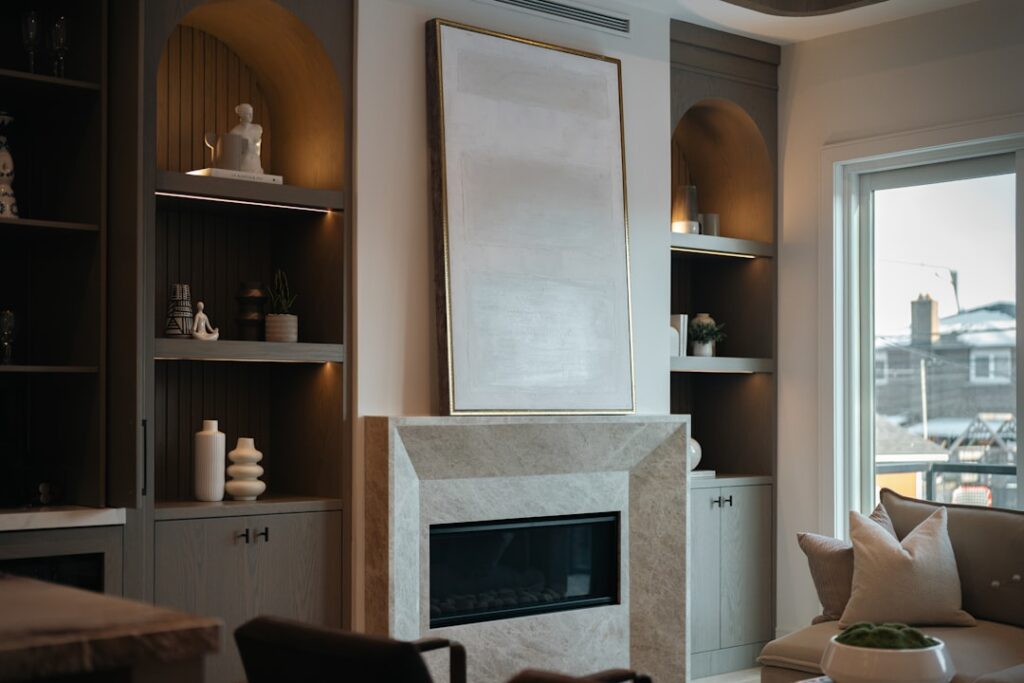
Walk into a well-designed living room and you do not notice the lighting. Walk into a poorly lit one and the only thing you notice is a single overhead fixture casting hard shadows on every wall. The ambient light meaning in interior design is the general illumination that fills a room — the foundation layer that makes a space usable before any task or accent lighting goes on top. Get this wrong and no amount of designer table lamps will save the room.
Most American homes underdo ambient lighting in the living areas and overdo it in kitchens. Both mistakes have simple fixes once you understand what the term means and how to measure it.
- What Ambient Light Means in a Home
- How Ambient Differs From Task and Accent Lighting
- How Much Ambient Light a Room Actually Needs
- Best Ambient Light Sources for Each Room
- Color Temperature and Why It Matters
- Daylight as Ambient Light
- Common Ambient Lighting Mistakes
- Bulb Lumens and Wattage Equivalents
What Ambient Light Means in a Home
Ambient light is the soft, diffuse, room-filling illumination that lets you see comfortably without straining. It comes from ceiling fixtures, recessed cans, large floor lamps with fabric shades, daylight through windows, or wall sconces aimed at the ceiling. The defining trait is diffusion — light spreads broadly rather than spotlighting a specific surface.
Designers talk about layered lighting in three parts. Ambient is the base layer. Task lighting handles specific activities like reading or chopping vegetables. Accent lighting highlights art, architecture, or plants. A well-lit room uses all three, with ambient setting the mood and brightness floor.
How Ambient Differs From Task and Accent Lighting
Task lighting is focused — a desk lamp at a workstation, under-cabinet strips on a kitchen counter, a swing-arm by the bed for reading. The light points at the work surface. Accent lighting is dramatic — a picture light over framed art, a track spot on a sculpture, low-wattage uplights on a bookshelf. Both create contrast and visual interest.
Ambient does the opposite. It eliminates harsh shadows, fills corners, and gives the eye a comfortable baseline. A room with only task and accent lighting feels stagey and uneven. A room with only ambient feels flat and uninspired. You need all three.
How Much Ambient Light a Room Actually Needs
Lighting designers measure ambient illumination in lumens per square foot, sometimes called footcandles. Living rooms target 10 to 20 footcandles. Bedrooms 10 to 20. Kitchens jump to 30 to 40 because food prep needs more brightness. Bathrooms target 20 to 30 for ambient with task lighting on top at the mirror.
For a 200-square-foot living room at 15 footcandles, you need roughly 3,000 lumens of ambient output. That breaks down to one or two ceiling fixtures, plus a couple of large lamps, or four to six recessed cans on a dimmer.
Best Ambient Light Sources for Each Room
Living rooms benefit most from a mix. A central pendant or chandelier handles the visual centerpiece. Two or three table or floor lamps fill the corners with warm light at lower elevations. Wall sconces aimed up at the ceiling add a soft glow without glare.
Kitchens need stronger overhead ambient because workspace tasks demand visibility. Recessed LED cans on 4-foot grid spacing work well — six 6-inch cans at 800 lumens each cover roughly 200 square feet at 30 footcandles. Add under-cabinet strips for task and pendant lights over an island for accent.
Color Temperature and Why It Matters
Bulb color temperature is measured in Kelvin. Lower numbers are warmer and yellower. Higher numbers are cooler and bluer. For ambient lighting in living spaces and bedrooms, stick with 2700K to 3000K. Kitchens can handle 3000K to 3500K because the slightly cooler tone supports accurate color reading on food. Bathrooms work at 3000K to 4000K depending on whether the room is for relaxing or grooming.
Avoid 5000K or higher anywhere in the home except a workshop or garage. The blue-white light reads as institutional and unflattering on skin tones.
Daylight as Ambient Light
Windows are the original ambient source. North-facing windows give consistent soft light all day. South-facing get strong direct sun that feels too bright at midday and too low at sunset. East and west windows have golden hour swings that move shadows across the room.
For homes with limited natural light, a few practical tricks help. Mirrors opposite windows double the light. Light wall colors reflect more than dark — a 70 percent light reflectance value for paint adds about 20 percent to perceived brightness compared to mid-tone walls. Sheer curtains diffuse harsh sun without blocking the room from feeling daylit.
Common Ambient Lighting Mistakes
One overhead fixture is the most common mistake. Even a 100-watt-equivalent LED in a single ceiling fixture creates flat shadowless light that feels like a hospital corridor. Add at least two other ambient sources — a floor lamp and a table lamp — to break up the visual flatness.
Skipping dimmers is the second mistake. A room needs different brightness for morning coffee and evening movie. Lutron Caseta dimmers at $25 to $40 per switch let you set scenes from a wall pad or phone app. Hard-wired ambient on a dimmer is the single biggest functional upgrade most homes can make for under $200.
Bulb Lumens and Wattage Equivalents
- 40W equivalent — 450 lumens, useful for accent and small lamps
- 60W equivalent — 800 lumens, the standard ambient bulb for living rooms
- 75W equivalent — 1,100 lumens, kitchen ambient and large rooms
- 100W equivalent — 1,600 lumens, garage, workshop, or large great rooms
Buy LED, period. Incandescent and halogen are inefficient and generate heat. CFL flickers and has poor color rendering. Modern LEDs in 90+ CRI deliver natural-looking ambient light, last 25,000 hours, and use 80 percent less energy than the bulbs they replace.
Understanding ambient light meaning makes every other lighting decision easier. Start by asking how the room feels at the brightest setting and at the dimmest. If both feel right, your ambient layer is doing its job. If only one feels right, you need to add fixtures or upgrade to dimmers. Lighting is the one renovation that pays back in daily quality of life every single time you walk into the room.