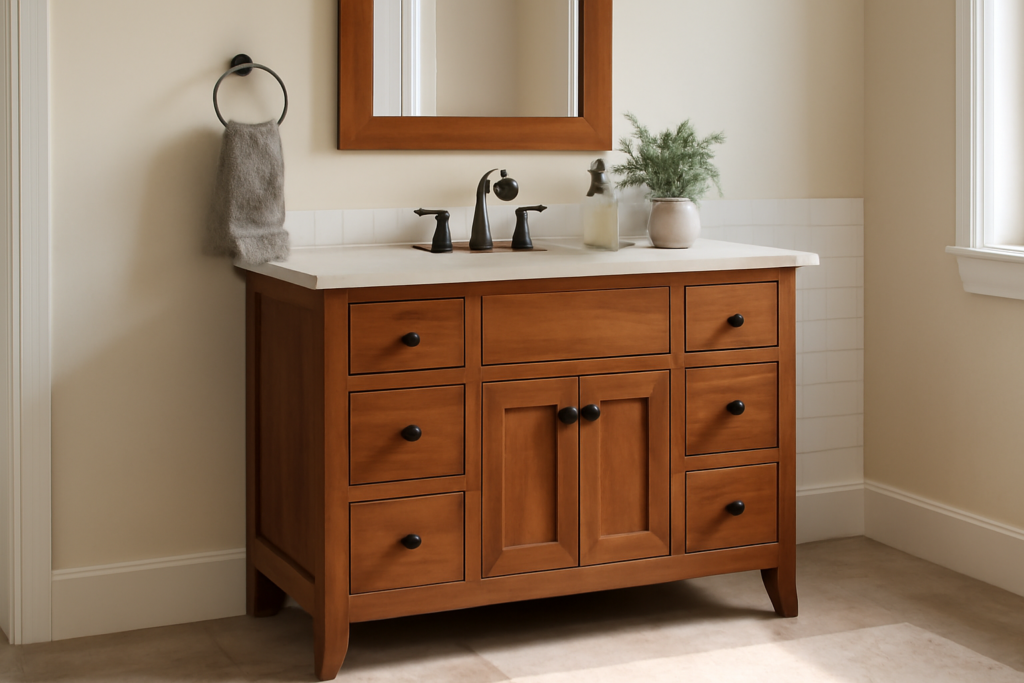
There’s a reason a piece of furniture built in an Ohio or Pennsylvania Amish shop can cost three times what a big-box unit does, and it isn’t marketing. An Amish made bathroom vanity is typically built from solid hardwood using mortise-and-tenon and dovetail joinery, finished by hand, and made to order rather than pulled off a pallet. As someone who has installed both the $300 flat-pack vanities and the $2,000 solid-wood pieces, I can tell you the difference is real, and so is the price gap. This guide covers how to spot genuine quality, what you’ll actually pay, and whether it makes sense for your bathroom.
- What "Amish-Made" Actually Means
- Signs of Real Quality Construction
- Wood Species and What They Cost
- Real-World Pricing
- The Made-to-Order Advantage
- Finish Durability in a Wet Room
- Door Styles and Customization Options
- Lead Time and Ordering Process
- Where These Vanities Are Sold
- Is It Worth the Money?
What “Amish-Made” Actually Means
The term points to furniture crafted in small workshops within Amish and Mennonite communities, mostly in Ohio, Pennsylvania, and Indiana. These shops favor traditional woodworking over mass production, though many use pneumatic and diesel-powered tools rather than working entirely by hand.
What you’re paying for is construction philosophy. A genuine piece is built from solid lumber, joined with time-tested methods, and finished to last generations rather than to hit a price point. Because most are built to order, you usually choose the wood species, the stain, the door style, the sink cutout, and the dimensions. That made-to-order flexibility is one of the biggest practical advantages over stock cabinetry.
Signs of Real Quality Construction
Not every vanity marketed as “Amish” is built the same, so learn the tells. Pull open a drawer and look at the corners; that one action reveals most of what you need to know.
- Dovetail joints: Interlocking, wedge-shaped joints at drawer corners. Look for hand-cut or tight machine-cut dovetails, not stapled butt joints.
- Solid hardwood: Real oak, cherry, maple, hickory, or walnut throughout the face frames and doors, not a thin veneer over particleboard.
- Mortise-and-tenon frames: Door and face-frame joints that interlock rather than relying on screws or dowels alone.
- Full-extension, soft-close slides: Quality hardware such as Blum or Grass under-mount slides.
- Hand-applied catalyzed finish: A durable conversion-varnish or catalyzed topcoat that resists water and toothpaste, sprayed and hand-rubbed rather than a thin factory dip.
If a seller can’t tell you the wood species or the finish type, be skeptical. Real makers know their materials cold.
Wood Species and What They Cost
The species you choose drives both the look and the price. Each has its own grain, hardness, and stain behavior.
Red oak is the value workhorse with a strong open grain, and it’s usually the least expensive. Maple is smooth, tight-grained, and takes paint beautifully. Cherry darkens richly with age and lands mid to upper range. Hickory brings dramatic grain contrast and serious hardness. Walnut sits at the top for both beauty and cost. Expect roughly a 20 to 60 percent premium moving from oak up to walnut on the same cabinet.
Real-World Pricing
Here’s where expectations need calibrating. A stock big-box vanity runs $200 to $700. An Amish-made piece is a different tier because you’re buying solid wood and custom labor.
- 30 to 36 inch single vanity: Roughly $800 to $1,800 depending on species and door style.
- 48 to 60 inch single or double: About $1,500 to $3,000.
- 72 inch and custom builds: $2,500 to $5,000 and up, especially in walnut or with elaborate detailing.
Those figures are usually for the cabinet alone. The countertop, sink, and faucet are typically separate, and installation adds $150 to $500 depending on plumbing. Shipping a heavy solid-wood piece cross-country can add $150 to $400, since these cabinets weigh far more than a flat-pack.
The Made-to-Order Advantage
The strongest argument for going custom isn’t just quality, it’s fit. Standard vanities come in fixed widths, and if your bathroom has a 53-inch nook, you’re stuck cutting fillers or accepting a gap. An Amish shop builds to your exact opening.
You also control the details that stock cabinets never offer: an odd depth to clear a radiator, a comfort-height base at 36 inches, a specific drawer configuration around your plumbing, a matching linen tower, or an integrated hamper pull-out. If you have a design in mind, you can usually send a sketch and get it built. That level of specification is hard to overstate once you’ve fought with a stock cabinet that almost fits.
Finish Durability in a Wet Room
Solid wood and a bathroom’s humidity can coexist, but only with the right finish. This is why the topcoat matters as much as the joinery. A quality Amish piece gets a catalyzed conversion varnish or a post-catalyzed lacquer, both of which form a hard, water-resistant shell far tougher than the wiping stains and thin polys on budget furniture.
Still, treat it like fine furniture. Wipe standing water promptly, run your exhaust fan, and re-oil or touch up the finish if you ever see it dull near the sink. Done right, the finish should shrug off daily splashes and the occasional overflow for decades. Ask the maker specifically what topcoat they use and whether the underside and sink cutout are sealed too, because unsealed end grain is where moisture problems start.
Door Styles and Customization Options
One of the quiet pleasures of ordering custom is choosing every visible detail, and the door style sets the whole tone of the piece. Amish shops typically offer the full range of traditional profiles, and the choice affects both the look and the price.
- Raised panel: The classic formal door with a contoured center panel. Timeless and slightly pricier to machine.
- Shaker: A clean, flat center panel with a simple square frame. Fits both traditional and transitional baths and is often the value pick.
- Flat panel: Sleek and modern, the least ornamented option.
- Beadboard: A cottage or farmhouse look with vertical grooves in the panel.
Beyond the door, you can usually specify the drawer configuration, added roll-out trays, a built-in tilt-out tray at the sink, a matching mirror or medicine cabinet, decorative feet or a furniture base, and custom crown or apron trim. This is where a custom vanity pulls ahead of stock: you’re designing the exact piece your bathroom needs rather than adapting to what a factory decided to build.
Lead Time and Ordering Process
Because these vanities are built to order rather than pulled from a warehouse, you have to plan ahead. This isn’t a same-day pickup, and rushing the timeline is the most common frustration for first-time buyers.
Typical lead times run four to twelve weeks depending on the shop’s backlog, the wood species, and how custom your order is. Busy seasons stretch that further. The ordering process usually starts with your dimensions and a discussion of species, finish, and door style, sometimes through a local dealer or showroom that represents the shop, sometimes directly. You’ll approve a stain sample before production, which matters because the same stain reads very differently on oak versus cherry. Order early in your remodel, before the plumber sets a firm schedule, so the vanity’s arrival doesn’t hold up the rest of the bathroom.
Where These Vanities Are Sold
You won’t find genuine Amish-made vanities stacked in a big-box aisle, and knowing where to look saves you from imitations. The authentic pieces come through a handful of channels.
Local furniture stores and cabinet dealers in and around Amish country, particularly in Ohio, Pennsylvania, and Indiana, often carry or can order them. A growing number of online retailers specialize in Amish-built furniture and ship nationwide, and some shops sell directly with a build-to-order process. Wherever you buy, ask the seller to confirm the wood species, the joinery, and the finish type in writing, since the term “Amish” gets applied loosely. A reputable dealer will happily tell you exactly what the box is made of and how the drawers are joined. If they dodge those questions, keep shopping.
Is It Worth the Money?
For a short-term rental flip, no; a stock vanity does the job. For a home you plan to keep, an heirloom bath, or an odd-size space that stock cabinets can’t fill, the answer is often yes. You’re buying a piece that can be refinished and passed down rather than replaced when the particleboard swells.
Think of it in cost-per-year terms. A $400 vanity that fails in eight years and a $1,600 solid-wood vanity that lasts forty tell very different stories. If you value repairability, real wood, and a perfect fit, an Amish made bathroom vanity earns its premium. If you’re watching every dollar or expect to remodel again soon, put the money elsewhere and buy stock.