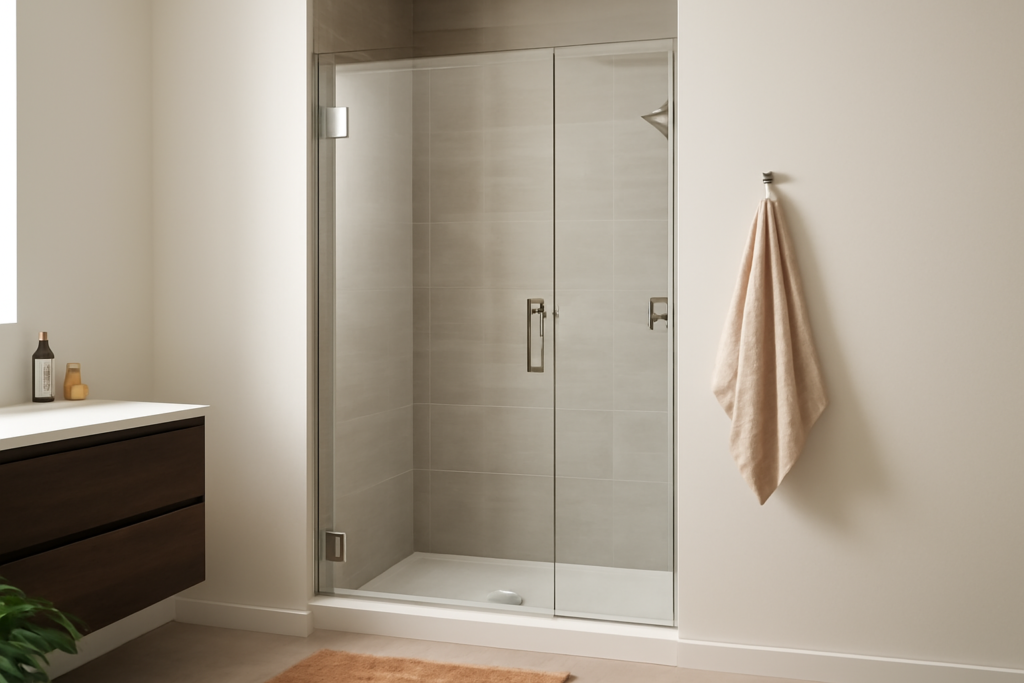
Budget-tier frameless doors are a minefield of thin glass and flimsy hinges, which is why the anzzi romance frameless swinging shower door keeps coming up in remodel conversations — it promises the hinged frameless look at a price hundreds below DreamLine’s Unidoor. I have installed a handful of them on rental refreshes and one primary-bath remodel, so this is a working assessment of the anzzi romance frameless swinging shower door: what you get for the money, where ANZZI cut costs, and how to install it so it stays tight.
- ANZZI in Context
- Sizes and Configurations
- Glass Specs: Where the Money Went
- Hinges, Hardware, and the Cost-Cutting You Should Expect
- Installation: A Detailed Walk-Through
- Sealing Strategy: Getting a Budget Door Watertight
- Price and Warranty Reality
- Romance vs. the Competition at Its Price
- Verdict: Who Should Buy It
ANZZI in Context
ANZZI is a Florida-based fixture brand that sells aggressively through Home Depot, Lowe’s, Wayfair, and Amazon rather than plumbing showrooms. Its shower door catalog spans framed sliders up through frameless hinged units, and the Romance series is its core swinging frameless line — a single pivot-hinged panel, sometimes paired with an inline fixed panel on wider SKUs, hung from wall-mounted hinges with no perimeter frame. Think of it as the value alternative to a Unidoor or a Delta frameless pivot, generally selling for $380 to $650 depending on width and finish.
Sizes and Configurations
The Romance line covers standard walk-in alcoves rather than the huge configuration matrix DreamLine offers. Typical retail listings include:
- Door-only units around 24 to 34 inches wide
- Door-plus-fixed-panel combinations spanning roughly 36 to 60 inches
- Height: 72 inches on the standard series
- Adjustment: about 1/2 inch at the wall profile — measure to the smallest of three opening measurements
Orientation is reversible at install time on most SKUs, so the door can hinge left or right. Confirm the swing lands clear of the toilet and vanity; a hinged door wants roughly 30 inches of unobstructed floor in front of the opening, and unlike higher-end lines the Romance’s self-centering hinges will not hold the door half-open out of the way.
Glass Specs: Where the Money Went
Here is the pleasant surprise: most Romance SKUs use 3/8-inch (10mm) tempered glass, the same thickness as doors costing twice as much, with ANSI Z97.1 certification and polished edges. A 30-by-72 panel weighs about 70 pounds, and the door closes with the solid thunk buyers associate with custom glass. Some narrower and older SKUs run 5/16-inch glass, so read the spec sheet line by line before ordering — the listing title will not always tell you.
ANZZI’s hydrophobic treatment goes by ActiveShield or similar naming depending on the production run. It works like every factory coating: water sheets instead of spotting for the first couple of years, then gradually needs help from a squeegee and a non-abrasive cleaner. Avoid anything gritty, and never scrape the coated face with a razor.
Hinges, Hardware, and the Cost-Cutting You Should Expect
Hardware is where a $450 door differs from a $900 one. The Romance’s wall-mount pivot hinges are metal-bodied and rated for the panel weight, but the machining tolerances and internal cams are a step below Unidoor-grade. In practice that means the self-closing action is less refined, the adjustment range at the hinge is smaller, and you should recheck screw torque at six months because the hinges settle. The seals and sweep are serviceable polycarbonate, and the handle is a 6-inch through-glass pull.
- Finishes: polished chrome, brushed nickel, matte black; brushed gold appears on some newer SKUs
- Hinge type: wall-mounted pivot with limited self-close through the last few degrees
- Included: wall profile, seals, sweep, handle, installation hardware and template
None of that is a dealbreaker at the price. It just means the install has to be more precise, because cheaper hinges forgive less misalignment than premium ones.
Installation: A Detailed Walk-Through
Difficulty is a 6.5 out of 10 — comparable to a Unidoor, with less adjustment slack. Two people, 4 hours, and a genuine level are non-negotiable.
- Check the hinge wall for plumb over the full 72 inches. More than 3/8 inch out and you should correct with the wall profile shimmed and scribed, or reconsider the door.
- Find framing. Every hinge fastener must land in a stud or added blocking; the cyclic load of a 70-pound swinging panel destroys hollow-wall anchors within a year.
- Tape and drill the tile with a 1/4-inch carbide bit, mount the wall profile plumb, and set the fixed panel first on combination units.
- Hang the door with a helper carrying the glass while you engage the hinge plates. Set the strike-side reveal to a uniform 3/16 inch before final torque.
- Fit the seals and bottom sweep, silicone the fixed panel and profile on the exterior side only, and give it 24 hours before the first shower.
Field tip: ANZZI’s paper template can shift while taping. Measure the hinge hole centers off the actual glass panel and verify against the template before you drill tile — patched holes in porcelain are forever.
Sealing Strategy: Getting a Budget Door Watertight
Frameless swinging doors leak at three predictable places, and the Romance is no exception: the hinge-side gap, the strike-side gap, and the bottom corner where the sweep ends. ANZZI ships seals for all three, but installation order matters. Fit the strike-side seal to the fixed panel or wall profile first and close the door against it, then set the bottom sweep so its deflector fin overlaps the curb’s inside edge, and finally check the hinge side — the hinge gap should stay at 1/8 inch or less, which the glass gaskets themselves effectively seal.
Corner leaks are the one to watch on this door. Because the sweep dies at the glass edge, water running down the strike side can sneak past the last half inch. A pair of stick-on corner splash guards, $6 to $10 at any hardware store, dams that path completely. I install them by default on every budget frameless door and have not had a leak callback since adopting the habit.
- Hinge-side gap target: 1/8 inch, uniform top to bottom
- Strike-side reveal: 3/16 inch against the seal
- Sweep drop: fin contacts curb lightly along its full length
- Corner guards: install both ends of the curb, bedded in silicone
Price and Warranty Reality
Expect $380 to $500 for chrome and nickel door-only units, and $500 to $650 for wide combos and black or gold hardware. That undercuts the equivalent DreamLine by $250 to $500 and lands near Delta’s frameless pivot pricing. ANZZI advertises a limited lifetime warranty on the series; in practice its customer service is retail-driven, so buy from Home Depot or Lowe’s where returns and freight-damage claims are handled at the store level. Inspect the glass edges within 48 hours of delivery — edge chips from freight are the most common claim, and tempered panels with chips must be rejected, not installed.
Parts availability is the honest weak spot. Replacement sweeps and seals are generic enough to source from third parties, but hinge components are ANZZI-specific and the parts pipeline is slower and less certain than DreamLine’s. If you plan to own the house for 15 years, weigh that.
Romance vs. the Competition at Its Price
Cross-shop honestly and the picture is clear. Against DreamLine’s Elegance pivot ($550 to $750), the Romance saves about $150 and gives up hinge refinement and parts depth. Against big-box house brands like Glacier Bay frameless pivots, the Romance’s 3/8-inch glass usually wins on feel. Against a semi-frameless framed door at $300, the Romance buys a visibly cleaner glass line for a modest premium. Where it cannot compete is odd-sized openings and out-of-plumb walls — with only 1/2 inch of adjustment, difficult openings belong to custom shops.
Verdict: Who Should Buy It
Buy the Romance for rental upgrades, flips, guest baths, and budget-capped primary remodels where the opening is standard, the walls are straight, and the installer is careful. The 3/8-inch glass delivers 80 percent of the premium experience at 50 percent of the price. Skip it if your walls are crooked, your opening is oversized, or long-term parts support ranks high on your list — spend up to a Unidoor instead. Whichever way you go, anchor into framing, torque hinge hardware gently against its gaskets, and recheck everything at the six-month mark. Do that and this door will keep swinging quietly for a decade.