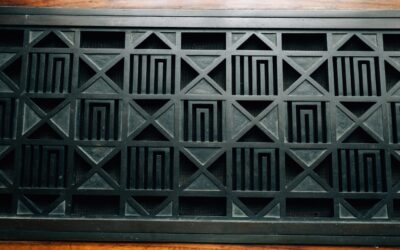
Walk into any restored Pac-Man-era arcade and you remember the floor before you remember the games — wild geometric prints in magenta, teal, and electric purple, designed to hide soda spills and pop under blacklight at the same time. That look is back. Home theaters, basement game rooms, and short-term-rental “experience” properties are pulling the arcade floor pattern aesthetic forward, and manufacturers have responded with both reproduction carpet and licensed vinyl planks that nail the original Joy Carpets and Brintons designs. Picking the right product depends on whether you want exact 1985 nostalgia or a cleaner modern interpretation.
Why Arcade Floors Looked the Way They Did
Original arcade carpets were engineered for high-foot-traffic concealment. The chaotic patterns of overlapping shapes, scatter dots, and contrasting colors hid stains, gum, and wear that would scream from a solid color within weeks. Joy Carpets, Lees Commercial, and Patcraft dominated the market, producing nylon-tufted carpet rated for 8,000-12,000 foot traffic counts per day.
The visual chaos was functional design, not just decoration. That same principle — busy pattern hides dirt — still applies when you’re picking a floor for a game room used by teenagers.
Carpet Options: Licensed Reproductions and Originals
Joy Carpets still produces several authentic arcade-era patterns under their KidPlay line. The “Neon Lights” and “Space Walk” designs run about $32 per square yard ($3.55 per square foot) in 12-foot rolls, with 6-week production lead times. Brintons offers their “Renaissance” collection with similar maximalist patterns at $45 per square yard.
- Joy Carpets KidPlay: nylon, 30 oz face weight, $3.55/sqft
- Lees Commercial Solution Q: $4.20/sqft, premium stain resistance
- Patcraft “Spectrum”: $3.10/sqft budget option, lower face weight
Luxury Vinyl Plank Alternatives
For a wipe-clean alternative, Karndean and Forbo both offer printed LVT collections with arcade-adjacent geometric patterns. Karndean’s “Korlok Select” runs about $5.50 per square foot in 6×36 planks and stands up better to spills, costumes, and party traffic than any carpet. Look for the “Knight Tile” and “Da Vinci” lines for the closest approximation to retro carpet aesthetics in vinyl form.
Forbo’s Marmoleum sheet linoleum in Wild Splash and Neon collections is the most period-accurate hard-surface option — it actually was used in arcades in the 1990s and reads exactly the right vintage.
Color Palettes That Read Authentic
Three palette families dominate the genre. The first is dark navy or black background with magenta, cyan, and lemon-yellow shapes — the classic Aladdin’s Castle look from 1986. The second is hot pink and turquoise on a deep teal field — Chuck E. Cheese 1988 territory. The third is more sophisticated: matte black background with metallic gold geometric shapes, the higher-end Dave & Buster’s restoration palette.
Skip pastels and earth tones entirely. Arcade aesthetic only works with saturated, near-fluorescent colors against dark backgrounds. Muted versions just look like ’90s motel carpet.
DIY Painted Concrete Approach
For garages, basements, or short-term game rooms, you can paint an arcade floor pattern directly onto sealed concrete for under $200. Sherwin-Williams Pro Industrial Pre-Catalyzed Water-Based Epoxy ($65 per gallon) in five colors plus a graphic floor stencil from Stencil Ease ($95) creates a durable, washable surface that lasts 5-7 years with light traffic.
Prep matters more than paint. Acid-etch the concrete with muriatic acid, rinse, fully dry, prime with Sherwin-Williams ArmorSeal Rexthane, then apply the colored epoxy. Skip any of those steps and the paint flakes within a year.
Room Layout Considerations
Busy patterns visually shrink rooms. A 12×12 game room with full arcade carpet floor-to-wall reads claustrophobic — better to inset the pattern as a 10×10 “stage” with solid black or charcoal carpet around it. Defines the play area, makes the pattern pop, and keeps the room from feeling smaller than it is.
Lighting also matters. UV-reactive elements in carpet pop under blacklight, but standard tungsten or warm-LED room lighting can wash out the colors. Run a separate circuit for blacklight strips and dim the main lights for full effect.
Maintenance and Cleaning
Commercial-grade carpet handles spills well if you act fast. Soda, beer, and pizza grease lift with a blot of cold water and a tablespoon of dish soap, then a clean-water rinse. Avoid hot water on synthetic fibers — it sets stains permanently. Vacuum twice a week with a beater-bar machine to lift trapped debris from the dense tufting.
Steam clean annually with a commercial-grade unit. The combination of high foot traffic and busy patterns hides wear, but the dirt accumulates underneath and eventually flattens the fibers. A $300 yearly clean keeps a $1,200 installation looking sharp for a decade.
Pairing the Floor with the Rest of the Room
Once the arcade floor pattern is down, the rest of the room needs to step back. Solid black or charcoal walls let the floor breathe; busy wallpaper or murals create visual war. Cabinets in matte black or dark wood ground the space, and neon signage at eye level draws the eye where you want it. The floor is the centerpiece — every other surface plays support. Done right, a 200-square-foot game room can deliver the exact transportive feel of a 1989 arcade for around $1,400 in materials.
Prefer to explore on your own?
See how new flooring looks in your actual room in seconds — free, no signup.
Try the free Floor Studio →