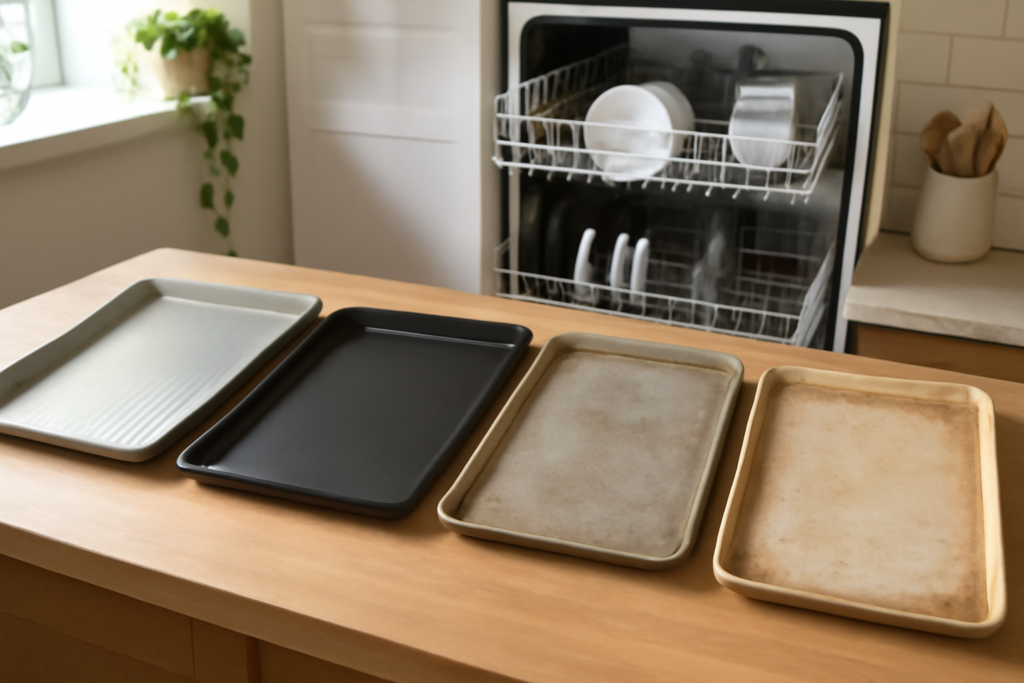
The honest answer to are baking sheets dishwasher safe is that it depends entirely on what the pan is made of, and most people learn this the expensive way after a favorite sheet warps or loses its coating. A heavy-gauge stainless pan can shrug off the dishwasher for years, while an aluminum or nonstick sheet often comes out dull, pitted, or peeling. Before you load that pan, it pays to know exactly which materials tolerate machine washing and which need a quick hand wash. This guide breaks it down so your bakeware lasts.
- The Short Answer Comes Down to Material
- Aluminum Baking Sheets
- Nonstick Baking Sheets
- Stainless Steel Baking Sheets
- Coated and Specialty Sheets
- How to Tell If Your Pan Is Dishwasher Safe
- Hand-Washing Baking Sheets the Easy Way
- Why the Dishwasher Damages Certain Pans
- Removing Stubborn Stains and Discoloration
- Buying Pans That Last
- The Bottom Line
The Short Answer Comes Down to Material
Dishwasher detergents are far more aggressive than dish soap. They are highly alkaline and rely on high-temperature water and a long, hot dry cycle. That combination is hard on soft metals and surface coatings. Sturdy materials handle it fine; delicate finishes do not. Always check the manufacturer’s care instructions first, because they override every general rule here.
Aluminum Baking Sheets
Bare aluminum, including the popular commercial half-sheet pans, is generally not dishwasher safe. The alkaline detergent reacts with the metal and causes oxidation, a process called pitting that leaves the surface dull, chalky, and sometimes darkened. The pan still works, but it looks rough and can transfer a gray residue.
Anodized aluminum is more resistant because the surface has been chemically hardened, but many manufacturers still recommend hand washing to preserve the finish. When in doubt with any aluminum sheet, wash it by hand with warm water and a soft sponge.
Nonstick Baking Sheets
Treat nonstick pans as hand-wash only, even when a label claims they are dishwasher safe. The harsh detergent and repeated high-heat cycles gradually break down the coating, which shortens its life and can cause flaking. A nonstick sheet washed only by hand can last several years longer than one run through the machine.
To clean nonstick, let the pan cool, then wipe it with a soft sponge, warm water, and a little dish soap. Skip steel wool and abrasive powders, which scratch the surface and ruin its release properties.
Stainless Steel Baking Sheets
Stainless steel is usually the safest choice for the dishwasher. It resists corrosion and tolerates hot water and strong detergent without pitting. Most stainless sheets come out clean and shiny.
One caveat: water spots and faint rainbow heat stains can appear over time. These are cosmetic and easy to remove with a stainless cleaner or a paste of baking soda and water. If a stainless pan has a riveted or layered base, occasional hand washing helps prevent trapped water from causing spots.
Coated and Specialty Sheets
Carbon steel pans, often sold for serious baking, should be hand washed. Many are seasoned like cast iron, and dishwasher detergent strips that seasoning and invites rust. Silicone baking mats are typically dishwasher safe on the top rack, though hand washing keeps them flexible longer. Glass and ceramic baking dishes are usually dishwasher safe, but extreme temperature swings can crack them, so let them cool before washing.
- Stainless steel: Usually dishwasher safe; expect occasional water spots.
- Aluminum (bare): Hand wash to prevent pitting and discoloration.
- Anodized aluminum: Often hand-wash recommended despite better resistance.
- Nonstick: Hand wash only to protect the coating.
- Carbon steel: Hand wash; never dishwasher, to preserve seasoning.
- Silicone mats: Top rack only, or hand wash for longevity.
How to Tell If Your Pan Is Dishwasher Safe
The most reliable method is to check the bottom of the pan or its packaging for a dishwasher-safe symbol, usually a plate or glass under falling water droplets. If you no longer have the box, search the manufacturer’s website by model. When you cannot find any guidance, default to hand washing. It is always safer to hand wash a pan that could have gone in the machine than to ruin one that should not have.
Hand-Washing Baking Sheets the Easy Way
Baked-on grease is the real reason people want to skip hand washing, but it surrenders quickly to a soak. Fill the sink or the pan with hot water and a squirt of dish soap and let it sit for 15 to 30 minutes. For stubborn brown residue, sprinkle baking soda over the wet surface, add a little vinegar or hydrogen peroxide, wait 20 minutes, then scrub with a non-abrasive sponge. This loosens carbonized grease without scratching the metal.
Dry pans promptly and completely. Leaving water on aluminum or carbon steel invites spots and rust. A quick wipe with a towel is all it takes to keep bakeware looking new.
Why the Dishwasher Damages Certain Pans
It helps to understand the mechanism behind the damage, because it explains why a pan that looks fine after one cycle slowly degrades after fifty. Dishwasher detergents are formulated with high-alkaline salts and enzymes that dissolve grease aggressively. On bare aluminum, those salts react chemically with the metal, oxidizing the surface and leaving a chalky, gray film. On nonstick coatings, the combination of heat, strong detergent, and the long hot-dry cycle gradually breaks the bond between the coating and the metal, which is what leads to flaking. The cumulative effect, not a single wash, is what ruins these pans, so it is easy to assume the dishwasher is harmless when it is quietly shortening a pan’s life.
Removing Stubborn Stains and Discoloration
If a pan has already discolored, you can often restore much of its look without replacing it. For aluminum that has oxidized in the dishwasher, make a paste of cream of tartar and water, or simmer a mixture of water and a tablespoon of cream of tartar in the pan, then scrub gently; the mild acid brightens the dulled surface. For baked-on carbon and grease on any pan, a baking soda and hydrogen peroxide paste left to sit for 20 to 30 minutes lifts the residue. Stainless steel heat tint and water spots wipe away with a dedicated stainless cleaner or a vinegar-dampened cloth followed by a thorough rinse and dry.
Buying Pans That Last
If easy cleanup is a priority, the material you buy matters as much as how you wash it. Heavy-gauge stainless steel sheets are the most dishwasher-tolerant and resist warping at high oven temperatures. If you prefer nonstick for its easy release, accept that hand washing is part of the deal and choose a reputable brand with a thicker coating. For aluminum, anodized versions hold up better than bare ones. Whatever you choose, look explicitly for a dishwasher-safe label if machine washing is non-negotiable for your household, and keep the documentation so you remember each pan’s requirements.
The Bottom Line
Stainless steel and silicone mats generally handle the dishwasher well, while aluminum, nonstick, and carbon steel last far longer with a quick hand wash. The single best move is to read the manufacturer’s care label before the first use and follow it. A few minutes of hand washing protects pans that cost real money to replace, and it keeps your baking results consistent for years.