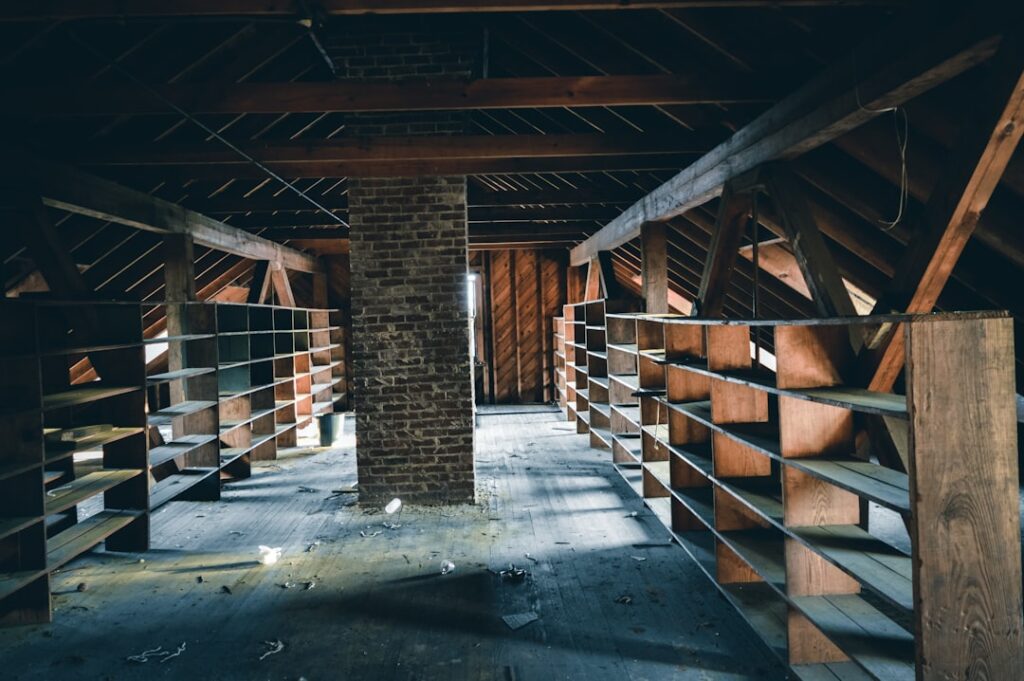
Most homes built after 1990 came with attics framed for ceiling load, not storage load. Stacking 30 plastic totes on naked truss chords or 2×4 joists is how ceilings start cracking and insulation gets crushed into uselessness. Attic flooring for storage done right involves checking joist spans, using the correct subfloor thickness, and preserving insulation depth — usually by raising the deck above the joists. This guide walks through the realistic options and what they cost.
- First Question: Can Your Attic Hold the Load?
- Plywood vs OSB for the Deck
- The Insulation Problem
- Raised Storage Panel Systems
- Step-by-Step: Decking a Standard Attic
- What This Actually Costs
- Pros of Attic Storage Flooring
- Cons to Plan Around
- Final Buying Considerations
- Access, Ventilation, and What to Store Up There
First Question: Can Your Attic Hold the Load?
Trusses and joists in modern homes are typically rated for 10 to 20 pounds per square foot of live load in attic spaces marked as non-habitable. Habitable attics need 30 psf. Holiday decorations and a few totes are fine; a workshop of cast iron tools is not. Pull permit documents or the truss tag stapled to the bottom chord if you can find one. When in doubt, a structural engineer’s visit runs $300 to $600 and saves drywall.
If your attic uses 2×4 bottom chords on engineered trusses, the design assumed minimal load. Adding storage means distributing weight across many joists rather than concentrating it in one corner.
Plywood vs OSB for the Deck
For joists spaced 16 inches on center, 1/2-inch plywood or 5/8-inch OSB works for light storage. For 24-inch spacing, jump to 23/32-inch (typically labeled 3/4-inch) tongue-and-groove subfloor panels. OSB costs roughly $24 per 4×8 sheet at the lumberyard versus $42 for equivalent sandeply plywood.
OSB handles attic temperature swings (sometimes 140 degrees Fahrenheit in summer) just as well as plywood when installed dry. The difference is edge swelling if any roof leak hits an unsealed cut. Seal cut edges with a thinned coat of exterior-grade primer when using OSB.
The Insulation Problem
Code requires R-38 to R-60 attic insulation depending on climate zone. In zones 4 through 8, that’s 12 to 20 inches of blown cellulose or fiberglass. Decking directly to the joists compresses insulation, dropping R-values by 30 to 50 percent and creating thermal bridges that show up as ice dams and high utility bills.
Two solutions work: install raised panel systems that bridge over the insulation, or sister taller joists onto the existing framing before decking. Sistering 2x10s onto 2×6 joists adds 4 inches of insulation depth and load capacity, but it’s heavy lift work in a cramped space.
Raised Storage Panel Systems
The cleanest solution for most homeowners is a raised-deck product like Attic Dek, AtticMaxx, or the Owens Corning Attic Storage Solution. These plastic or steel platforms span the joists and elevate the deck 6 to 16 inches, leaving insulation intact below.
Attic Dek panels run $14 to $18 each and cover 2 by 2 feet per panel. Plan on 25 panels per 100 square feet of storage at roughly $4 per square foot for materials. Steel rail systems like LoftZone in the UK market are slowly arriving stateside through Amazon at higher cost. Install time for a 200 square foot platform is 4 to 6 hours for one person.
Step-by-Step: Decking a Standard Attic
- Verify joist spacing and dimensions. Photograph the truss tag if accessible.
- Calculate live load capacity — multiply joist count by their rating or hire an engineer.
- Plan a deck footprint that distributes weight across the most joists possible.
- Choose decking: direct-to-joist if insulation depth allows, or raised system if not.
- Cut sheets to break joints over joists (never floating ends between joists).
- Fasten with 2-inch screws every 6 inches at edges, 12 inches in the field.
- Leave a 1/2-inch gap between sheets for thermal expansion.
- Mark joist locations on the deck surface so future fasteners hit framing.
What This Actually Costs
A direct-decked 200 square foot attic storage area runs $150 to $250 in OSB plus $40 in fasteners — call it $1.50 per square foot DIY. Raised panel systems push the number to $4 to $6 per square foot. Hiring a handyman to do the install adds $400 to $900 in labor for a typical attic.
Compare that to renting a 5×10 climate-controlled storage unit at $90 per month — roughly $1,080 per year — and the attic project pays back in months for anything you’d otherwise store off-site.
Pros of Attic Storage Flooring
- Free square footage already inside your envelope
- One-time cost replaces ongoing storage rental fees
- Raised systems preserve insulation R-value and code compliance
- Increases home value when finished properly during resale
Cons to Plan Around
- Truss attics often lack load capacity for heavy storage
- Summer temperatures damage electronics, candles, leather, and vinyl records
- Pull-down stairs are not rated for carrying heavy items — separate access is safer
- Adding too much load voids many truss warranties
Final Buying Considerations
If your attic has stick-framed 2×8 or 2×10 joists at 16-inch spacing, direct decking works for most household storage. If you have engineered trusses, raised panel systems are nearly always the right call. Either way, factor in lighting (battery LED puck lights at $15 each work great) and a switch at the access point. Plan the deck so the heaviest items live closest to load-bearing walls below.
Access, Ventilation, and What to Store Up There
Most attic access uses pull-down stairs rated for 250 to 300 pounds total load including the person climbing them. That means carrying a 50-pound bin up requires steady footing and a free hand on the rail. Heavier items belong nowhere near pull-down stairs — install fixed framed stairs if you need to move 75-plus pound items routinely. A grab handle mounted at the top opening costs $25 and prevents falls.
Attic temperatures swing from below freezing in winter to 140 degrees Fahrenheit in summer attics without ridge vents. That kills electronics, melts candles, warps vinyl records, dries out paint, and damages anything leather. Store seasonal decor, holiday items, luggage, and inert items — never photos, electronics, medications, or anything temperature sensitive. Soffit and ridge vent airflow keeps temperatures closer to outdoor ambient and improves storage viability.
Prefer to explore on your own?
See how new flooring looks in your actual room in seconds — free, no signup.
Try the free Floor Studio →