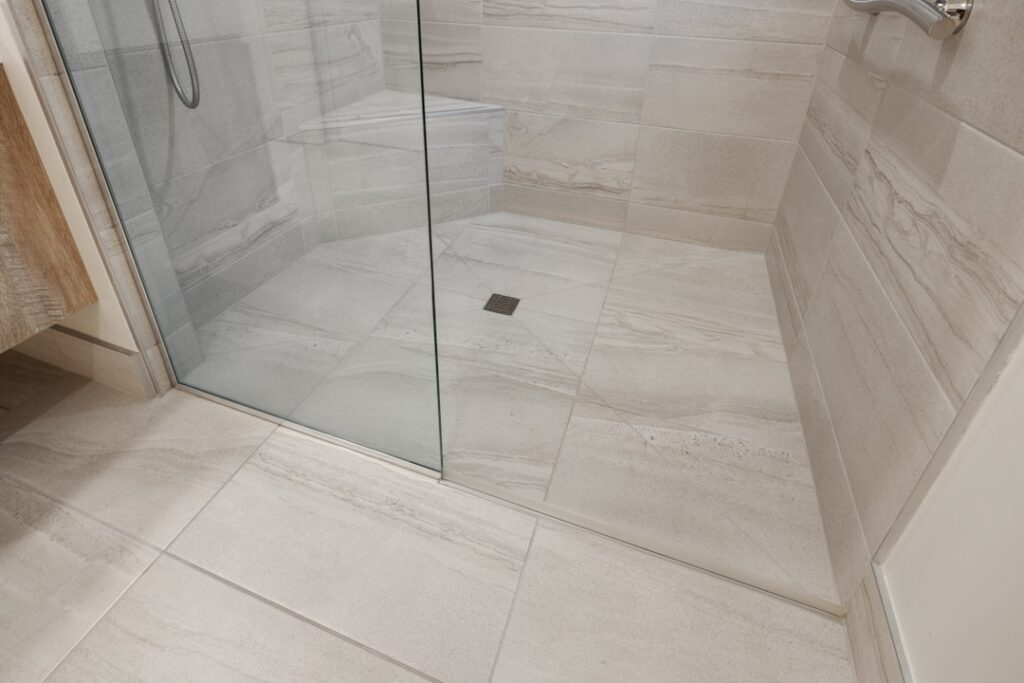
Bathroom laminate flooring is one of the most debated topics in home improvement. Laminate’s attractive appearance, comfortable feel, and affordable price make it tempting for bathroom use — but its core construction material (HDF or MDF fiberboard) is inherently vulnerable to water damage. The question is not whether laminate looks good in a bathroom — it does — but whether it can survive the daily moisture, splashing, and occasional flooding that bathrooms inevitably produce.
This guide gives you the complete picture: why most professionals advise against laminate in bathrooms, what water-resistant and waterproof laminate options exist in 2026, what happens when laminate gets wet, practical tips for minimizing damage if you choose to install it, and the alternative flooring that delivers the same look with genuine waterproof performance.
Can You Use Laminate in a Bathroom?
The short answer: you can, but in most cases you should not. Standard laminate flooring is not designed for wet environments. Its fiberboard core absorbs water, causing irreversible swelling, warping, and delamination. However, a new generation of waterproof laminate products with plastic or polymer cores has expanded the options for bathroom use — though these products blur the line between laminate and luxury vinyl plank.
The right answer depends on your specific bathroom, your tolerance for risk, and your budget. A seldom-used half-bath with no shower is a very different moisture environment than a primary bathroom with a tub/shower combo used daily by a family of four. This guide helps you assess your situation and make an informed decision.
Why Most Pros Say No
Professional flooring installers and contractors overwhelmingly recommend against bathroom laminate flooring, and their reasoning is rooted in years of warranty claims, failed installations, and water damage repairs.
The core is the problem. Traditional laminate flooring consists of four layers: a wear layer, a decorative image layer, an HDF (high-density fiberboard) core, and a backing layer. The HDF core is made from compressed wood fibers — and wood fibers absorb water. No matter how well the top surface is sealed, water finds its way to the core through seams between planks, edges along walls and fixtures, and any cuts made during installation around toilets, vanities, and door frames.
Warranties exclude bathrooms. Most laminate flooring manufacturers explicitly exclude bathrooms, laundry rooms, and other wet areas from their warranty coverage. If your laminate fails due to water exposure in a bathroom, the manufacturer’s warranty will not cover replacement.
The damage is invisible until it is severe. Water absorbed into the HDF core swells the fiberboard from the inside. By the time you see visible warping, buckling, or edge swelling, the core is already severely compromised and the affected planks must be replaced. Unlike surface water that can be wiped away, absorbed water cannot be dried out of the core.
Mold risk. Moisture trapped beneath laminate planks and in the swollen HDF core creates an ideal environment for mold growth. In a bathroom with daily moisture exposure, mold can develop between the laminate and subfloor without any visible sign until the flooring is removed.
What Happens When Laminate Gets Wet
Understanding the failure progression helps explain why professionals are cautious about bathroom laminate flooring.
Stage 1 — Seam infiltration: Water enters through the joints between planks. Even click-lock laminate with tight seams allows microscopic water penetration. Standing water (puddles from a shower, toilet overflow, bath splash) accelerates infiltration dramatically.
Stage 2 — Core absorption: The HDF core absorbs water like a sponge. Absorption is fastest at cut edges (around toilets, vanities, and transitions) where the core is directly exposed. The core can absorb water for hours before any surface sign appears.
Stage 3 — Swelling: As the HDF absorbs water, it expands. Individual planks swell at the edges, creating raised seams that are visible and felt underfoot. This edge swelling is permanent — it does not flatten when the moisture evaporates.
Stage 4 — Buckling and warping: Continued moisture exposure causes the planks to buckle upward at joints, warp across their width, and separate from adjacent planks. The click-lock connections may break as the swollen core distorts the tongue-and-groove profile.
Stage 5 — Delamination: In advanced water damage, the decorative image layer separates from the swollen core — the layers literally peel apart. At this stage, the flooring is destroyed and must be completely replaced.
Water-Resistant vs Waterproof Laminate
The laminate industry has responded to bathroom demand with two categories of improved moisture performance.
Water-Resistant Laminate
Water-resistant laminate uses enhanced HDF cores with wax-impregnated or resin-treated edges and seams. The surface treatment repels water on contact, and the treated edges slow (but do not prevent) water infiltration at joints. Water-resistant laminate can handle occasional splashes and brief wet mopping, but it is not designed for sustained moisture exposure or standing water.
Water-resistant laminate is appropriate for kitchens, laundry room walkways, and powder rooms where moisture is occasional and spills are wiped up promptly. It is not recommended for full bathrooms with showers or tubs.
Waterproof Laminate
Waterproof laminate replaces the traditional HDF core with a rigid polymer, plastic, or stone-polymer composite (SPC) core that is completely impervious to water. The decorative layer and wear layer remain similar to traditional laminate, but the core will not absorb water, swell, or warp regardless of moisture exposure.
These products are genuinely waterproof and suitable for bathroom installation. However, it is worth noting that waterproof “laminate” with an SPC or rigid plastic core is functionally very similar to luxury vinyl plank (LVP) — the distinction between the two categories has become increasingly blurred as manufacturers push the boundaries of both product types.
| Feature | Standard Laminate | Water-Resistant Laminate | Waterproof Laminate |
|---|---|---|---|
| Core material | HDF (wood fiber) | Treated HDF | Polymer / SPC |
| Water tolerance | Very low | Moderate (surface only) | High (fully waterproof) |
| Standing water survival | Minutes | Hours (with prompt cleanup) | Indefinite |
| Bathroom suitable | No | Powder room only | Yes |
| Warranty covers bathrooms | No | Rarely | Usually yes |
| Cost per sq ft | $1 – $3 | $2 – $4 | $3 – $6 |
Waterproof Laminate Brands (2026)
Pergo Outlast+: One of the most recognized water-resistant laminate brands, with SpillProtect24 surface technology that protects against spills for up to 24 hours. Available in realistic wood and stone visuals. Note: Pergo classifies Outlast+ as water-resistant, not fully waterproof — it still uses an enhanced HDF core.
Mohawk RevWood Plus: Features Mohawk’s UniClic Multifit locking system with a waterproof seal and genuine wood fiber core treated for moisture resistance. RevWood Plus offers 72-hour surface water protection and is one of the most popular water-resistant laminates for near-bathroom applications.
Shaw Repel: Shaw’s water-resistant laminate line features a hydrophobic core treatment and tight-seam locking system. Repel is designed for all rooms including kitchens and laundry rooms, with visual options spanning hardwood and stone looks.
AquaGuard (Floor & Decor): A waterproof laminate with a rigid SPC-like core that is genuinely impervious to water. AquaGuard is one of the few laminate-positioned products with full bathroom warranty coverage. Available exclusively at Floor & Decor.
Quick-Step Impressive Ultra: European-manufactured water-resistant laminate with HydroSeal coating on all four sides of each plank. The treated seams provide strong splash resistance, though the HDF core still limits full immersion tolerance.
For a complete comparison of laminate brands and their moisture ratings, see our waterproof laminate flooring guide.
Tips for Using Laminate in Bathrooms
If you choose to install bathroom laminate flooring despite the risks, these precautions will maximize the floor’s lifespan.
Choose waterproof (not just water-resistant) laminate. The cost difference between water-resistant and waterproof laminate is $1 to $3 per square foot. In a bathroom, this upgrade is essential — it is the difference between a floor that might survive and one that will.
Seal all edges and seams. Apply a bead of clear 100% silicone caulk along all wall edges, around the toilet base, at the vanity perimeter, and at the tub/shower threshold. Water infiltration is most likely at these perimeter points.
Use a quality underlayment with vapor barrier. Install a moisture-barrier underlayment beneath the laminate to prevent subfloor moisture from wicking upward. This is particularly important on concrete slabs or above crawl spaces.
Install a bath mat at every splash zone. Place absorbent bath mats outside the shower/tub and in front of the sink. These catch the majority of splashed and dripped water before it reaches the laminate surface.
Run the exhaust fan during and after every shower. Bathroom humidity accelerates moisture-related damage. Run the exhaust fan for at least 20 minutes after showering to reduce airborne moisture that condenses on the floor surface.
Wipe up standing water immediately. Even waterproof laminate benefits from prompt water removal. Make it a household habit to wipe up puddles and splashes promptly rather than leaving them to evaporate.
Inspect seams quarterly. Check the seams between planks for signs of edge swelling or separation. Catching early moisture infiltration allows you to re-seal or replace individual planks before the damage spreads.
Better Alternatives: LVP and More
For most bathrooms, there are flooring options that deliver the wood or stone look of laminate with genuinely waterproof construction and zero risk of water damage.
Luxury Vinyl Plank (LVP)
LVP is the #1 recommended alternative to bathroom laminate flooring. Modern luxury vinyl plank is 100% waterproof, available in wood and stone visuals that rival laminate, comfortable underfoot, and typically priced within $1 to $2 per square foot of waterproof laminate. LVP can be submerged in water indefinitely without damage — making it genuinely bathroom-proof.
LVP with a rigid SPC core provides the dimensional stability and realistic feel that early vinyl flooring lacked. It clicks together like laminate, installs over most existing subfloors, and is backed by bathroom-inclusive warranties. For the vast majority of bathroom renovations, LVP is simply a better choice than laminate. Learn more in our LVP in bathroom guide.
Porcelain Tile
Porcelain tile is the traditional bathroom flooring gold standard — completely waterproof, extremely durable, and available in wood-look planks that closely mimic hardwood. Porcelain costs more than laminate or LVP ($5 to $15 per square foot installed) but lasts 50+ years in a bathroom environment. Visit our bathroom flooring guide for a complete comparison of all bathroom-appropriate materials.
Sheet Vinyl
Sheet vinyl is the most waterproof bathroom flooring available — the seamless surface eliminates joint infiltration entirely. Modern sheet vinyl offers improved visuals and cushioned comfort at the lowest price point ($1 to $5 per square foot installed). It is the best budget waterproof bathroom flooring option.
Cost Comparison
| Flooring Type | Material per Sq Ft | Installed per Sq Ft | Waterproof | Bathroom Warranty |
|---|---|---|---|---|
| Standard laminate | $1 – $3 | $3 – $7 | No | No |
| Water-resistant laminate | $2 – $4 | $4 – $8 | Partial | Rarely |
| Waterproof laminate | $3 – $6 | $5 – $10 | Yes | Usually |
| Luxury vinyl plank (LVP) | $2 – $5 | $4 – $9 | Yes | Yes |
| Porcelain tile | $3 – $10 | $7 – $18 | Yes | Yes |
| Sheet vinyl | $1 – $3 | $2 – $6 | Yes | Yes |
For a deeper dive into laminate bathroom suitability, see our laminate flooring in bathroom detailed analysis.
Frequently Asked Questions
Can you put laminate flooring in a bathroom with a shower?
Standard and water-resistant laminate should not be installed in bathrooms with showers due to the constant splash exposure and humidity. Waterproof laminate (with polymer/SPC core) can handle shower-adjacent installation if properly sealed at all edges. However, LVP is a safer and often equally affordable choice for bathrooms with showers.
Is waterproof laminate really waterproof?
Waterproof laminate with a polymer or SPC core is genuinely waterproof — the core material will not absorb water or swell. However, water can still seep through joints and sit on the subfloor beneath, potentially causing subfloor damage or mold. Proper installation with sealed edges is still important.
How long does laminate last in a bathroom?
Standard laminate in a full bathroom typically shows water damage within 1 to 3 years. Water-resistant laminate may last 3 to 5 years with careful maintenance. Waterproof laminate can last as long as it would in any other room — 15 to 25 years — because its core is impervious to moisture.
Is LVP better than laminate for bathrooms?
Yes. LVP is the superior choice for bathroom flooring in virtually every comparison — it is fully waterproof, available in equally realistic visuals, similarly priced, and backed by bathroom-inclusive warranties. The only advantage laminate holds over LVP is that some homeowners prefer the slightly different feel of laminate’s HDF-based construction underfoot.
What is the best flooring for a small bathroom?
LVP and porcelain tile are the two best options for small bathrooms. Both are fully waterproof, available in a wide range of visuals, and suitable for the confined, high-moisture environment of a small bathroom. Sheet vinyl is the best budget option for small bathrooms.
Can laminate flooring be repaired after water damage?
No. Once the HDF core has absorbed water and swelled, the damage is permanent. Swollen, buckled, or delaminated planks must be replaced. This is why waterproof laminate (with a non-absorbent core) is essential for bathroom applications — it eliminates the possibility of irreversible water damage.
Prefer to explore on your own?
See how new flooring looks in your actual room in seconds — free, no signup.
Try the free Floor Studio →