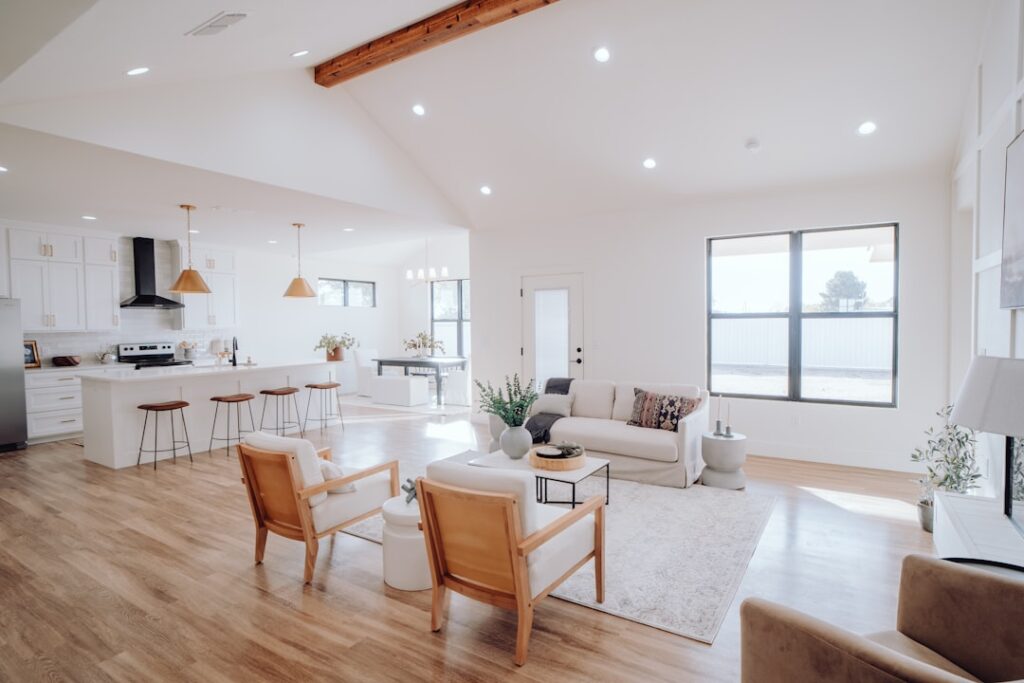
Most homeowners spend more time picking a paint color than a floor, even though the floor is the largest visible surface in any room. Beautiful flooring is not about chasing a trend. It is about choosing a material, scale, and finish that makes the rest of the design work harder, sits comfortably with the architecture, and still looks current ten years from now. The best floors disappear into the background until you really look, and then they hold up to that scrutiny.
- Scale and Width Drive Visual Impact
- Pattern Installations That Hold Up Over Time
- Natural Stone and Marble for Statement Floors
- The Power of a Matte Finish
- Color: Warm Naturals Over Cool Grays
- Tile Patterns That Elevate Bathrooms and Mudrooms
- Brand Spotlight: Where Designers Shop
- Trim, Transitions, and Finishing Details
- Rugs That Layer With the Floor
Scale and Width Drive Visual Impact
Plank width changes a room more than color does. A 2.25-inch oak strip floor reads busy and dated in a modern open plan. The same room in a 7 to 9-inch wide European oak plank reads calm, contemporary, and intentional. For ceilings under 8 feet, stay between 5 and 7 inches wide. For higher ceilings or larger rooms, 8 to 12-inch widths anchor the space without overwhelming it.
Length matters too. Random-length planks ranging from 12 inches to 84 inches read more natural than uniform 48-inch boards. Premium brands like Mannington Maison and Mirage Sweet Memories ship random-length cartons specifically for this reason.
Pattern Installations That Hold Up Over Time
Herringbone, chevron, and parquet patterns add architectural interest without depending on bold color. Herringbone uses rectangles laid at 90-degree angles, while chevron cuts the ends at 45 degrees to form continuous V-shapes. Both work in oak, walnut, and reclaimed pine. Pricing for installed herringbone runs $14 to $24 per square foot, about 30 to 50 percent more than straight-lay.
For a more current take, look at large-format herringbone with 9-inch by 36-inch planks. The scale reads modern rather than traditional, and it pairs beautifully with minimalist trim and matte black hardware. Specialty mills like Carlisle Wide Plank and Hull Forest Products do custom layouts on request.
Natural Stone and Marble for Statement Floors
For entryways, primary baths, and formal dining rooms, natural stone produces a beauty that no manufactured product can match. Honed Calacatta marble, polished Carrara, and matte limestone all carry an organic depth that comes from real geological variation. Pricing starts at $12 per square foot for basic Carrara and climbs past $40 for premium Calacatta Gold.
Slabs and large-format tiles (24×48 or 32×32) read more luxurious than smaller cuts because they reduce grout lines. Schluter ARDEX X 90 OUTDOOR thinset and 1/16-inch grout joints in coordinating color keep the focus on the stone itself.
The Power of a Matte Finish
Glossy finishes used to signal luxury. Now they signal a 1990s remodel. Matte and ultra-matte finishes in the 5 to 10 sheen range produce a refined, almost raw-wood appearance that designers across every price tier are specifying. The matte finish also hides micro-scratches and traffic patterns that high-gloss highlights.
For site-finished wood, two coats of Bona Traffic HD Matte at about $90 per gallon deliver the look with commercial-grade durability. For factory-finished engineered floors, Bruce’s Hydropel, Shaw’s Floorte Pro, and Mannington’s Restoration all offer matte SKUs with UV-cured aluminum oxide protection.
Color: Warm Naturals Over Cool Grays
The gray and whitewash trend that peaked around 2020 has lost ground to warm naturals, soft caramels, and creamy blondes. Pure natural-finish white oak with a clear matte sealer is now the bestselling SKU at premium dealers across the US. It pairs with brass, black, polished nickel, and almost any wall color.
For deeper tones, smoked oak and reactive-stained European white oak produce chocolate and espresso shades with grain depth that flat-pigmented stains cannot replicate. Expect to pay $12 to $18 per square foot installed for these specialty finishes.
Tile Patterns That Elevate Bathrooms and Mudrooms
Beautiful does not stop at wood. Patterned cement tile, encaustic-look porcelain, and large-format marble-look porcelain all produce showstopper bathroom and mudroom floors. Cle Tile, Granada Tile, and Bedrosians Cloe collections offer hand-painted looks for $12 to $25 per square foot.
For a budget-friendly take, porcelain printed with encaustic patterns from MSI’s Anya series or Daltile’s Memoir runs $4 to $8 per square foot and installs faster because the tiles are calibrated. Pair pattern floors with simple walls and neutral cabinetry so the floor stays the visual lead.
Brand Spotlight: Where Designers Shop
Three brands consistently appear in the floor specs of award-winning residential projects:
- Mannington Maison — hand-finished European oak in 7 to 9-inch widths with 6mm sawn wear layer. Pricing $11 to $16 per sq ft.
- Carlisle Wide Plank — custom-milled domestic species in widths up to 12 inches. Starts at $14 and climbs past $25.
- Stuga — Swedish-made engineered oak with pre-applied matte oil finishes. $13 to $19 per sq ft.
For more accessible pricing without sacrificing visual quality, Shaw Castlewood, Mohawk TecWood Select, and LL Flooring’s Bellawood Artisan all deliver designer-friendly looks under $10 per square foot.
Trim, Transitions, and Finishing Details
A beautiful floor needs beautiful edges. Skip the chunky 1×4 quarter-round shoe molding and use a slim 1/2-inch by 3/4-inch profile in a paint-grade pine or primed MDF. For transitions between rooms, flush thresholds in matching wood or brushed metal reads cleaner than the bulky T-molding that comes in the floor manufacturer’s accessory kit.
At door jambs, undercut the casing with an oscillating tool so the flooring slides underneath. This $5-per-cut detail eliminates the visual break that scribed flooring around jambs creates, and it is one of the cheapest upgrades available on any install.
Rugs That Layer With the Floor
Even the most beautiful flooring benefits from area rugs that define seating areas, soften acoustics, and protect high-traffic zones. Choose rug sizes that fit the room. A living room rug should sit under the front legs of all major furniture at minimum, ideally fully under the seating group. Standard sizes are 5×8, 8×10, 9×12, and 10×14. Dining rugs extend 24 to 30 inches beyond the table edge in every direction so the chairs stay on the rug when pulled out.
Natural fiber rugs (wool, jute, sisal) layer beautifully with hardwood and stone. Use a 1/4-inch felt-and-rubber rug pad like the Mohawk Better Stay or Rug Pad USA Superior Lock to prevent shifting and protect the floor finish from grit underneath.
Prefer to explore on your own?
See how new flooring looks in your actual room in seconds — free, no signup.
Try the free Floor Studio →