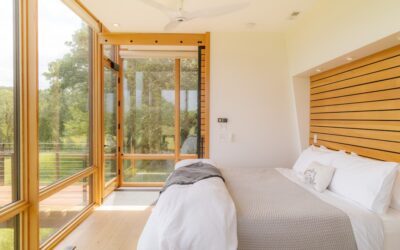
Most bedrooms get a rug that is too small. The standard 5×7 looks fine in the showroom and shrinks to the size of a placemat once it lives under a queen bed. Choosing the right bedroom rug sizes is less about square footage and more about how much rug actually appears on three sides of the bed once you slide it underneath. If you can see at least 18 to 24 inches of rug peeking out around the foot and sides, the room reads finished.
Wrong-sized rugs are the single most common mistake homeowners make when furnishing a bedroom. The fix is cheap if you measure first and order second.
The Three Standard Placement Strategies
Three layouts cover almost every bedroom. The first puts the rug fully under the bed and nightstands — the most luxurious feel and the most rug to buy. The second slides the rug only under the bottom two-thirds of the bed, stopping short of the nightstands. The third uses runners on either side of the bed instead of a single large rug.
Each layout demands different dimensions. Pick the layout before you shop or you will end up with a rug that fits no plan at all.
Bedroom Rug Sizes for a Queen Bed
A queen mattress is 60 inches wide by 80 inches long. For full coverage including nightstands, an 8×10 is the minimum and a 9×12 looks better in any room over 12×14 feet. For under the bottom two-thirds only, a 6×9 placed perpendicular to the bed works well — about 24 inches of rug shows past the foot and sides.
Skip the 5×7 under a queen unless you only want a soft landing for your feet in the morning. It will look like an undersized accent rather than a designed element.
Bedroom Rug Sizes for a King Bed
A king mattress is 76 inches wide by 80 inches long. A California king is 72 by 84. Either way you need a 9×12 minimum and a 10×14 is the better look for full coverage with nightstands. For partial coverage under the foot two-thirds, jump to 8×10 perpendicular.
One sleeper trick — runners on either side of a king bed save money compared to a single 10×14. Two 2.5×8 runners run roughly $200 to $400 at most retailers, while a quality 10×14 wool rug starts at $1,200 and climbs fast.
Bedroom Rug Sizes for a Twin or Full
A twin is 38×75 inches. A full is 54×75. Both work with smaller rugs because the room itself is usually smaller. For a twin bed, a 5×8 placed perpendicular under the bottom half is the standard go-to. For a full, step up to a 6×9 or 8×10 depending on how much floor you want covered.
In kids rooms, leaning toward 6×9 over 5×8 gives more play area on the floor. The cost difference is usually under $100 for a synthetic flatweave.
Material Choices That Survive Bedroom Use
Wool is the gold standard. Durable, naturally stain-resistant, and softens underfoot. Expect to pay $4 to $12 per square foot. Hand-knotted wool from places like Loloi or Surya runs higher but lasts decades.
For lower budgets, jute and sisal under $300 for an 8×10 give natural texture but are scratchy on bare feet — fine if the rug only frames the bed. Polypropylene rugs from brands like Ruggable and Boutique Rugs run $200 to $600 for an 8×10 and are machine-washable, which matters if pets or kids are in the room.
Pile Height and Walking Comfort
Low pile under 0.5 inches is the easiest to walk on, vacuum, and place a bed on. Medium pile from 0.5 to 0.75 inches feels softer underfoot but compresses where the bed legs sit. High pile and shag over 0.75 inches looks dramatic but creates uneven surfaces — bed legs sink, drawers stick, and furniture leaves permanent compression marks.
Stick with low pile if any furniture sits on the rug. Save the shag for accent rugs that live next to the bed, not under it.
Don’t Forget the Rug Pad
A quality rug pad adds 15 to 25 percent to the felt softness underfoot and doubles the rug’s lifespan. Use felt-and-rubber pads on hardwood and laminate — RugPadUSA and Mohawk both make good ones at $80 to $200 for an 8×10. Skip the cheap PVC pads from import sites. They yellow, crumble, and can stain finished hardwood within a couple of years.
Cut the pad about 1 inch shorter than the rug on each side so it does not show at the edges.
Quick Sizing Cheat Sheet
- Twin bed (38×75 in) — 5×8 perpendicular or 6×9 full coverage
- Full bed (54×75 in) — 6×9 perpendicular or 8×10 full coverage
- Queen bed (60×80 in) — 8×10 minimum, 9×12 for full coverage with nightstands
- King bed (76×80 in) — 9×12 minimum, 10×14 for full coverage
- Cal king (72×84 in) — 9×12 minimum, 10×14 for full coverage
- Runners on either side — 2.5×8 each, both kings and queens
Measure the actual room before ordering. A 10×14 in a 12×12 bedroom leaves no walkway around the edges. Tape out the rug dimensions on the floor with painter’s tape before purchase. Live with the tape outline for a few days. If the proportions feel right after a week of walking around them, that is the size to buy. Bedroom rug sizes are only difficult on paper. Once you see the dimensions on your actual floor, the right answer becomes obvious.