The benefits of laminate flooring explain why it remains one of the most-installed floors in American homes decades after it first appeared. It delivers a convincing hardwood or stone look for a fraction of the price, resists the scratches that plague real wood, and installs as a floating click floor that a confident DIYer can finish in a weekend. For families with kids, pets, and a realistic budget, laminate hits a sweet spot that few other floors match.
I’ve installed plenty of laminate and recommended it to countless homeowners, but I’ll also be straight about where it falls short. Here’s an honest look at the advantages, the trade-offs, and what it costs.
Affordability That’s Hard to Beat
Cost is the headline benefit. Quality laminate runs $1 to $3 per sq ft for the planks, and installed costs land around $4 to $7 per sq ft, roughly half the price of hardwood. For a 1,000 sq ft main floor, you might spend $4,000 to $7,000 installed, versus $8,000 to $14,000 for solid hardwood. That gap lets you floor more of the house, or redirect the savings to other projects, without sacrificing a high-end appearance.
Scratch and Wear Resistance
This is where laminate genuinely outshines hardwood. The clear top layer is coated with aluminum oxide, one of the hardest surface treatments in flooring. Measured by the AC durability scale, an AC4 or AC5 laminate easily handles dog nails, dragged furniture, and heavy foot traffic that would dull and gouge real wood in months.
For homes with large pets or busy kids, that toughness is a daily benefit. You can drag a chair across a quality laminate floor and it stays unmarked, something you’d never risk on hardwood.
Realistic Looks at Every Price Point
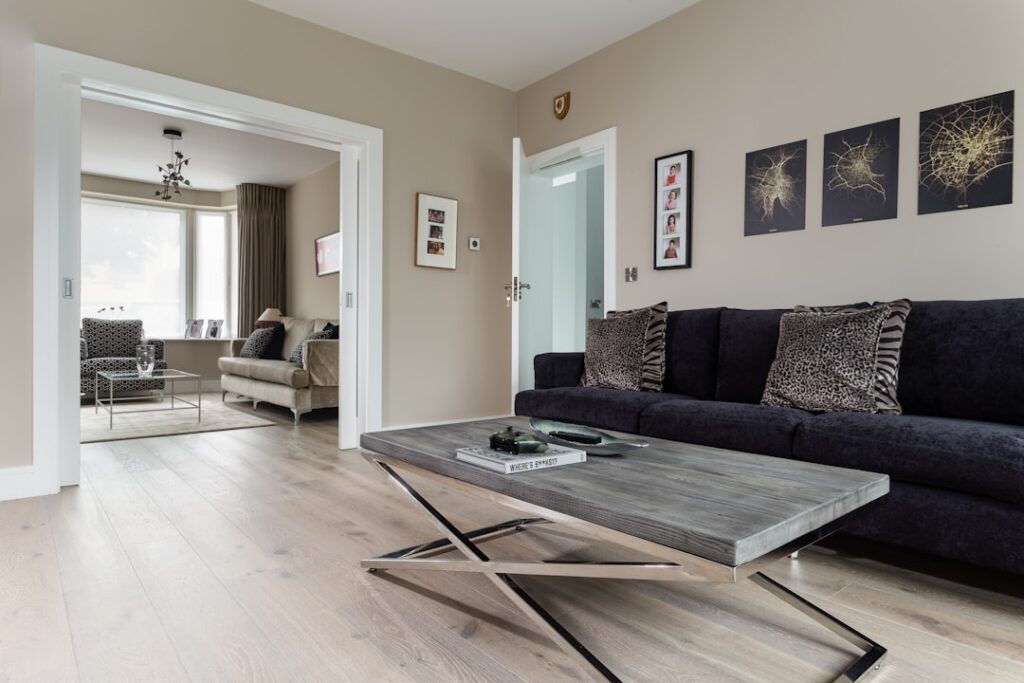
Modern laminate has come a long way from the plasticky planks of the early 2000s. High-resolution photographic layers and embossed-in-register texturing align the surface grooves with the printed grain, creating planks that look and feel remarkably like real oak, hickory, or even stone. From a few feet away, premium laminate is genuinely hard to distinguish from hardwood.
You also get nearly unlimited style options: hand-scraped, wire-brushed, wide-plank, gray-washed, and classic warm tones, all at the same affordable price.
DIY-Friendly Installation
Laminate’s click-lock floating system is one of the easiest floors to install yourself. The planks snap together and float over the subfloor without nails or glue, riding on a thin underlayment. A handy homeowner with a tape measure, a saw, and a tapping block can floor a bedroom in a day and a full main level over a weekend.
Installing it yourself saves the $2 to $4 per sq ft labor cost, which on 1,000 sq ft means $2,000 to $4,000 back in your pocket. Few flooring types reward DIY effort so generously.
Low Maintenance and Easy Cleaning
Daily care is simple: sweep or vacuum, then damp-mop with a laminate-safe cleaner. The sealed surface resists stains, doesn’t need refinishing, and won’t show the patina of wear that hardwood develops. There’s no waxing, no resealing, and no sanding. For busy households, that low-upkeep nature is a quiet but real benefit over the years.
The Honest Drawbacks
No floor is perfect, and laminate has real limitations worth knowing.
- Moisture sensitivity: Standard laminate’s fiberboard core can swell if water sits on a seam. Use water-resistant grades and avoid it in bathrooms and flood-prone areas.
- Can’t be refinished: When the wear layer eventually fails, you replace rather than sand.
- Hollow sound: A floating floor can sound louder underfoot; a quality underlayment helps.
- Lower resale impact: It doesn’t add the resale value that genuine hardwood does.
Where Laminate Makes the Most Sense
Laminate shines in bedrooms, living rooms, hallways, home offices, and any dry, high-traffic space where you want a wood look without the cost or fragility. It’s ideal for rental properties, first homes, and budget renovations. For wet rooms, basements with moisture, or homes where you want maximum resale value, waterproof vinyl plank or hardwood may serve better.
Comfort, Sound, and Underfoot Feel
Laminate offers a few comfort benefits that often go unmentioned. Because it floats over an underlayment rather than being nailed down, it has a slight give that’s easier on your legs than tile or concrete during long stretches of standing. Pairing it with a quality 2mm to 3mm foam or cork underlayment also dampens footfall noise and softens the hollow sound that cheaper installs can produce.
It’s also a friendly surface in cold climates. Laminate doesn’t conduct cold the way tile does, so it feels warmer underfoot in winter, and it pairs well with low-voltage radiant heating systems rated for floating floors. For a basement playroom or a chilly bedroom, that warmth is a genuine day-to-day perk.
Health and Allergy Advantages
For allergy-prone households, laminate’s hard, sealed surface is a real benefit over carpet. It doesn’t trap dust mites, pet dander, pollen, or pet hair, all of which embed deep in carpet fibers. A quick sweep or vacuum clears the surface completely, and a damp mop removes the fine particulate that aggravates allergies. Many homeowners notice cleaner indoor air within weeks of replacing old carpet with laminate. Look for products certified to low-emission standards like GREENGUARD Gold to ensure minimal off-gassing of VOCs after installation.
My Recommendation
The benefits of laminate flooring, namely affordability, scratch resistance, realistic looks, easy DIY installation, and low maintenance, make it one of the best values in home improvement. For most living spaces, a 12mm water-resistant laminate with an AC4 rating delivers a floor that looks great, survives family life, and costs about half of hardwood. Respect its moisture limits, buy 10% overage, install it over a quality underlayment, and you’ll enjoy a smart, durable floor for 15 to 25 years.
Prefer to explore on your own?
See how new flooring looks in your actual room in seconds — free, no signup.
Try the free Floor Studio →