Poly outdoor furniture has a quality spread wider than almost any category on the patio — from $150 flat-pack Adirondacks that warp in one Texas summer to heirloom pieces that outlive their warranties. Berlin Gardens patio furniture sits firmly at the top of that spread. Built by an Amish-owned company in Berlin, Ohio, the brand has spent three decades turning recycled HDPE poly lumber into some of the heaviest, best-jointed outdoor furniture in the country. This review covers what the company actually builds, the construction details that justify the price, the honest downsides, and how it stacks up against the flood of cheap poly imports.
- The Company: Amish Craftsmanship in Holmes County, Ohio
- The Material: HDPE Poly Lumber, Not Cheap Resin
- Signature Pieces: Adirondacks First, Then Everything Else
- Color Options and Customization
- Build Details That Separate It from Cheap Poly
- Warranty and Longevity
- Berlin Gardens vs. Cheap Poly Imports
- Where to Buy and What to Pay
- Care, Cleaning, and Winter Handling
- Bottom Line
The Company: Amish Craftsmanship in Holmes County, Ohio
Berlin Gardens operates out of Berlin, Ohio, in the heart of Holmes County Amish country — the same woodworking culture that supplies much of America’s heirloom-grade indoor furniture. Founded in 1988, the company started with wooden gazebos and lawn structures before pivoting to poly lumber as the material matured. Everything is manufactured domestically: poly boards are cut, routed, and assembled by Amish and Mennonite craftspeople, and the company runs its own finishing and sewing operations for cushions. That local, vertically integrated production shows up in two practical ways — consistent build quality piece to piece, and the ability to order custom color combinations rather than choosing from three warehouse SKUs.
The Material: HDPE Poly Lumber, Not Cheap Resin
Berlin Gardens builds with high-density polyethylene (HDPE) poly lumber containing a high percentage of recycled content — much of it post-consumer milk jugs and detergent bottles. This is a different animal from the hollow injection-molded “resin” chairs at grocery stores. Poly lumber is solid extruded board, colored all the way through with UV-stabilized pigment, so a scratch reveals the same color underneath and there is nothing to peel, rot, or repaint. The boards are dense — a Berlin Gardens Comfo-Back Adirondack weighs roughly 45-50 lbs versus 25-30 for import versions — which is why the chairs stay planted in wind that sends plastic furniture into the neighbor’s yard. HDPE is impervious to moisture, insects, and salt, making it a default recommendation for lakefront and coastal properties, and it cleans with soap and water or, for stubborn grime, a mild bleach solution.
Signature Pieces: Adirondacks First, Then Everything Else
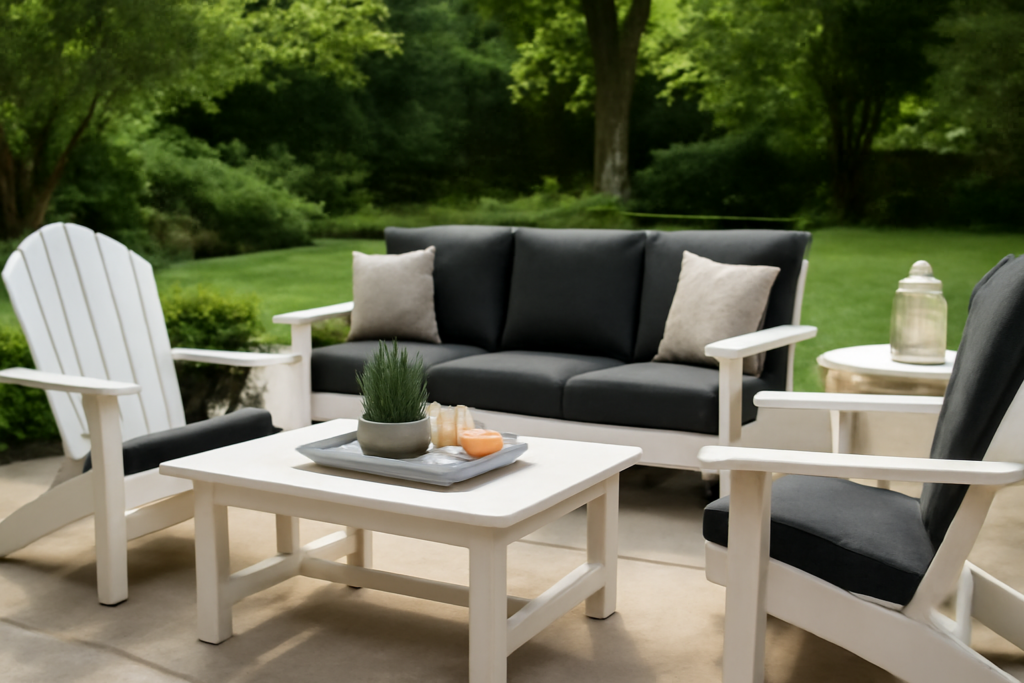
The poly Adirondack is the brand’s calling card. The Comfo-Back Adirondack (around $450-$600 depending on color class) has a deeply contoured seat and waterfall front edge that reads more like a shaped wooden chair than flat poly slats; pair it with the matching Comfo-Back rocker, glider, or footrest. Beyond Adirondacks, the catalog is unusually deep for a poly maker: full dining collections (the Garden Classic and Keystone lines with 44″-72″ tables), counter and bar sets, the Mayhew and Nordic deep-seating collections with Sunbrella cushion programs, porch gliders and swings, chaise lounges, and fire-pit-height chat sets. Dining chairs run roughly $300-$450; a six-person poly dining set typically lands between $2,800 and $4,500. Berlin Gardens also builds pergolas, pavilions, and outdoor kitchens, but furniture is the core line.
Color Options and Customization
Color depth is a genuine differentiator. Berlin Gardens runs 20+ standard poly colors — coastal pastels (Aruba Blue, Seafoam), saturated primaries (Cardinal Red, Yellow), earth tones (Weathered Wood, Antique Mahogany), and neutrals (White, Light Gray, Coastal Gray, Black) — plus two-tone ordering on most pieces, so you can spec a Weathered Wood seat with Black frame or a White frame with Aruba accents. Wood-grain-textured premium colors cost a step more than solid classics. Because pieces are built to order in Ohio, expect 4-8 week lead times in season rather than off-the-shelf shipping; in exchange, replacement parts and matching add-on pieces remain available years later — something no import brand offers.
Build Details That Separate It from Cheap Poly
- Stainless steel hardware: chairs are assembled with marine-grade stainless fasteners, not the zinc-plated screws that streak rust on budget poly within two coastal seasons.
- Thick, solid boards: full-dimension poly lumber with routed edges, not thin slats that flex under a heavy sitter. Weight capacities on most seating run 350-400 lbs.
- Joinery: mortised and screwed connections with reinforcement at stress points; arms do not wiggle loose the way bolted flat-pack imports do.
- Cushions and slings: sewn in-house with Sunbrella solution-dyed acrylic — the fabric standard for fade resistance outdoors.
- Finish consistency: color-matched plugs and clean routing; these read as furniture, not molded product.
Warranty and Longevity
Berlin Gardens backs residential poly furniture with a 20-year limited warranty on the poly lumber against splintering, cracking, chipping, peeling, and rot, plus shorter coverage on hardware and fabric (Sunbrella carries its own 5-year fabric warranty). Commercial use carries a reduced term, typically 3-5 years. The realistic ownership experience matches the paper: poly boards themselves essentially do not wear out, and the failure points on any poly chair — hardware and cushions — are the two places Berlin Gardens over-specs. Lighter colors can show mildew film in damp shade (it washes off; it is on, not in, the material), and dark colors get hot in full summer sun, a physics problem shared by every poly brand.
Berlin Gardens vs. Cheap Poly Imports
An Amazon poly Adirondack at $180-$250 looks similar in photos. The differences surface fast: import boards are thinner and often skinned composite rather than solid HDPE, hardware is plated steel, seat contours are flat, weight is half, and warranties run 1-2 years from brands that may not exist in five. Against peer-grade American poly — Polywood being the biggest name — Berlin Gardens competes on heft, contouring, two-tone custom colors, and dealer-serviced parts, while Polywood wins on price (roughly 20-30% lower), retail availability, and faster shipping. If you want the best-sitting poly Adirondack made and plan to own it for decades, Berlin Gardens is the stronger chair; if you need six chairs next week on a budget, Polywood is the rational buy.
Where to Buy and What to Pay
Berlin Gardens sells through a dealer network rather than direct-to-consumer: Amish furniture stores, independent patio retailers, and a set of authorized online dealers. Expect to pay roughly $450-$600 for an Adirondack, $250-$350 for a footrest or side table, $1,200-$1,800 for a glider or swing set-up, and $2,800-$4,500+ for full dining collections; premium wood-grain colors and Sunbrella cushions add 10-20%. Dealers run legitimate 10-15% sales in early spring and late fall, and buying floor models at season end can save more. Before ordering, sit in a Comfo-Back somewhere if you can — the contour is the reason people pay double the import price, and it is the rare piece of poly furniture that sells itself in thirty seconds. For buyers who value American manufacturing, recycled content, and a 20-year warranty the company will actually be around to honor, Berlin Gardens patio furniture is one of the safest long-hold purchases in the outdoor category.
Care, Cleaning, and Winter Handling
Ownership is nearly maintenance-free, which is most of the poly pitch. Routine cleaning is dish soap, water, and a soft-bristle brush; for embedded grime or mildew film on shaded pieces, a mix of one-third bleach to two-thirds water sits for ten minutes and rinses clean without harming the color. A pressure washer works at 1,500 psi or below with a wide fan tip held a foot off the surface — closer or harder can burnish the texture. Skip solvents, acetone, and abrasive pads. Winter needs no storage: poly lumber is unbothered by minus-30°F, and many owners leave Adirondacks out year-round, simply tipping them forward so snow sheds. Cushions are the exception — bring Sunbrella pads into a deck box or garage for the season, and let frames air-dry before covering anything. Two practical quirks: dark colors expand slightly in extreme heat, so poly gates and dining tables include engineered gaps (not defects), and static can attract pollen film in spring, which the soap wash clears in minutes.
Bottom Line
Berlin Gardens occupies the spot in the poly market that Barlow Tyrie holds in teak: not the cheapest, not the most advertised, but the brand insiders point to when asked what they would put on their own porch. The Comfo-Back contour, stainless hardware, in-house Sunbrella sewing, two-tone custom program, and 20-year warranty add up to furniture priced roughly 30-50% above mass-market poly and worth every point of the spread for a decades-long hold. Order in late winter to beat the spring lead-time crunch, spring for the premium wood-grain colors if the budget allows — they hide pollen and wear best — and expect the set to outlast the deck it sits on.