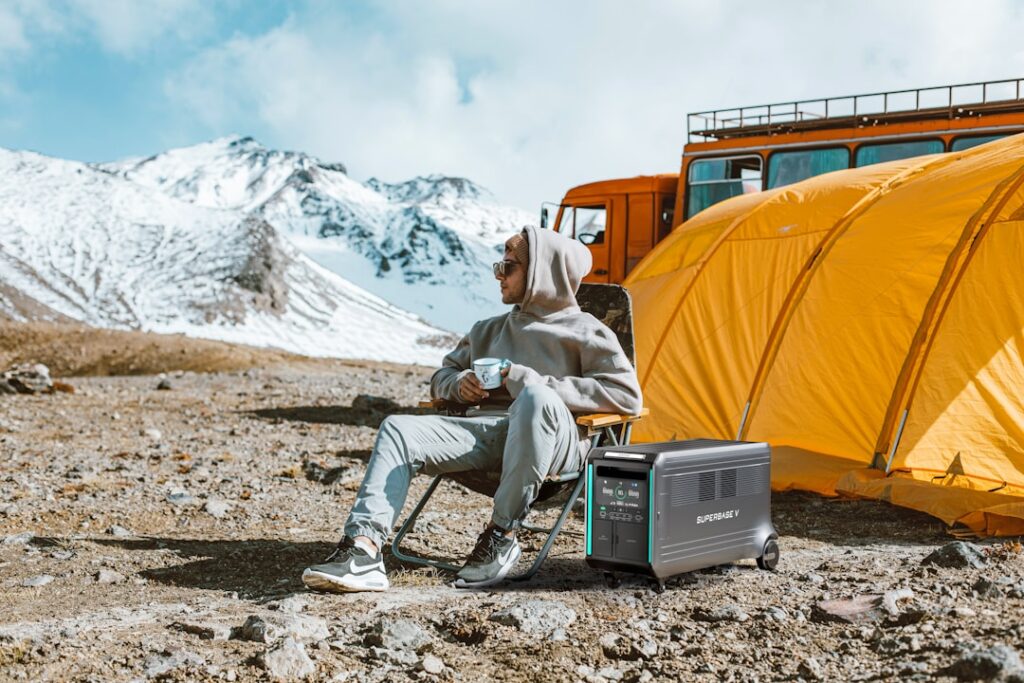
The best portable solar generator is really a big battery with an inverter and a solar charge controller built in — no gas, no fumes, no pull cord. Prices run from about $200 for a 300-watt-hour weekend unit to $4,000 for a 3,000+ Wh whole-room backup, so the right pick depends entirely on what you need to keep running and for how long.
- Price Ranges at a Glance
- How to Size It: Watt-Hours Are Everything
- Top Portable Solar Generator Picks
- EcoFlow Delta 2 — Best All-Around
- Jackery Explorer 1000 v2 — Best Value
- Bluetti AC200L — Best for Long Outages
- Anker SOLIX C300 — Best Compact / Budget
- EcoFlow Delta Pro — Best Whole-Room Backup
- Solar Panels: What to Pair
- LiFePO4 vs Older Lithium
- Safety: The Big Advantage Over Gas
- Runtime Examples You Can Trust
- Chaining and Expandable Systems
- Outlets and Real-World Use
- Solar vs Gas: The Real Trade-Off
- The Bottom Line
I’ve hauled these to job sites and lived off them during outages. The two specs that actually matter are watt-hours (how much energy it stores) and the inverter’s continuous watts (how much it can push at once). Nail those and everything else is detail.
Price Ranges at a Glance
- $150-$400: 200-500 Wh units. Phones, laptops, a CPAP for a night, small fans.
- $500-$1,200: 700-1,500 Wh units. A fridge for several hours, power tools, extended CPAP use.
- $1,500-$2,800: 2,000-3,000 Wh units. Run a full-size fridge overnight, medical devices, most of a room.
- $3,000-$4,500: 3,500-5,000+ Wh expandable systems. Partial home backup with add-on batteries.
How to Size It: Watt-Hours Are Everything
Add up the watts of what you want to run, then multiply by hours. A 60-watt fridge cycling at roughly 50% duty draws about 720 Wh over 24 hours, so a 1,000 Wh station gets you a day if you baby it. Two rules save people from disappointment:
- Usable capacity is ~85-90% of the label. Inverter losses eat the rest. A “1,000 Wh” unit delivers roughly 850-900 Wh to your devices.
- Watch the surge. A fridge compressor rated 120 running watts can spike to 600-1,200 starting watts. Your inverter’s surge rating has to cover that or it’ll fault out.
Top Portable Solar Generator Picks
EcoFlow Delta 2 — Best All-Around
1,024 Wh LiFePO4 battery, 1,800 W inverter (2,700 W surge), and up to 500 W of solar input that refills it in about 3-6 hours of good sun. Fifteen outlets including six AC, USB-C at 100 W, and a car port. It charges wall-to-full in under 80 minutes. Around $700-$900, and expandable to 3,000 Wh with add-on batteries. This is the one I recommend first.
Jackery Explorer 1000 v2 — Best Value
1,070 Wh, 1,500 W inverter (3,000 W surge), 3 AC outlets, and up to 400 W solar input. Lighter than most rivals at about 23.8 lbs, and the app is dead simple. Frequently $600-$800. If you want reliable, no-fuss backup for a fridge and electronics, this is the sweet spot.
Bluetti AC200L — Best for Long Outages
2,048 Wh base with a stout 2,400 W inverter (3,600 W surge) and huge 1,200 W solar input, so it recharges fast on a sunny day. Expandable past 8,000 Wh with extra batteries. Runs $1,400-$1,800. When power goes out for days, not hours, this is the platform to build on.
Anker SOLIX C300 — Best Compact / Budget
288 Wh, 300 W inverter (600 W surge), and up to 100 W solar. Weighs about 9 lbs and slings over a shoulder. For $200-$250 it keeps phones, a laptop, and a CPAP alive on a camping trip or a short outage. The right pick when you don’t need to run a fridge.
EcoFlow Delta Pro — Best Whole-Room Backup
3,600 Wh, a massive 3,600 W inverter (7,200 W surge), and 1,600 W solar input. It’ll run nearly anything short of central AC and chains up to 25 kWh with extra units. Around $2,500-$3,200. Overkill for camping, ideal for home resilience.
Solar Panels: What to Pair
Match panel wattage to the station’s max solar input, and don’t expect nameplate output — real-world solar lands at 60-80% of rated on a clear day. A 400 W folding array feeding a 1,000 Wh unit realistically banks 250-320 Wh per good sun-hour, so figure 3-5 hours to refill from empty. Most stations accept 11-60 V input; check the voltage window before you buy third-party panels.
LiFePO4 vs Older Lithium
Buy LiFePO4 (lithium iron phosphate) if you can. These cells survive 3,000-6,000 charge cycles versus 500-800 for older NMC lithium, tolerate heat better, and are far less prone to thermal runaway. Nearly every unit above is LiFePO4 now — it’s why prices dipped and lifespans jumped over the last few years.
Safety: The Big Advantage Over Gas
Here’s the honest pitch for going solar over a gas inverter generator: a battery power station produces zero carbon monoxide and zero emissions, so it’s completely safe to run indoors. You can sit it on the kitchen counter during an outage and sleep next to it. A gas generator can never come inside — CO from even a small unit can kill in an enclosed space in minutes.
That said, respect the electrons:
- Never charge a battery station from a gas generator inside an enclosed space. The station is safe indoors; the gas generator feeding it is not. Keep any gas generator outdoors, well away from windows, and only run the charging cable inside.
- Don’t exceed the continuous wattage. Overloading trips the inverter at best and stresses cells at worst.
- Keep it cool and dry. These aren’t weatherproof. Shade them while charging and don’t leave them in rain.
- Store at 50-80% charge if you won’t use it for months, and top it off every 3-6 months so the battery management system stays happy.
Runtime Examples You Can Trust
Numbers on a box mean nothing until you translate them to your gear. Working from usable capacity (about 90% of the label), here’s what a 1,024 Wh unit like the Delta 2 realistically delivers:
- CPAP (40 W, no humidifier): roughly 20+ hours — two to three nights.
- Full-size fridge (cycling ~60 W average): about 12-16 hours if you keep the door shut.
- Laptop (60 W): 14-15 recharges.
- Phone (12 Wh battery): 60-70 full charges.
- 1,000 W microwave: about 45 minutes of actual cook time — fine for reheating, not for all-day use.
Pair the same unit with a 400 W panel in decent sun and you extend that fridge indefinitely during a daytime outage, banking charge faster than the fridge draws it.
Chaining and Expandable Systems
The smartest money move is buying into a platform that grows. Units like the Delta 2, AC200L, and Delta Pro accept bolt-on battery packs that double or quadruple capacity without a second inverter. Start with the base station for camping and short outages, then add a battery when you decide you want multi-day resilience. It’s cheaper over time than buying a bigger unit you don’t yet need, and it spreads the cost out. Confirm the expansion battery is the same chemistry and generation as your base — cross-generation packs sometimes won’t talk to each other.
Outlets and Real-World Use
Count your ports before buying. A good station gives you 3-6 AC outlets, multiple USB-A, at least one 60-100 W USB-C for laptops, a 12 V car socket, and often a DC5521 barrel jack. For medical devices like a CPAP, look for a pure sine wave inverter — every unit above has one — because modified sine wave can damage sensitive electronics. Check the continuous AC rating against your biggest single appliance too: a 300 W station won’t start a fridge no matter how many watt-hours it stores, because the inverter simply can’t push the surge.
Solar vs Gas: The Real Trade-Off
A solar generator is quiet, maintenance-free, safe indoors, and fuels itself off the sun. A gas inverter generator is louder, needs oil changes and stabilized fuel, exhausts deadly CO, but delivers effectively unlimited runtime as long as you keep pouring gas. For most homeowners the sweet spot is a solar station for daily and indoor use, with a small gas generator held in reserve for a multi-day grid-down event — used strictly outdoors, and only to recharge the battery station you keep inside.
The Bottom Line
For most people the best portable solar generator is a 1,000-1,100 Wh LiFePO4 unit like the EcoFlow Delta 2 or Jackery Explorer 1000 v2 — enough to run a fridge and devices through a typical outage, light enough to carry, and $600-$900. Scale up to a Bluetti AC200L or Delta Pro if you want multi-day home backup, or grab an Anker C300 if you just need clean, silent, fume-free power for a weekend.