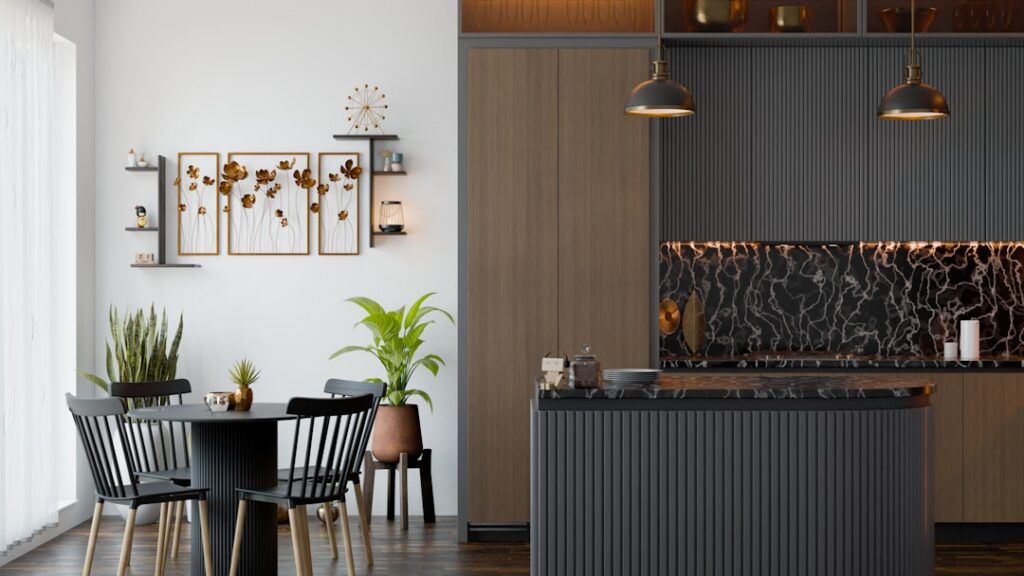
Brown kitchen cabinets give a room the one thing an all-white kitchen usually lacks: warmth you can feel the second you walk in. Wood tones read as timeless rather than trendy, they hide crumbs and fingerprints far better than white, and they anchor everything from a rustic farmhouse to a sleek modern galley.
- Why Choose Brown Cabinets Over White
- The Range of Brown Tones
- Wood Species and How They Take Stain
- Pairing Brown Cabinets with Countertops
- Wall Colors and Backsplash
- Hardware and Fixtures
- Flooring That Works with Brown Cabinets
- Door Styles That Suit Brown
- Lighting a Brown Kitchen
- Costs and Refinishing Options
The catch is that “brown” covers a huge range, from pale honey oak to near-black espresso. Getting it right means matching the tone to your light, your floors, and your countertops. This guide walks through every decision so your cabinets look intentional, not dated.
Why Choose Brown Cabinets Over White
White kitchens dominated for a decade, and that is exactly why brown is having a comeback. A warm wood tone stands out precisely because so many kitchens went cold and clinical. Beyond looks, brown cabinets earn their place practically:
- They hide daily mess. Coffee splatter, greasy fingerprints, and dust disappear on a medium-brown door in a way they never do on gloss white.
- They age gracefully. Real wood grain reads as classic decade after decade, so a brown kitchen looks less tied to a single trend cycle.
- They flatter warm lighting. Under 2700K bulbs and evening light, wood tones glow instead of turning gray or yellow the way white paint can.
The Range of Brown Tones
Think of brown as a spectrum from light to dark, each end setting a completely different mood:
- Light brown / honey (oak, hickory) — casual and airy, great for small kitchens because pale wood keeps the room feeling open. Reads country or coastal.
- Medium brown (walnut-stained maple, natural cherry) — the versatile middle, warm and rich without darkening the room. The safest choice for most homes.
- Chocolate and espresso — dramatic and modern, especially in flat-panel doors. Stunning in a kitchen with big windows, but it can close in a room with little natural light.
- Gray-brown (greige-leaning walnut) — the contemporary option, a muted tone that pairs with cool marbles and matte-black hardware.
Wood Species and How They Take Stain
The wood under the finish decides how the brown finally looks, because every species takes stain differently:
- Oak — bold, open grain that shows through any stain. Beautiful for a rustic or craftsman look; skip it if you want a smooth, uniform surface.
- Maple — tight, fine grain that stains evenly and reads clean and modern. It can blotch with dark stains, so a pro applies a conditioner first.
- Cherry — naturally reddish-brown that deepens and darkens over the first year or two of light exposure. Gorgeous, but plan for that shift.
- Hickory — dramatic light-to-dark variation in the same board; a signature rustic look you either love or avoid.
- Walnut — naturally chocolate-brown with straight grain, the premium choice and the priciest.
Stain versus paint matters too. A translucent stain lets the grain show and is the classic wood-cabinet look. An opaque brown paint (think a warm taupe or coffee color) gives a smooth, grain-free finish and lets you get an exact color that no stain can match.
Pairing Brown Cabinets with Countertops
Countertop choice can make brown cabinets feel either fresh or heavy. A few combinations that consistently work:
- White or light-gray quartz — the crispest contrast, keeping the kitchen bright while the wood adds warmth. The most fail-safe pairing for medium and dark brown.
- Warm cream or beige granite — a softer, tone-on-tone look that leans traditional and cozy.
- Black or soapstone — dramatic with light honey cabinets, creating a striking two-tone kitchen.
- Marble-look quartz with gray veining — modern and upscale, especially against gray-brown or walnut doors.
As a rule, if your cabinets are dark, go lighter on the counter; if your cabinets are light, you have room for a bold dark counter. Matching dark on dark can feel like a cave unless the room has abundant natural light.
Wall Colors and Backsplash
Because brown is a warm color, cool wall paint balances it and stops the room from feeling too heavy. Soft sage green, muted blue-gray, warm white, and greige all frame wood cabinets beautifully. For a rich, enveloping look, deep green or navy on the walls turns brown cabinets into a feature rather than a background.
On the backsplash, white subway tile keeps things bright and classic. Natural stone in cream or taupe leans traditional. For a modern edge, a large-format porcelain slab in a soft gray-white gives you almost no grout lines and a clean, upscale finish that lets the wood grain be the star.
Hardware and Fixtures
Hardware is the jewelry of the kitchen, and metal finish shifts the whole mood of brown kitchen cabinets:
- Brushed brass or gold — warm and current, gorgeous against medium and dark brown for an upscale, layered look.
- Matte black — high-contrast and modern, especially sharp on lighter honey and gray-brown doors.
- Oil-rubbed bronze — tone-on-tone and traditional, blending into the wood for a subtle, rustic feel.
- Brushed nickel — the safe, cool neutral that keeps a brown kitchen from feeling too warm.
Whatever you choose, carry the finish through to the faucet, pendant lights, and cabinet hinges where visible. Consistency is what separates a designed kitchen from a collected one.
Flooring That Works with Brown Cabinets
Flooring is where many brown kitchens go wrong, because wood-on-wood can clash if the undertones fight. The trick is contrast. If your cabinets are medium-to-dark brown, use a lighter floor, such as pale oak, light luxury vinyl plank, or a warm gray tile. If your cabinets are light honey, you can go darker underfoot to ground the room.
Avoid matching your floor and cabinets to the exact same brown; without at least two shades of separation, the two blur together and the cabinetry loses definition. When in doubt, bring home samples and lay them side by side under your actual kitchen lighting before you commit.
Door Styles That Suit Brown
The door profile changes how formal or casual your brown cabinets feel, so pick a style that matches both the wood tone and the room. A few pairings that consistently land well:
- Shaker — a clean, five-piece frame with a recessed flat center. The universal choice, it flatters every brown tone and never looks dated.
- Flat-panel (slab) — a single smooth surface with no frame, ideal for espresso and walnut where you want the grain to run uninterrupted. Reads modern and minimal.
- Raised-panel — a traditional door with a beveled center that catches light. Best on cherry and oak for a classic or formal kitchen.
- Beadboard or planked — vertical grooves that lean farmhouse and rustic, especially in honey and hickory.
Whatever the profile, ask for full-overlay doors if you want a contemporary, seamless front, or partial-overlay for a more traditional look with a sliver of frame showing between doors.
Lighting a Brown Kitchen
Dark cabinets absorb light, so a brown kitchen needs a lighting plan that a white one can skip. Layer three sources so the room never feels dim. Recessed ceiling cans on a dimmer handle general light; aim for one fixture every 4 to 6 feet. Under-cabinet LED strips are non-negotiable, because they wash the countertop and stop dark uppers from casting shadows on your prep area. Finally, a pendant or two over the island adds warmth and a focal point.
Bulb color matters with wood. Stick to 2700K to 3000K warm-white bulbs, which make brown tones glow rich and inviting. Cooler 4000K bulbs can wash the warmth out and push cherry or walnut toward a flat, grayish cast. If your kitchen has few windows and dark cabinets, add an extra row of recessed lights rather than fighting the shadows later.
Costs and Refinishing Options
New brown cabinets run a wide range. Stock cabinets start around $100 to $300 per linear foot installed, semi-custom lands near $150 to $650, and full custom walnut can exceed $1,000 per linear foot. A typical 10-by-10 kitchen in semi-custom wood often totals $8,000 to $16,000.
If your boxes are solid, you have cheaper paths. Refacing with new wood or veneer doors runs roughly $4,000 to $9,000 and delivers a brand-new brown finish in a few days. Restaining existing wood cabinets costs $1,500 to $4,000 and is the greenest, fastest way to shift from an outdated orange oak to a rich modern walnut tone. Either route gives you the warmth of brown kitchen cabinets for a fraction of a full replacement, which is exactly why so many homeowners are choosing wood again.