The carpet under most office desks isn’t there for comfort. It’s there to dampen sound, hide cabling, reduce slips, and survive 5,000 office-shoe footsteps a week without showing wear. Business carpet is engineered for those jobs, and the gap between it and residential carpet is wider than most homeowners realize. Commercial carpet tile runs $25 to $80 per square yard, traffic-rated for ten-year warranties, and replaces tile-by-tile when one section gets stained at the executive lunch. Pick the right product and a 20,000 sq ft office floor lasts 15 years. Pick the wrong product and you’re replacing it during the third lease renewal.
- Carpet Tile vs Broadloom: The Strategic Choice
- Construction Types That Drive Performance
- Traffic Ratings to Look For
- Top Brands in the Commercial Market
- Backing Systems That Matter
- Adhesive Systems and Loose-Lay
- Real Pricing for Commercial Carpet Projects in 2026
- Maintenance Programs That Extend Lifespan
- When Business Carpet Doesn't Belong
- The Honest Verdict on Business Carpet
Carpet Tile vs Broadloom: The Strategic Choice
Carpet tile (typically 24-inch x 24-inch or 18-inch x 36-inch modular squares) dominates modern commercial installations for one structural reason: serviceability. When a printer leaks toner or an executive spills coffee, you replace the affected tiles instead of the entire room. Tile installations also accommodate raised access flooring (RAF) where cabling and HVAC run beneath.
Broadloom (rolled goods, typically 12 feet wide) still has a place in conference rooms, executive offices, and open spaces where a seamless visual matters and serviceability is less important. Material costs are typically 15% to 25% lower than carpet tile, but lifecycle costs are usually higher because broadloom must be replaced wholesale rather than in sections.
Construction Types That Drive Performance
Three construction methods dominate commercial carpet:
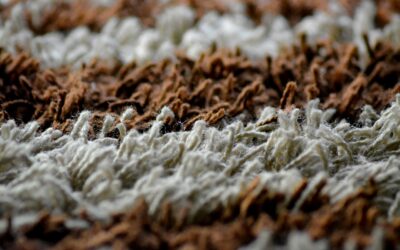
- Tufted loop pile: the workhorse — yarn loops not cut, durable, easy to clean, $15 to $40 per sq yd
- Tufted cut pile: softer underfoot, shows footprints, used in executive areas — $20 to $50 per sq yd
- Tufted cut-and-loop: patterned mix, hides traffic better, $25 to $55 per sq yd
- Woven (Axminster, Wilton): luxury hospitality and corporate, very durable, $50 to $200+ per sq yd
For most office applications, tufted loop pile is the right answer 70% of the time. Cut pile reads more upscale but shows traffic patterns badly in high-use corridors.
Traffic Ratings to Look For
Commercial carpet uses several rating systems, and the spec sheet typically lists them all. The most important is the manufacturer’s recommended traffic level:
- Heavy commercial: for high-traffic corridors, lobbies, and call centers
- Moderate commercial: for typical open-plan offices, conference rooms, individual workstations
- Light commercial: for executive suites, private offices, hospitality guest rooms
Buying light commercial carpet for a high-traffic corridor is the most common spec error in commercial installations. The carpet looks fine for two years, then shows visible wear lanes, and the building’s facilities manager wonders why the warranty doesn’t cover it. Always match the rating to the actual room use.
Top Brands in the Commercial Market
- Interface: the carpet tile category leader, sustainability-focused, 25-year warranties — $40 to $90 per sq yd
- Shaw Contract: wide product range, strong tile and broadloom both — $25 to $75 per sq yd
- Mohawk Group: aggressive pricing, good rep for value commercial — $20 to $60 per sq yd
- Tarkett (formerly Tandus Centiva): European design language, used in upscale corporate — $35 to $85 per sq yd
- Milliken Carpet: patterned and PDQ Print Dye Quality custom designs — $30 to $80 per sq yd
- Mannington Commercial: good mid-market value, healthcare specialization — $25 to $65 per sq yd
Backing Systems That Matter
Carpet tile backing is where lifecycle differences hide. Closed-cell PVC backing (Interface GlasBac, Shaw Eco-Solution Q) provides dimensional stability, moisture resistance, and recyclability. Bitumen backing is older technology with limited recyclability and worse long-term flatness. Modern fiber-based backing systems like Interface CQuest BioX use bio-based materials with comparable performance to PVC.
For ground-floor installations on slab-on-grade, backing matters even more. Closed-cell systems with integral moisture barriers handle slab vapor better than older bitumen products that can develop black-staining mold from below.
Adhesive Systems and Loose-Lay
Most commercial carpet tile installs with releasable adhesive (Shaw 5095, Interface TacTiles) — pressure-sensitive glue that bonds the tile to the subfloor but allows lift-and-replace for service. Some systems use sticker-style TacTiles that bond tiles to each other rather than to the subfloor, creating a fully removable floor.
Full glue-down installations are uncommon now except for ground-floor lobbies with intense traffic. The serviceability advantage of releasable adhesive almost always wins on lifecycle cost.
Real Pricing for Commercial Carpet Projects in 2026
For a typical 10,000 sq ft (1,111 sq yd) office fit-out:
- Material at mid-grade carpet tile ($35/sq yd): $38,900
- Adhesive and underlay allowance: $3,200
- Installation labor at $5/sq yd: $5,555
- Subfloor prep and self-leveling: $4,500
- Tear-out of existing carpet: $3,300
Total: approximately $55,500 for the project, or roughly $5.55 per sq ft all-in. Premium installations with patterned tile and closed-cell backing run $7 to $10 per sq ft. Budget installations with basic loop pile run $3.50 to $4.50 per sq ft.
Maintenance Programs That Extend Lifespan
Commercial carpet manufacturers void warranty claims when buildings can’t document their cleaning programs. The standard spec is daily vacuuming with commercial upright vacuums, monthly low-moisture encapsulation cleaning of high-traffic zones, and twice-yearly deep extraction of the entire space. Documentation matters — when warranty issues arise, the building’s cleaning logs are the first thing manufacturers ask for.
Modular tile rotation is another lifecycle extension trick. Every 18 to 24 months, swap tiles from heavy-traffic corridors with tiles from light-traffic areas (executive offices, secondary conference rooms). The unworn tiles take over the visible high-traffic lanes; the partially-worn tiles disappear into low-visibility zones. Done over a 15-year lease, this can extend visible life by 30% to 50%.
When Business Carpet Doesn’t Belong
For lobbies and entry vestibules, walk-off matting backed by hard-surface flooring outperforms carpet for grit management. Most modern offices specify 8 to 12 feet of walk-off matting at every exterior entrance to capture grit before it hits the carpet. Skipping this is the fastest way to age a $50,000 carpet installation prematurely.
For wet zones (kitchen breakrooms, pantries, server rooms with cooling condensation), carpet is the wrong material category entirely. Specify rubber, vinyl, or polished concrete in those areas instead.
The Honest Verdict on Business Carpet
For most modern office fit-outs, mid-grade tufted-loop carpet tile from Interface, Shaw Contract, or Mohawk Group at $35 to $50 per square yard delivers genuinely 12 to 15 year service when paired with proper traffic-rating selection, releasable adhesive, and a documented cleaning program. The biggest mistakes are spec’ing residential or light-commercial carpet for heavy-traffic zones, skipping walk-off matting at exterior doors, and choosing broadloom in spaces where serviceability matters. Match the product to the room and document the maintenance program — those two habits drive 80% of commercial carpet success stories.