
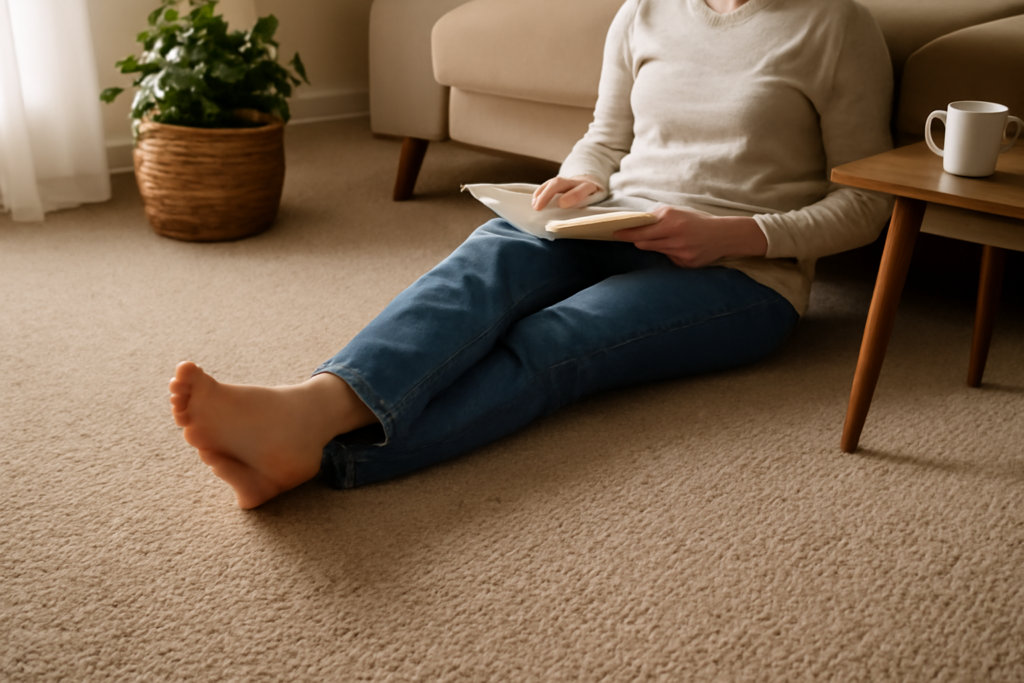
Carpet construction varies more than any other flooring category, with fiber choice, pile height, twist count, and weave method producing visibly and physically different floors at the same retail price point. Carpet flooring texture determines durability, stain resistance, footprint visibility, vacuum compatibility, and the feel underfoot that buyers actually notice. The seven mainstream textures — Saxony, frieze, cable, Berber loop, level loop, multi-level loop, and patterned cut-and-loop — each serve specific room and lifestyle requirements. Expect $1.99 to $9.99 per square foot for residential carpet across all textures, with installation adding $1.49 to $3.49 per square foot including padding.
The Main Carpet Textures Explained
Saxony is the classic cut-pile texture with all yarn tufts cut to the same length, producing a smooth, uniform surface. Saxony shows footprints and vacuum tracks prominently, which makes it the favorite for formal living rooms and primary bedrooms where the “freshly vacuumed” look matters. Frieze (also called twist) uses high-twist yarn that curls back on itself, creating a textured surface that hides footprints far better than Saxony.
Berber is technically a loop-pile construction where the yarn loops over the backing without being cut. Modern Berber uses a level-loop or multi-level-loop construction with thicker yarn for a chunky, durable surface. Cable is similar to frieze but with longer, thicker yarn producing the shaggy looks popular in the late 1990s and again starting in 2022.
Texture Matched to Room Use
- Formal living rooms — Saxony for the “show” appearance, frieze if footprint-hiding matters
- Family rooms with heavy traffic — frieze or multi-level loop for durability and crush resistance
- Bedrooms — plush Saxony or cable for maximum softness underfoot
- Stairs and hallways — Berber loop or level loop for traction and pile compression resistance
- Basements and bonus rooms — patterned cut-and-loop hides stains and softens hard echoes
Pros That Drive Carpet Texture Choices
Footprint and vacuum-track hiding is the most-cited benefit when buyers upgrade from low-end Saxony to frieze or loop. A frieze carpet looks “vacuumed” all the time because the high-twist yarn returns to its tangled neutral position immediately after compression. Plush Saxony, by contrast, shows every footprint until the pile is brushed back upright.
Crush resistance follows the same logic. Higher-twist textures (frieze, cable, multi-level loop) hold their structure longer in heavy-traffic zones than low-twist Saxony. Where a 10-year-old Saxony shows obvious traffic paths through doorways and around furniture, a 10-year-old frieze still looks substantially fresh.
Cons That Each Texture Carries
Saxony’s main weakness is showing wear quickly in busy rooms. The clean uniform surface is also the surface that most clearly registers footprints, vacuum lines, and traffic patterns. Saxony belongs in low- to medium-traffic spaces, not in family rooms with kids and pets.
Berber and loop pile textures have their own weakness — snagging. A loose yarn loop can pull from the backing when caught by a vacuum beater bar, pet claws, or rough furniture feet, and the snag can travel several inches before being noticed. The fix is to clip the loose yarn flush, not pull it. Berber also shows seams more visibly than cut pile, which makes professional installation critical.
Fiber Choice Affects Texture Performance
Nylon (Stainmaster, Anso, Mohawk Wear-Dated) delivers the best long-term resilience across all textures. The fiber memory of nylon returns crushed pile to its upright position over months and years, where polyester and triexta gradually flatten in traffic zones. Nylon costs $0.50 to $1.50 per square foot more than polyester but lasts 15 to 25 years versus 7 to 12 years for equivalent polyester construction.
Triexta (Mohawk SmartStrand, Sorona) is the strong newcomer — bio-based fiber with excellent stain resistance and crush recovery approaching nylon performance at polyester pricing. For families with kids and pets where carpets see liquid spills monthly, SmartStrand triexta in a frieze or multi-level loop construction is the safest residential choice in 2026.
Cost Per Square Foot in 2026
- Builder-grade polyester Saxony, 30 oz face weight: $1.99 to $2.99
- Mid-grade nylon frieze, 40 oz to 50 oz face weight: $3.49 to $4.99
- Premium nylon plush Saxony, 55 oz to 65 oz: $5.49 to $7.99
- Berber loop with olefin (low-end) or nylon (high-end): $2.49 to $5.99
- Wool carpet (Karastan, Stark) in any texture: $7.99 to $14.99
- Pad and professional installation: $1.49 to $3.49 per square foot
Best Brands by Texture
Shaw Caress and Mohawk SmartStrand Silk dominate the plush Saxony category with the softest residential carpets available — face weights of 60 oz to 75 oz over premium 8 lb density pad. For frieze, Anderson Tuftex and Karastan both offer outstanding mid-range options at $4.99 to $6.99 per square foot. Berber buyers should look at Beaulieu, Shaw, and Mohawk loop collections with continuous-filament nylon for the best snag resistance.
For luxury wool, Karastan Smartstrand Silk Reserve and Stark Antelope deliver the natural-fiber warmth that no synthetic fully matches. Wool costs roughly twice synthetic per square foot but lasts 25 to 50 years with proper maintenance and develops a desirable patina over decades.
Padding Matters as Much as Texture
The carpet pad doubles the comfort and triples the wear life of any texture. Spec 7/16 inch thick rebond pad at 6 to 8 lb density for residential rooms (6 lb for bedrooms, 8 lb for living areas), and avoid the 5 lb builder-grade pad that comes free with installation promotions. Premium pad runs $0.59 to $0.99 per square foot extra and pays back in carpet longevity within five years.
For high-moisture areas or homes with pets, look at moisture-barrier pads from Future Foam or Shaw. The polyurethane backing prevents pet accidents and spills from soaking through to the subfloor, dramatically reducing odor and stain replacement costs. Carpet flooring texture is the most important spec after fiber choice, and matching the texture to the room’s actual use produces a carpet that looks fresh through years of family life rather than going threadbare in the doorways within five years.


