The wrong carpet on a busy stairway looks worn within 18 months and forces replacement at full cost, while the right carpet in the same location lasts 12 to 15 years and still looks acceptable when it gets pulled. Understanding the four main fiber categories and three primary pile constructions in carpet flooring types is the foundation of every smart purchase. This guide walks through each fiber and pile option, where it performs well, the realistic cost range in 2025, and the situations where you should not even consider certain combinations.
- The Two Variables That Define Carpet Flooring Types
- Fiber Type 1: Nylon
- Fiber Type 2: Polyester (PET)
- Fiber Type 3: Wool
- Fiber Type 4: Olefin (Polypropylene)
- Pile Construction 1: Cut Pile
- Pile Construction 2: Loop Pile
- Pile Construction 3: Cut and Loop
- Matching Carpet Type to Room
- The Pad Decision Matters Almost as Much
- FAQ
The Two Variables That Define Carpet Flooring Types
Every carpet sold in the US can be described by two characteristics: the fiber it is made from, and how that fiber is constructed into pile. The fiber determines stain resistance, fade resistance, and durability against crushing. The pile construction determines appearance, comfort underfoot, and how dirt shows up over time.
Get both right for the room and you have a floor that performs for a decade. Get one wrong and the carpet looks tired within years even with proper cleaning.
Fiber Type 1: Nylon
Nylon dominates the residential carpet market with about 60% share, and for good reason. It resists crushing better than any other synthetic fiber, holds dye color for 15 to 20 years without fading in sunlight, and tolerates frequent cleaning without breaking down. Modern nylon comes in two main types: nylon 6 (used by most major manufacturers) and nylon 6,6 (used by Stainmaster and a few premium lines, slightly more durable and stain-resistant).
Pricing: $2 to $7 per square foot in materials, $4 to $10 per square foot installed with pad. Best for: living rooms, family rooms, bedrooms, stairs, hallways. Avoid for: basements with moisture issues (nylon absorbs water).
Fiber Type 2: Polyester (PET)
Polyester has gained significant share in the budget and mid-tier market, mostly under the marketing names PET, Triexta, and SmartStrand. It offers excellent inherent stain resistance because the fiber itself is hydrophobic (water and most stains do not penetrate), bright colors with good fade resistance, and a soft hand feel.
The downside is crushing. Polyester does not bounce back from foot traffic the way nylon does, so it shows traffic patterns within 3 to 5 years in busy areas. Polyester also picks up oily stains more readily than nylon (perfect for kids spilling juice, less great for shoes tracked in driveway oil).
Pricing: $1.50 to $5 per square foot in materials. Best for: bedrooms, low-traffic family rooms, formal dining rooms, basements. Avoid for: stairs, hallways, primary living rooms.
Fiber Type 3: Wool
Wool is the premium natural fiber and the only one with a 50+ year track record in residential applications. It is naturally flame-resistant, anti-static, and biodegradable. Wool fibers have a natural protective layer (lanolin) that resists soiling and the crimp structure makes wool extraordinarily resistant to crushing.
Pricing: $7 to $20 per square foot in materials, $12 to $28 installed with quality pad. Best for: primary residences with longevity goals, formal living rooms, bedrooms in high-end homes. Avoid for: humid basements (wool can grow mold without proper ventilation), homes with moth issues.
Fiber Type 4: Olefin (Polypropylene)
Olefin is the budget commercial fiber that has crossed into residential. It is solution-dyed (color goes through the entire fiber, not just the surface), so it does not fade and tolerates aggressive cleaning including bleach. The drawback is poor crush resistance and a synthetic feel that homeowners rarely love.
Pricing: $1 to $3 per square foot in materials. Best for: basements, indoor-outdoor use, sun rooms, commercial spaces. Avoid for: primary living areas, bedrooms (the hand feel is plasticky).
Pile Construction 1: Cut Pile
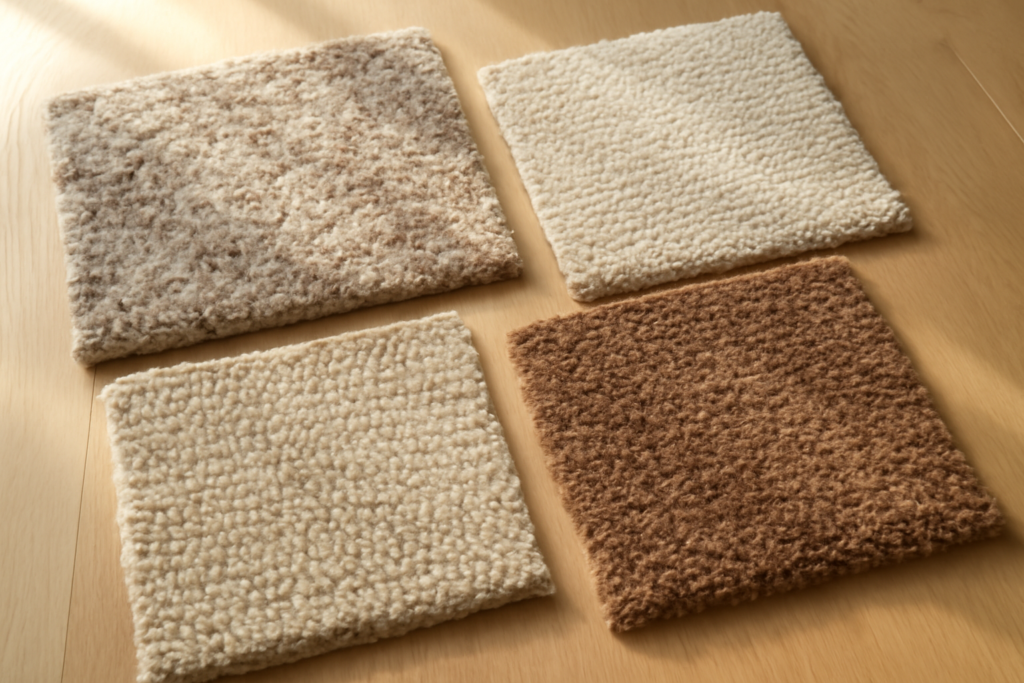
Cut pile means the loops created during weaving are sheared off so each tuft stands as an individual upright fiber. This produces the soft, plush feel most homeowners associate with residential carpet. Cut pile sub-types:
- Plush (velvet): Short, dense, formal look. Shows footprints and vacuum tracks.
- Saxony: Slightly longer than plush, twisted, less footprint-show.
- Frieze (pronounced free-zay): Tightly twisted curly pile. Hides footprints and dirt extremely well.
- Texture: Mid-twist between saxony and frieze. The most popular residential cut pile in 2025.
For a busy household with kids and pets, frieze or texture cut pile in nylon hides traffic and soil better than any other combination at moderate cost.
Pile Construction 2: Loop Pile
Loop pile leaves the woven loops uncut, creating a flat textured surface. Sub-types:
- Level loop: All loops the same height. Most durable construction available. Common in commercial.
- Multi-level loop: Loops at varying heights create patterns and visual texture.
- Berber: Originally referred to large-loop wool carpet from North Africa, now used loosely for any large-loop carpet regardless of fiber.
Loop pile resists crushing better than cut pile and is the right call for stairs, hallways, and home offices. The downside: pet claws can snag and pull individual loops, creating runs that propagate. Pet households should choose cut pile or sealed-loop construction.
Pile Construction 3: Cut and Loop
Cut-and-loop combines both styles in patterns, with cut tufts in some areas and uncut loops in others. This creates sculptural patterns and visual interest. The construction is more durable than pure cut pile and more pet-friendly than pure loop. Pricing typically matches cut pile in the same fiber.
Matching Carpet Type to Room
For practical decisions, match the room demand to the carpet type:
- Stairs and hallways: Nylon frieze or level loop. Highest durability per dollar.
- Family room with kids and pets: Nylon texture cut pile. Hides traffic, durable, easy to clean.
- Primary bedroom: Polyester or wool plush. Soft underfoot, low traffic.
- Formal living room (low use): Wool saxony or plush. Best look, durability not critical.
- Basement: Solution-dyed olefin or polyester level loop with synthetic pad rated for moisture.
- Home office: Nylon level loop in commercial-grade construction.
The Pad Decision Matters Almost as Much
Carpet warranty is typically void without a manufacturer-specified pad underneath. Even when not strictly required, a quality pad doubles the perceived comfort and extends the carpet’s life by 20 to 40%. Specifications that work:
- Residential primary spaces: 8 lb density, 7/16 inch thick rebond pad. $0.50 to $0.75 per square foot.
- Stairs and hallways: 10 lb density, 3/8 inch thick. Lower thickness reduces shifting.
- Basement: Rubber slab pad with moisture barrier. $1 to $1.50 per square foot.
Cheap thin pads (under 6 lb density) feel okay on day one and break down within 18 months, taking the carpet warranty with them.
FAQ
What is the most durable carpet type? Nylon frieze or nylon level loop. Both consistently outlast other combinations in high-traffic areas.
Is wool carpet worth the cost? For homeowners planning to stay 10+ years and value natural materials, yes. For 3-5 year holds, nylon offers similar performance at a quarter the price.
What is the difference between Berber and frieze? Berber is loop pile (uncut loops), frieze is cut pile with tightly twisted tufts. Both hide soil well but have different feels and durability characteristics.
How long does carpet last? Quality nylon: 10-15 years. Polyester: 5-10 years. Wool: 20-50 years. Olefin: 5-8 years. All assume proper cleaning and a quality pad.