
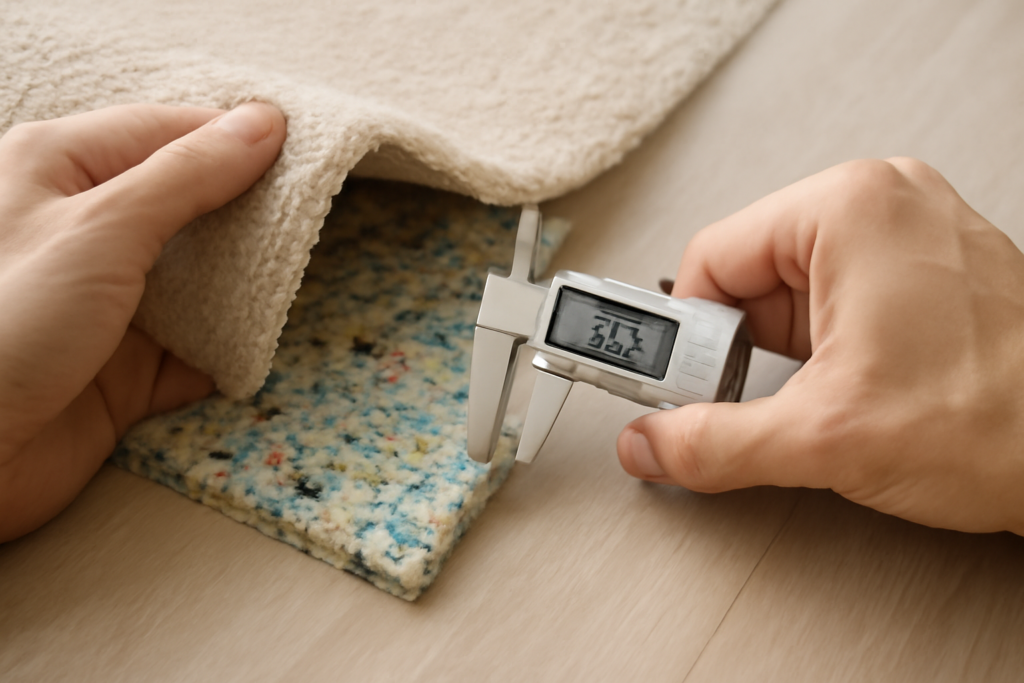
The cheapest mistake in any carpet install is underbuying the pad. The carpet itself shows up in catalogs and price quotes, but the pad underneath is what determines how the carpet feels, how long it lasts, and whether the manufacturer honors the warranty. Choosing the right carpet pad thickness means understanding both thickness and density — two different specs that get confused all the time. This guide covers the rules that actually matter, the warranty fine print most installers skip over, and room-by-room recommendations that hold up in real homes.
Two Specs That Both Matter: Thickness and Density
Thickness is measured in inches (typically 1/4, 3/8, 7/16, or 1/2 inch). Density is measured in pounds per cubic foot, with residential pad ranging from 4 to 10 pounds. Higher density pad supports the carpet better and lasts longer at the same thickness.
The two work together. A 7/16-inch pad at 8-pound density outperforms a 1/2-inch pad at 5-pound density even though the thinner one feels firmer underfoot at first. Most carpet warranties specify both — typically requiring at least 6-pound density for residential applications.
Standard Thickness Options
Pad comes in four common residential thicknesses: 1/4 inch (commercial and stairs), 3/8 inch (low-pile carpets and Berbers), 7/16 inch (the residential default for most cut pile), and 1/2 inch (premium plush cut pile only).
The instinct that thicker is always better is wrong. Pad thicker than 1/2 inch causes carpet to ripple, separate at seams, and fail prematurely. Pad thinner than 1/4 inch transmits subfloor irregularities and feels hard underfoot. The sweet spot for almost every residential install is 7/16 inch.
Density Standards Explained
Pad density is the number that determines lifespan. Cheaper rebond pad runs 5 to 6 pound density. Standard residential rebond runs 6 to 8 pound density. Premium memory foam and rubber pads run 8 to 10 pound density.
For light-traffic areas (guest bedrooms, formal living rooms), 6-pound density holds up fine. For high-traffic areas (family rooms, hallways, stairs), step up to 8-pound density minimum. Pad density also affects the squish factor — denser pad feels more supportive and less “marshmallow soft.”
- 4-5 lb density: builder-grade only, fails fast under traffic
- 6 lb density: residential minimum, light traffic only
- 8 lb density: standard residential workhorse
- 10 lb density: premium, suits high-traffic and heavy furniture
The Manufacturer Warranty Trap
Read the carpet warranty before buying pad. Most major brands (Mohawk, Shaw, Stainmaster) specify maximum 7/16-inch thickness and minimum 6-pound density. Installing 1/2-inch pad voids the warranty on most cut-pile carpets, even though the homeowner thinks they are upgrading.
For Berber and looped carpets, the warranty is even stricter. Most require 3/8-inch thickness maximum and 8-pound density minimum. Loop carpets installed over plush pad tend to ripple and unravel at the loops because there is too much give underneath.
Pad Materials Compared
Bonded urethane (rebond) is the dominant residential pad — recycled foam pieces compressed and bonded into a sheet. Multicolored, available in every density and thickness, and priced 30 to 80 cents per square foot. The right choice for 80 percent of residential installs.
Memory foam pad adds a softer feel and is sometimes marketed as “luxury” pad. Costs run 80 cents to 1.50 dollars per square foot. The performance difference is real but modest. Most homeowners cannot tell the difference at the same density rating.
Rubber pad (slab or waffle) is the traditional choice for high-end wool and tufted carpets. Costs 1.50 to 3 dollars per square foot. Lasts 25-plus years. Suits hospitality and high-end residential where the carpet itself is premium.
Fiber pad is mostly used commercially or under glue-down installations. Not the right choice for typical residential carpet.
Moisture Barriers and When You Need One
Spillproof or moisture-barrier pad has a thin film bonded to one face that prevents liquid from soaking through to the subfloor. Worth the 20-cent-per-square-foot premium in homes with kids, pets, or basement installations.
Common spec products include Stainmaster Active Family pad and Shaw All-Pet pad. Both deliver real protection against accidents that would otherwise reach the subfloor and cause subfloor mold.
Room-by-Room Recommendations
Bedrooms benefit from 7/16-inch, 6 to 8-pound rebond. Soft enough underfoot for bare feet, dense enough to support a bed frame and dressers. Avoid 1/2-inch in bedrooms — the give catches feet at doorway transitions.
Family and living rooms call for 7/16-inch, 8-pound rebond minimum. The traffic level demands the higher density. If kids and pets are in the equation, add a moisture barrier.
Hallways and stairs are the highest-stress carpet zones. Use 3/8-inch, 8 to 10-pound dense pad on stairs (most warranties require it). For hallways, 7/16-inch at 8-pound density holds up.
Basements need both moisture protection and density. Use a moisture-barrier pad or install a vapor barrier under standard pad. 7/16-inch, 8-pound is the right call here.
- Master bedrooms: 7/16 inch, 6-8 lb rebond
- Kids’ rooms: 7/16 inch, 8 lb rebond with moisture barrier
- Family rooms: 7/16 inch, 8 lb rebond
- Hallways: 7/16 inch, 8 lb rebond
- Stairs: 3/8 inch, 8-10 lb (check warranty for exact spec)
- Basements: 7/16 inch, 8 lb with moisture barrier
Cost Comparison
Pad pricing in 2026 runs 0.30 to 1.50 dollars per square foot for residential rebond. For a 1,500-square-foot install, that is 450 to 2,250 dollars in pad alone. The difference between minimum 6-pound and 8-pound rebond at 7/16 inch is roughly 200 to 400 dollars on that same install — money that pays back through extended carpet lifespan.
Skip the absolute cheapest tier. A bargain 4-pound rebond at 25 cents per square foot will collapse within 3 years and force you to replace the carpet 5 years earlier than necessary. The math always favors mid-tier pad.
Installation Considerations
Pad joins must be taped, not just butted together. Cheap installers skip the tape, which causes pad to slip and leaves visible bumps in the carpet within months. Watch for this during install — taped seams are visible until the carpet goes down.
Subfloor must be clean and smooth before pad goes down. Squeaks, nail pops, or moisture issues underneath compound through the pad and ruin the carpet experience. Address subfloor problems first, install pad second, lay carpet third.
Common Mistakes
- Buying 1/2-inch pad assuming thicker is better
- Skipping density on the spec sheet
- Installing residential pad on stairs (warranty void)
- Mixing pad densities across adjacent rooms
- Reusing old pad with new carpet — never works long-term
Final Take
Carpet pad thickness is half the equation. The other half is density. Spec 7/16-inch at 8-pound density for most residential applications, drop to 3/8-inch at 8-pound for stairs, add a moisture barrier where it makes sense. The carpet itself will feel better and last longer, the warranty will stay intact, and the spend on pad will look small compared to the years of comfort it adds.


