Retailers frequently advertise carpets with free fitting and underlay as a compelling bundle offer, and in many cases these deals do represent genuine value. But the word “free” can obscure a lot of detail about what’s actually included and what comes with extra charges. Understanding the structure of these offers before you walk into a showroom — or click buy online — puts you in a much stronger position to compare deals fairly and avoid surprise costs.
This guide explains how free-fitting-and-underlay deals work, what to look for in the quality of the included underlay, which extras are often charged separately, and how to get everything confirmed in writing before work starts.
- How Retailers Structure These Offers
- What “Free Underlay” Actually Means
- What’s Usually Included in a Free Fitting Deal
- Common Exclusions and Surcharges to Watch For
- How to Compare Free-Fitting Deals Fairly
- Getting It in Writing
- When a Free-Fitting Deal Is Genuinely Good Value
- Preparing Your Home for Fitting Day
How Retailers Structure These Offers
No retailer absorbs the cost of installation and underlay as a pure gift. What they’re doing is pricing the carpet per square meter (or per square yard) at a rate that bundles the fitting labor and a mid-grade underlay into the total. You’re not paying for fitting and underlay as separate line items, but the cost is still there — it’s just incorporated into the carpet price itself.
This bundling serves the retailer too: it simplifies the sale, makes price comparison with competitors harder, and ties the installation to their own crew rather than allowing you to bring in a cheaper independent fitter. That’s not inherently bad — it’s just worth knowing so you can do an apples-to-apples comparison when you shop around.
When you see a headline like “carpet from $X per square foot, free fitting and free underlay included,” you need to look carefully at the carpet grade that qualifies for the offer. Entry-level and mid-grade carpets are usually what trigger free fitting. Premium wool or high-twist carpets may carry a fitting surcharge, or the “free” underlay offered with them may be a thinner, lower-grade product than the carpet warrants.
What “Free Underlay” Actually Means
The underlay included in a free deal is almost always a standard-grade product — adequate for typical use, but not necessarily the best option for your specific situation. Understanding underlay specs helps you judge whether what’s being offered is acceptable or whether you should upgrade.
Common Underlay Types in Bundle Deals
PU foam (polyurethane foam) is the most common underlay provided in free-fitting bundles. It’s manufactured in sheets, typically 7mm to 10mm thick, and provides reasonable cushioning and some thermal insulation. It works fine under most residential carpet, but at the lower density grades it compresses over time and loses its feel underfoot.
Crumb rubber underlay (sometimes called sponge rubber) uses recycled rubber compressed into a solid sheet. It’s denser than PU foam, more durable, and better at noise reduction. It’s less common as a freebie because it costs more to manufacture.
Waffle rubber — the classic honeycomb-pattern rubber underlay — is occasionally included in older-style offers. It’s durable and provides good cushioning but is bulkier and heavier than modern foam options.
Thickness and Density Matter More Than Brand
When evaluating a free underlay, ask specifically: what is the thickness in millimeters, and what is the density in kilograms per cubic meter? A 10mm underlay at 130 kg/m³ is a solid mid-grade product. A 7mm underlay at 100 kg/m³ is budget-grade. Most free-deal underlays fall in the 7–8mm range at lower density. That’s not terrible, but it means the carpet underfoot will feel softer initially and firm up faster than a premium underlay as it compresses.
For high-traffic areas — hallways, stairs, living rooms — a better underlay extends the life of the carpet significantly by absorbing impact before it reaches the carpet backing. If the free underlay isn’t up to spec for your busiest rooms, it’s worth asking whether you can pay a modest upgrade charge to get a better product under those specific areas.
What’s Usually Included in a Free Fitting Deal
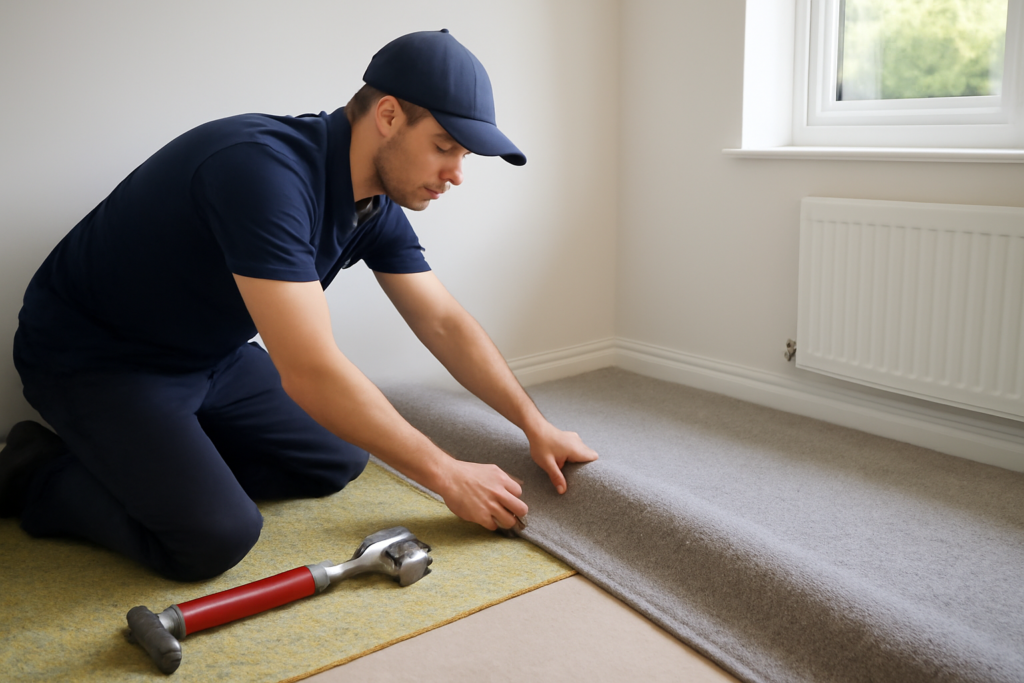
A genuine free fitting offer covers the labor to stretch and tack the carpet into place in standard rooms. Specifically, you should expect:
- Removal of the old carpet (sometimes) — see the caveat below
- Laying of the supplied underlay
- Cutting the carpet to fit the room perimeter
- Stretching the carpet and securing it with gripper rods along the walls
- Tucking edges along skirting boards
What’s typically included and what isn’t varies by retailer, which is why you need to get the scope confirmed in writing before you sign anything.
Common Exclusions and Surcharges to Watch For
This is where most homeowners get tripped up. Free fitting rarely means zero additional charges. Here are the most common extras that come with add-on fees:
Uplift and Disposal of Old Carpet
Many retailers will remove and dispose of your old carpet and underlay for a fee — typically charged per room or per quantity. Some include uplift in a “full free fitting” deal; many do not. Confirm this explicitly. If you’re replacing carpet in five rooms, uplift charges can add up to a meaningful amount.
Door Trimming
New carpet plus underlay adds height at the floor level, which can mean interior doors no longer clear the surface. If doors need to be trimmed, that’s usually an additional charge — and it requires removing the door, planing the bottom edge, and rehaning. Not every fitting crew does this; some will flag it as your responsibility.
Gripper Rods
Gripper rods are the toothed wooden strips nailed around the room perimeter that hold the carpet edges in tension. They may or may not be included in the fitting offer. If yours are old and damaged, they’ll need to be replaced, and that usually comes at an extra cost. Ask specifically.
Stairs Surcharges
Fitting carpet on stairs is significantly more labor-intensive than fitting it in a flat room. Nearly every free-fitting offer excludes stairs or applies a per-step surcharge. A standard staircase with 13 steps might carry an additional charge equivalent to one or two full rooms. Get this number before you commit.
Awkward Room Shapes
Rooms with alcoves, bay windows, or irregular angles require more cutting and more waste material. Some retailers charge extra for complex layouts. For a straightforward rectangular bedroom, you won’t see this; for an L-shaped living room, it’s worth asking about.
How to Compare Free-Fitting Deals Fairly
Because the fitting and underlay costs are buried in the carpet price, comparing two retailers who each offer “free fitting” requires a bit more work. Here’s a practical approach:
- Get the total installed price per square foot (or yard). Ask each retailer: if I want X square yards of carpet installed in my room, with fitting and underlay included, what is the total figure on the invoice? This flushes out hidden surcharges.
- Identify the underlay grade. Ask for the brand, thickness, and density of the included underlay. A retailer who can’t or won’t answer this question is likely offering a very low-grade product.
- Clarify every exclusion. Run through the list above — uplift, door trimming, gripper rods, stairs — and get a written confirmation of what’s included and what’s not.
- Ask about the fitting crew’s credentials. Are they in-house fitters or subcontractors? Who is responsible if the fit is poor or the carpet wrinkles within the first year? Make sure there’s a clear process for warranty claims.
- Compare the carpet grade, not just the price. Two quotes for “free fitting and underlay” can look identical on paper but use carpets with very different pile weights and fiber types. Check the pile weight (measured in ounces per square yard or grams per square meter) — residential bedrooms need at least 35 oz; high-traffic hallways benefit from 40 oz or higher.
Getting It in Writing
This is non-negotiable. Before you pay a deposit or confirm an installation date, you should have a written quote or order confirmation that specifies:
- The exact carpet product (name, color, pile weight)
- The exact underlay product (brand or specification, thickness, density)
- Room-by-room area measurements used to calculate the price
- What’s included in fitting (uplift, gripper rods, etc.) and any stated exclusions
- Any stairs or irregular-room surcharges
- The installation date and time window
- The warranty on both the carpet and the fitting
Verbal assurances from a salesperson don’t protect you if the fitting crew shows up and the scope is different from what you were told. Written documentation gives you grounds to dispute charges that weren’t agreed upon and to hold the retailer accountable if something goes wrong.
When a Free-Fitting Deal Is Genuinely Good Value
These offers work best for straightforward jobs — rectangular rooms, no stairs, existing gripper rods in good condition, old carpet you’ll handle yourself. In those situations, a bundled price that covers carpet, a decent 8–10mm underlay, and professional fitting can be very competitive compared to buying components separately and hiring an independent fitter.
They work less well when you have complex rooms, stairs, or a requirement for premium underlay beneath an expensive carpet. In those cases, you may be better served by pricing the components separately so you have full control over each element — and so you’re not paying a “free fitting” premium on a basic carpet price just to get the labor included.
For most homeowners fitting out a standard home, carpets with free fitting and underlay from a reputable retailer — with everything confirmed in writing — represent a solid option that simplifies the process and often comes in at a fair total cost.
Preparing Your Home for Fitting Day
A few simple steps before the fitters arrive will make the job go smoothly and reduce the chance of damage or delays. Clear all furniture from the room if you can; most fitters won’t move heavy furniture for free, and some policies explicitly exclude moving furniture from the fitting scope. Remove any fragile items from the room and the hallway the fitters will use to carry rolls in.
If the subfloor has any loose boards, squeaks, or damaged areas, have those repaired before fitting day. Carpet and underlay won’t fix a squeaky floor — they’ll muffle it temporarily, but the sound often returns. A properly prepped subfloor gives the carpet the stable foundation it needs to last.