Vinyl shake siding has a credibility problem — most of it looks like plastic pretending. CertainTeed’s answer has been the benchmark for two decades. Cedar Impressions siding is a line of injection-molded polymer panels cast from actual cedar shingles, thick enough to hold crisp shadow lines and deep grain that ordinary extruded vinyl can’t reproduce. It costs two to three times what standard vinyl lap runs, and on gables, seaside colonials, and craftsman facades it earns the premium. Here’s the full rundown of profiles, colors, pricing, and the tradeoffs nobody mentions in the brochure.
- What Makes Cedar Impressions Different From Vinyl Shake
- The Profile Lineup
- Colors and the TrueTexture Finish
- What Cedar Impressions Costs in 2026
- Strengths Beyond the Looks
- The Drawbacks Worth Weighing
- Cedar Impressions vs. Real Cedar and Other Rivals
- Installation Notes That Protect the Look and Warranty
- Ordering and Estimating Notes
- Quick Answers for Shoppers
What Makes Cedar Impressions Different From Vinyl Shake
Standard vinyl siding is extruded — hot PVC pushed through a die in long, thin (0.040-0.046 inch) sheets with grain embossed on the surface. Cedar Impressions is injection molded: polymer shot into molds taken from real hand-split and sawn cedar, producing panels roughly 0.100 inch thick, more than double typical vinyl. That thickness is the whole story. It holds deep, irregular shingle edges and true shadow lines, resists waviness and oil-canning on hot days, takes impacts better, and allows darker colors, since the rigid panel tolerates heat gain that would distort thin extrusion. Panels install like vinyl — nailed to sheathing over housewrap, hung loose to float with temperature — so any competent siding crew can handle it, though the molded interlocks demand more attention to coursing and stagger.
The Profile Lineup
- Double 7-inch Straight Edge Perfection Shingles: The flagship — clean sawn-shingle look, the classic Cape Cod and coastal profile. Available in standard and rough-split textures.
- Double 9-inch Staggered Rough-Split Shakes: Random bottom edges and heavy texture for the rustic hand-split look; the pick for craftsman and mountain styles.
- Triple 5-inch Sawmill Shingles: Tighter coursing that reads more formal and historic — common on Victorian and shingle-style restorations.
- Half-Round (fish scale) Shingles: The decorative scalloped panel for gable peaks and Victorian trim bands.
- Individual 5-inch Sawmill Shingles: Install-one-at-a-time pieces for maximum realism and pattern control, at maximum labor.
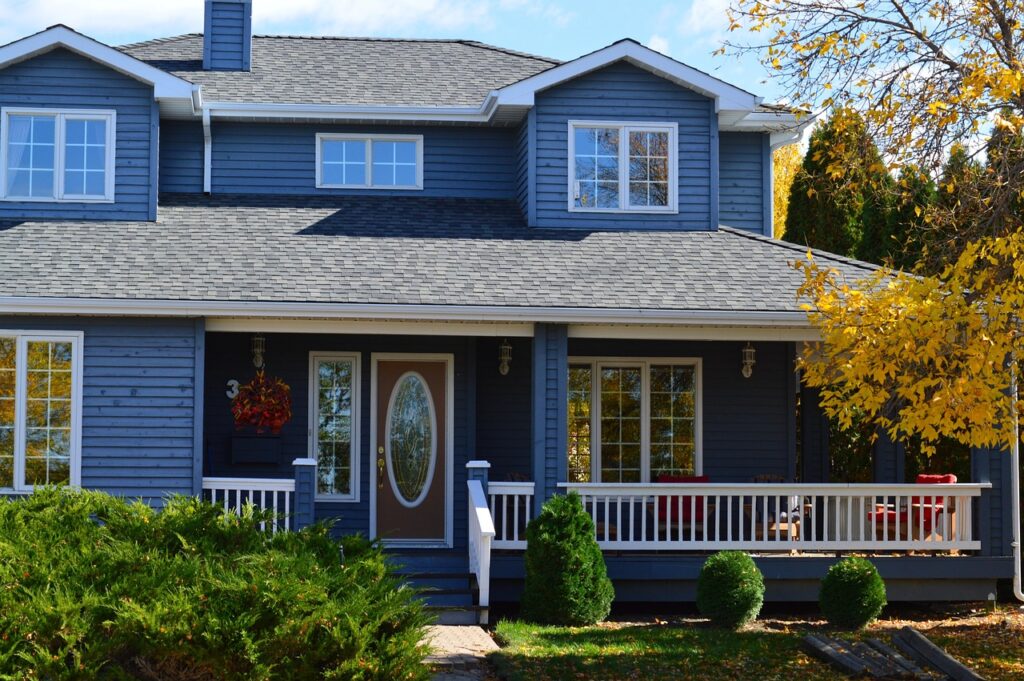
Most houses use Cedar Impressions as an accent — gables, dormers, bays, and entry surrounds over vinyl or fiber cement lap — but full-facade installs are common on coastal homes where the whole-shingle look is the point.
Colors and the TrueTexture Finish
The palette runs 20-plus colors depending on profile, from whites and sandy neutrals (Snow, Buckskin, Desert Tan) through popular coastal blues and grays (Pacific Blue, Flagstone, Granite Gray) to deep saturated options (Espresso, Sable Brown) enabled by the rigid panel. Several profiles offer blended “weathered” multicolor looks that mimic aging cedar. Color runs through the polymer with a molded TrueTexture surface taken from real cedar grain, so scratches don’t expose a different color the way paint does. CertainTeed backs the line with its lifetime limited warranty (transferable, with fade protection under the SureStart provisions) — stronger paper than nearly any paint-finish product.
What Cedar Impressions Costs in 2026
Materials run roughly $250-450 per square (100 square feet) depending on profile — individual shingles and half-rounds cost the most. Installed, realistic numbers land at $9-14 per square foot for full walls, and $12-18 per square foot for small fussy areas like gables where setup dominates. Compare that with $6-10 for quality standard vinyl, $10-16 for fiber cement, and $14-22+ for real cedar shingles installed and finished. A typical accent package — two gables and a dormer, maybe 300 square feet — adds $3,000-5,000 to a re-side. A full 2,000-square-foot facade in Double 7 Perfection runs $18,000-28,000. Labor varies by region and by how much cutting the design forces; half-round fish scale in a steep gable is slow work.
Strengths Beyond the Looks
- Zero finish maintenance: No staining cycle, no repainting, no cedar mildew battles. Wash with a hose and soft brush annually.
- Weather resistance: The molded panels handle impacts and cold-weather brittleness noticeably better than thin vinyl; CertainTeed rates the line for high wind with proper installation (published ratings vary by profile, commonly 180+ mph spec with correct nailing).
- No pests, no rot: Polymer removes the woodpecker, carpenter bee, and termite conversations entirely.
- Insurance and coastal practicality: On salt-air coasts where real cedar weathers fast and painters are expensive, polymer shake is the default for a reason.
The Drawbacks Worth Weighing
It’s still plastic, and a trained eye standing at the front door can tell — especially at outside corners, where molded corner pieces create repeating patterns real shingles wouldn’t have. Repeats are the giveaway: each panel molds the same shingle sequence, so on large uninterrupted walls you can spot the pattern every few feet if the crew didn’t stagger thoughtfully. Repairs require matching panels from the same line and ideally the same era; keep a spare box in the garage because colors and profiles get discontinued. Thermally, the panel itself insulates almost nothing (add foam sheathing underneath if you want wall R-value; CertainTeed also offers insulated backer on some products). And in wildfire zones, polymer melts and burns — fiber cement shingle lookalikes (like Hardie’s shingle panels) are the right call there instead. Finally, cost: on a tight budget, extruded vinyl shake panels from CertainTeed’s own Cedar Boards-adjacent lines or Mastic and Royal cost 30-40 percent less, at a visible realism penalty.
Cedar Impressions vs. Real Cedar and Other Rivals
Against real cedar, the polymer wins on lifetime cost and maintenance and loses on authenticity and repair simplicity — one cracked shingle in wood is a five-minute swap. Against fiber cement shingle panels (HardieShingle, GAF WeatherSide successors), Cedar Impressions offers deeper texture, lighter weight, and no repainting, while fiber cement counters with fire resistance and a painted-wood look some prefer. Against cheaper vinyl shake (Mastic Cedar Discovery, Royal Portsmouth, Foundry), Cedar Impressions is the thickness and mold-quality leader; the gap is obvious side by side in shadow depth. If the shake look matters and you’re keeping the house, the flagship product is the one that still looks right in year twenty. Ask your installer to bring physical panels of Cedar Impressions and one budget alternative to the estimate — ten seconds of holding both settles the decision faster than any spec sheet.
Installation Notes That Protect the Look and Warranty
Cedar Impressions installs over sheathing and housewrap like vinyl, but the molded panels punish shortcuts differently. Panels hang loose — fasteners centered in slots, heads 1/32 inch proud — because the thick polymer still moves with temperature, and a pinned panel telegraphs a buckle across the shingle field. Coursing must be laser-level: shingle bottoms form strong horizontal lines, and a starter course that drifts 1/4 inch shows in every course to the eaves. Stagger the molded panels per the instructions so pattern repeats don’t stack, and plan gable layouts so cut edges bury in J-channel rather than landing mid-wall. Cold-weather installs need wider expansion gaps at trim (the instructions publish temperature-based tables). None of this is exotic, but it argues for a crew that has hung this specific product before — ask to drive past two of their Cedar Impressions jobs at least a year old and look at the coursing in raking afternoon light.
Ordering and Estimating Notes
Cedar Impressions sells by the carton, with coverage per carton varying by profile — Double 7 Straight Edge covers the most wall per box, individual shingles the least. Estimators figure 10 percent waste on rectangular walls and 15-20 percent on gables and dormers, where every course ends in an angled cut. Order corners, starter strip, J-channel, and mounting blocks for lights and spigots in the same release so everything comes from one color lot; polymer blends can shift subtly between runs, and a gable is small enough that a mismatched half-carton shows. Popular coastal colors run 2-4 week lead times in spring. Keep one unopened carton after the job — future you, staring at a cracked panel after a ladder slip, will consider it the best $200 stored in the garage.
Quick Answers for Shoppers
Can it be painted later? Technically yes with vinyl-safe paints in approved lighter shades, but repainting molded polymer forfeits the point of through-color material and can affect warranty terms. Choose the color you can live with.
How does it handle hail? Far better than hollow vinyl — the thick molded sections resist puncture — though severe hail can still crack panels, and insurance adjusters treat it like any siding claim.
Is it worth it on a starter home? Usually only as gable accents. The full-facade premium pays off on homes you’ll hold long-term or in coastal markets where the shingle look drives value; elsewhere, a $2,000 gable package delivers 80 percent of the curb-appeal lift.