
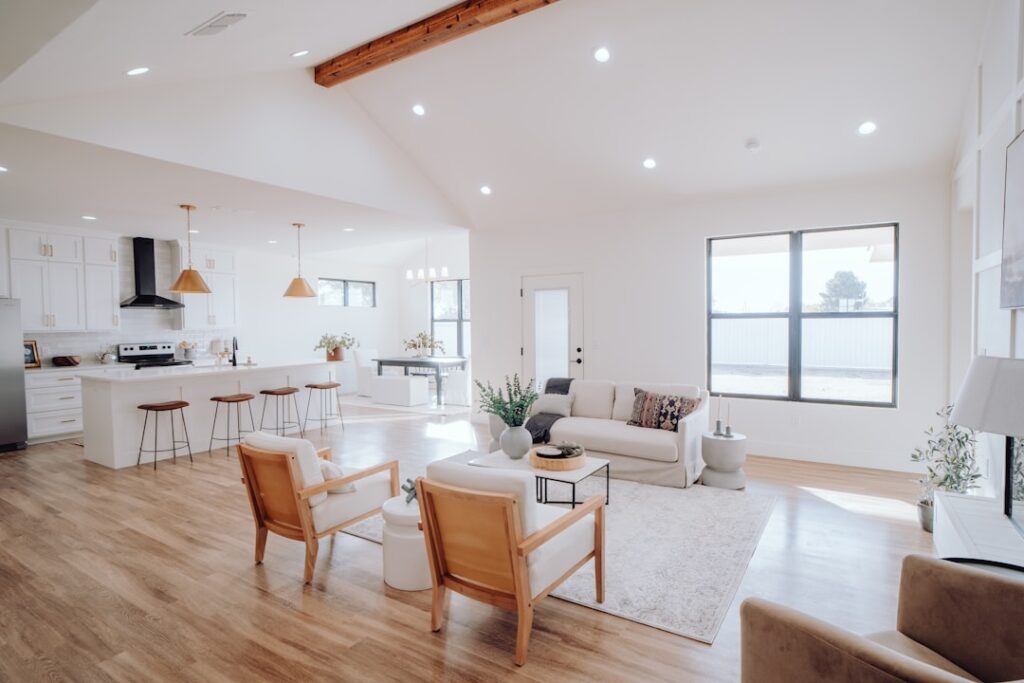
Step into any newly renovated kitchen on the design blogs and odds are the floor is some shade of smoky gray. Charcoal flooring has quietly overtaken classic mid-tone oak as the most-requested look in showrooms, and for good reason. It hides everyday grit, plays nicely with white cabinets and brass hardware, and reads modern without feeling cold. The trade-offs, though, are real once the sun hits it at the wrong angle.
What Counts as Charcoal Flooring
Charcoal is a deep, neutral gray that lands somewhere between true black and slate. In the flooring industry, it shows up across nearly every product category: stained white oak hardwood, dark-grain luxury vinyl planks, fired porcelain tile, dyed wool carpet, and even epoxy. The color usually carries warm undertones (brown, taupe) or cool ones (blue, green), and choosing the wrong undertone is the most common regret homeowners share after install.
Expect to see names like Mohawk’s RevWood Plus in Iron Ore, Shaw’s Anvil Plus 20-mil in Charred, COREtec Pro Plus in Indus Stone, and Pergo Outlast+ in Galaxy Charcoal. The price spread is wide.
Material Options and Pricing Tiers
Luxury vinyl plank (LVP) is the budget-friendly entry point. A 6 mil wear-layer builder-grade product runs $1.79 to $2.49 per square foot. Step up to a 12 mil residential LVP and you’re looking at $2.99 to $3.99. The 20- and 22-mil commercial-rated planks (Karndean Korlok, Shaw Floorte Pro) crest $4.50 to $6.50.
Charcoal-stained hardwood costs more. A prefinished engineered white oak with a fumed or reactive stain typically retails $6.50 to $9.50 per square foot in material; site-finished solid oak with a custom rubio or bona traffic HD stain pushes $11 to $15 installed. Porcelain tile in charcoal slate or concrete looks ranges $3.50 to $8.00 per square foot. Wool charcoal carpet from mills like Stanton or Couristan starts at $7.50 and climbs past $14.
Why Designers Keep Specifying It
Three factors keep dark gray on the mood board. First, contrast: charcoal makes white millwork, marble counters, and brass fixtures pop without competing for attention. Second, scale: deep tones visually anchor open floor plans where lighter floors can feel adrift. Third, dirt camouflage in the right doses. Charcoal hides red clay tracked from yards in Georgia or salt residue in Massachusetts winters far better than honey oak.
It also pairs well with the matte-finish trend. A 5 to 7 percent sheen on charcoal LVP or hardwood gives that high-end European feel that gloss simply cannot replicate.
The Honest Drawbacks
Dust shows. So does dog hair, lint, and footprints. The same surface that hides red mud highlights every gray particle of bathroom dust like a black T-shirt highlights lint. Plan on a robot vacuum running daily if you have shedding pets or kids in white socks.
Scratches are the bigger issue. When charcoal hardwood or LVP gets scuffed, the lighter substrate underneath flashes through and the damage reads twice as visible as it would on a tan floor. Buyers in light-flooded great rooms also report glare and “halo” reflections at low sun angles. Finally, dark floors absorb heat. South-facing rooms in Phoenix or Dallas can run 4 to 8 degrees warmer at floor level in summer.
Subfloor and Installation Notes
Slab homes need ASTM F2170 in-situ moisture testing before any glue-down install — charcoal LVP and engineered wood telegraph moisture cupping faster than lighter colors because the contrast with the grout lines or bevels exaggerates the lifting. For wood subfloors, run ASTM F1869 calcium chloride tests if the structure sits over a crawlspace.
Most charcoal LVP uses click-lock locking systems (Unilin, Välinge 5G) and floats over a 1.5 mm IXPE-attached pad or a separate Quiet Walk Plus underlayment. Glue-down 20-mil commercial planks need a urethane adhesive like Bostik Best or Mapei Ultrabond ECO 360. Hardwood planks 5 inches wide or more should be glue-assist nailed with a Powernail 50P or Bostitch MIIIFN cleat gun.
Matching Charcoal to Your Light Conditions
North-facing rooms with cool LED lighting drift blue under charcoal flooring. Counter that with planks that lean warm (Shaw Paragon Mix Plus in Stone Hearth, Mohawk’s Castlebriar in Smoked Pewter). South-facing or west-facing rooms with abundant natural light handle cooler-toned charcoals like Mannington Adura Max Apex in Lakeview Asphalt without going cave-dark. Bring home three full planks and lay them in the actual room for 48 hours before committing. Showroom fluorescents lie.
Care and Long-Term Wear
Use pH-neutral cleaners only. Bona Pro Series Hardwood Floor Cleaner works for hardwood, and Shaw R2X or Mannington Ultra Clean handles LVP. Skip steam mops on any floating product; the heat softens the wear layer’s UV finish over time and dulls the matte sheen. Felt pads under every chair leg are non-negotiable on charcoal — abrasions are 10 times more obvious here than on lighter species.
For high-traffic entries, lay a low-pile charcoal or graphite mat sized at least 4 feet long to catch grit before it scratches the planks. Wipe up pet accidents within 10 minutes; urine left overnight can ghost the stain on reactive-finish hardwood.
Resale Value Considerations
Real estate data is mixed on dark floors. National Association of Realtors surveys put dark hardwood and gray-toned LVP as the third and fourth most-requested features among millennial buyers, just behind hardwood overall and quartz countertops. But staging photographers consistently report that homes with very dark floors photograph as smaller than the same homes with mid-tone or light flooring. If you’re 3 to 5 years from listing, mid-tone neutrals usually photograph and show better. If you’re staying 10-plus years, choose what you love.
Is It Right for Your Home
Charcoal flooring rewards homes with bright natural light, white or pale cabinetry, and owners willing to vacuum more than they expected. It punishes dim rooms, dusty climates, and households with multiple shedding dogs. Sample widely, look at it under your actual lighting, and budget for slightly more frequent maintenance than you would with a mid-tone floor. Done right, it’s the kind of choice that still looks current 10 years from now.
Prefer to explore on your own?
See how new flooring looks in your actual room in seconds — free, no signup.
Try the free Floor Studio →

