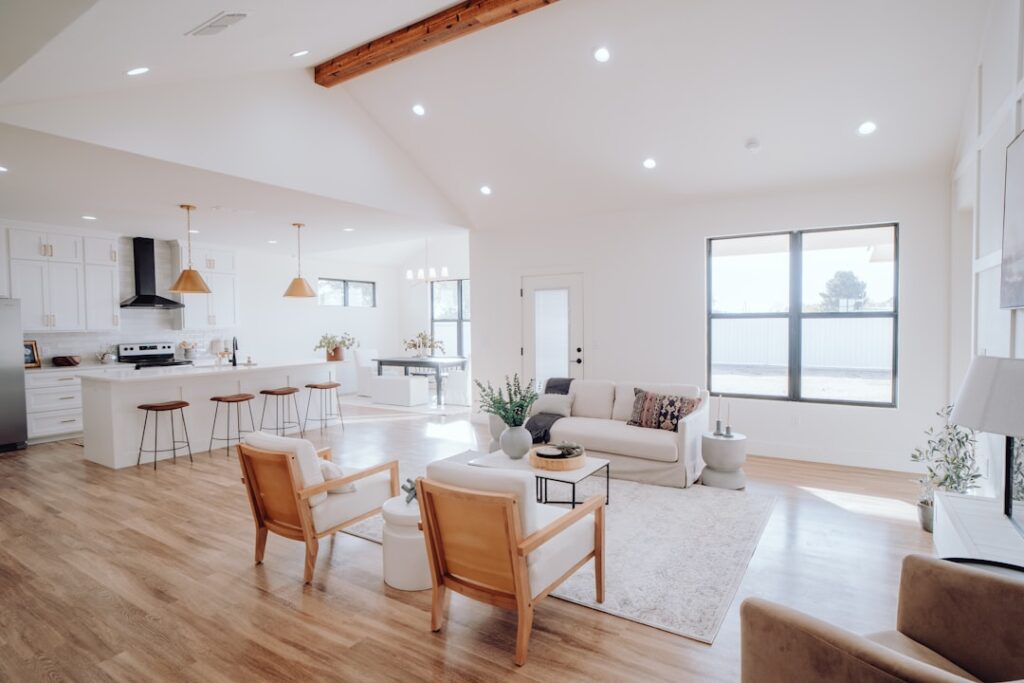
Most people pick a floor by walking a showroom, falling for a color, and ordering it. Then they discover the wood-look they loved swells in their humid basement, or the soft carpet they chose mats down in the entry within a year. Choosing flooring well is less about taste and more about matching the right material to how each room actually gets used. Get that match right and the floor lasts decades; get it wrong and you’ll be tearing it out before the loan is paid off. Here’s the framework I use with every client.
Start With the Room, Not the Material
Every good flooring decision begins with three questions about the space: How much traffic does it see? Will it get wet? And is the subfloor concrete or wood? A second-floor bedroom and a ground-floor mudroom have almost nothing in common, even if you love the same plank in both.
Moisture is the single biggest filter. Bathrooms, kitchens, laundry rooms, and below-grade basements demand waterproof materials, which immediately rules out solid hardwood and standard laminate. Dry, low-traffic bedrooms open the field to nearly anything.
Match Material to Performance Needs
Once you know the room’s demands, the material choice narrows fast. Here’s how the main options stack up:
- Luxury vinyl plank (LVP): Waterproof, durable, $2 to $5 per sq ft. The default for kitchens, baths, and basements.
- Tile (porcelain/ceramic): Fully waterproof, extremely hard, $1.50 to $8 per sq ft. Ideal for wet rooms and high heat.
- Solid hardwood: Refinishable for decades, $6 to $12 per sq ft. Best for dry living areas and bedrooms.
- Engineered hardwood: Real wood veneer, more stable, $4 to $9 per sq ft. Works over concrete where solid wood can’t.
- Laminate: Scratch-resistant, budget-friendly, $1 to $3 per sq ft. Good for bedrooms and offices, not wet areas.
- Carpet: Soft and warm, $1 to $5 per sq ft. Best for bedrooms, stairs, and family rooms.
Weigh Durability Honestly
Durability isn’t a single number. For vinyl, the wear layer matters most: 12-mil for normal homes, 20-mil where pets and kids are hard on floors. For laminate, look at the AC rating; AC3 suits bedrooms while AC4 or AC5 handles busy hallways. Tile is rated by PEI; PEI 3 works for residential floors and PEI 4 or 5 for heavy traffic.
Be realistic about your household. Large dogs, dropped toys, and dragged furniture punish soft or thin floors. If that’s your life, spend up on the wear layer rather than the visual.
Set a Realistic Budget
The price on the sample tag is only part of the story. Budget for the full stack: material, underlayment, installation labor, old-floor removal, and trim. Professional installation typically runs $1.50 to $4.00 per square foot, sometimes more for tile or stair work.
For a 300 sq ft room, a complete project commonly lands between $1,500 and $4,000 depending on material. Always add 7 to 10 percent material overage for cuts and future repairs, and keep a few sealed boxes for matching later.
Consider Installation and Maintenance
How a floor goes down affects both cost and your DIY options. Click-lock LVP and laminate float over the subfloor and suit confident DIYers. Tile, glue-down vinyl, and nail-down hardwood are best left to pros unless you have the tools and patience.
Maintenance matters for the long haul. Smooth vinyl and tile wipe clean in minutes, hardwood needs periodic recoating, and carpet requires regular deep cleaning. Be honest about how much upkeep you’ll actually do.
Don’t Forget Comfort and Acoustics
Hard floors are easy to clean but loud and cold underfoot. If you want warmth and quiet, carpet or a WPC vinyl with attached cork backing softens both sound and temperature. In open-concept homes and apartments, a quality underlayment cuts echo and footfall noise dramatically.
Radiant heat is another factor. Tile and many engineered woods pair well with in-floor heating; solid hardwood and some vinyls have temperature limits, so check the manufacturer’s rating first.
Order Samples and Test Them
Never commit to a floor based on a showroom chip alone. Order full-size samples or at least large swatches, then live with them in the actual room for a few days. Flooring color shifts dramatically between fluorescent showroom light and the natural light of your home, and a plank that looked warm in the store can read gray or pink at home.
Lay samples next to your cabinets, trim, and furniture, and view them in morning, afternoon, and evening light. Walk on them barefoot to judge comfort and temperature. This simple step prevents the single most common flooring regret: a color or texture that looked perfect in the store and wrong the moment it was installed.
Plan for the Long Term
Think past the install date when you choose. Consider how long you’ll stay in the home, since a five-year flip calls for a different investment than a forever home. Factor in resale appeal too; neutral hardwood and quality LVP appeal to the widest range of buyers, while bold colors and niche materials can narrow your market.
Also weigh how the floor ages. Solid hardwood can be refinished several times across decades, while vinyl and laminate are replaced rather than restored once worn. Matching the material’s lifespan to your plans keeps you from over- or under-spending.
Putting It All Together
When choosing flooring, work in order: define the room’s traffic and moisture, shortlist materials that survive those conditions, then compare durability specs and total installed cost before you ever pick a color. That sequence keeps you from falling for a beautiful floor that fails in the wrong room. Order samples, view them in your own lighting, and buy a little extra. Do that, and you’ll choose a floor that still looks right ten years from now.
Prefer to explore on your own?
See how new flooring looks in your actual room in seconds — free, no signup.
Try the free Floor Studio →