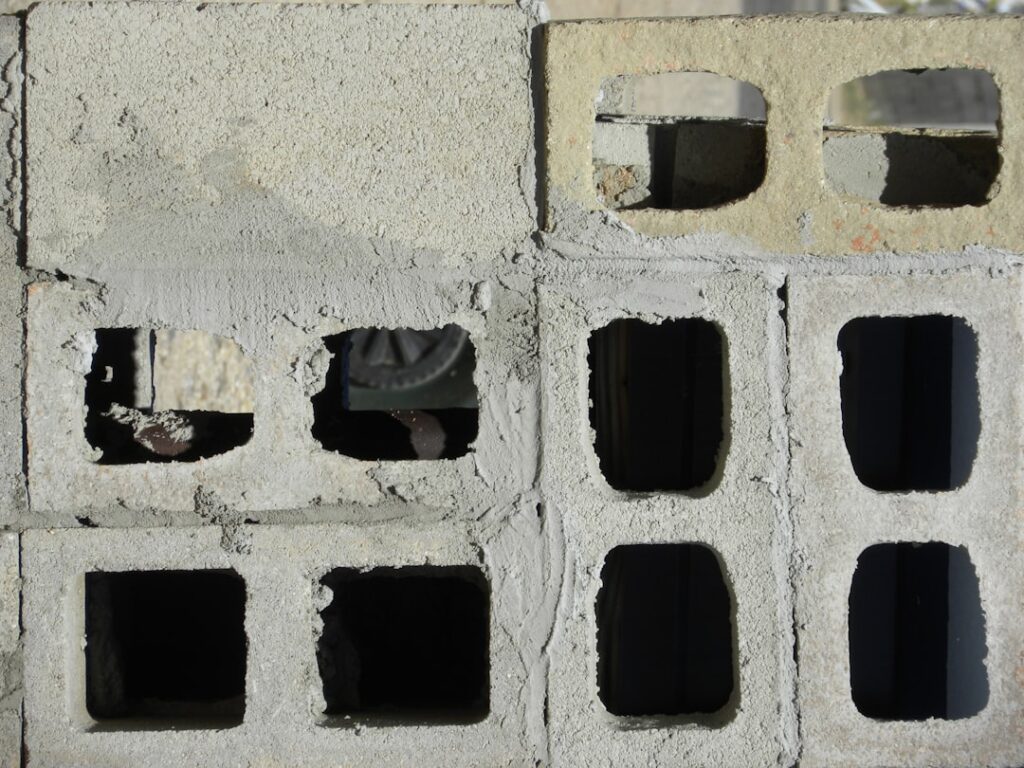
Ask for cinder blocks at any masonry yard and they will sell you concrete blocks without correcting you — but the two terms describe genuinely different materials with different weights, strengths, and code standing. The cinder block vs concrete block distinction is partly history and partly engineering: true cinder blocks used coal-cinder aggregate and mostly left production decades ago, while the modern concrete masonry unit (CMU) is a standardized structural product. Sorting out cinder block vs concrete block matters most when you are repairing an old wall, buying used block, or speccing a new structural project. Here is the full picture.
Where the Two Names Came From
Early twentieth-century block plants sat near coal-fired industry for a reason: coal cinders — the porous ash and clinker left from burning coal — were free aggregate. Blocks molded from cement and cinders were light, cheap, and everywhere from the 1920s through the 1950s, and the name stuck to the entire category. As coal byproduct supplies declined and standards tightened, plants switched to crushed stone, gravel, and sand, and the product became the modern concrete block governed by ASTM C90 (load-bearing concrete masonry units). Today “cinder block” survives as slang; virtually every gray hollow block sold in North America is a concrete CMU. Genuine cinder-aggregate block still exists in older buildings, which is exactly where the differences below become practical rather than academic.
Weight: The Number You Feel Immediately
Pick one of each up and the difference is obvious:
- True cinder block (8x8x16 nominal): roughly 20 to 26 lb — the porous cinder aggregate makes a light unit
- Modern normal-weight CMU (8x8x16): 33 to 38 lb, dense stone aggregate
- Modern lightweight CMU (8x8x16, expanded shale/clay aggregate per ASTM C331): 22 to 28 lb — the legitimate modern successor to the cinder block’s weight class
- Solid 8x8x16 concrete block: 50+ lb; 4-inch partition CMU: about 18 to 22 lb
Density classes are formalized: ASTM C90 recognizes lightweight (under 105 lb per cubic foot of concrete), medium weight (105 to 125), and normal weight (125+). Masons care because a crew laying 200 lightweight units a day is measurably faster and fresher than the same crew slinging normal weight — labor bids reflect it, and lightweight block often carries a 10% to 20% material premium that pays for itself on tall walls.
Strength: Where the Materials Separate
This is the difference that matters structurally. Modern C90 CMU must deliver a minimum net-area compressive strength of 2,000 psi, and typical production runs 2,500 to 3,500 psi, with high-strength units past 4,800 psi available for engineered work. Old cinder-aggregate blocks tested all over the map — commonly in the 700 to 1,000 psi range — with the porous aggregate also making them more absorptive, more prone to freeze-thaw spalling, and rougher on embedded fasteners. Practical translations: a modern grouted and reinforced CMU wall is an engineered structural system good for foundations, retaining walls, and multi-story bearing walls; a vintage cinder-block wall should be treated as the weaker, thirstier material it is. Anchors tell the same story — a wedge anchor rated for thousands of pounds in grouted CMU holds far less in crumbly cinder aggregate, which is why old-basement shelf projects strip out.
What Code Says
Building codes settled the argument. The IBC and IRC reference ASTM C90 for load-bearing concrete masonry, and TMS 402/602 (the masonry design standard) governs engineered masonry — all written around the modern CMU’s verified strength. Consequences worth knowing: new structural work must use compliant units, so salvaged mystery block has no place in a foundation, retaining wall, or anything an inspector will see; repairs to old cinder-block walls are generally allowed in kind for non-structural patching, but significant structural repair triggers modern-material requirements; and fire ratings are a quiet CMU advantage — an 8-inch CMU wall achieves 2 to 4-hour fire-resistance ratings depending on aggregate and equivalent thickness, which is why party walls, stairwells, and mechanical rooms are built from it. If you are evaluating an older home with light, porous, dark-flecked blocks in the basement, that is a clue to involve a structural engineer before hanging new loads on it.
Moisture, Insulation, and Durability
Porosity drives the secondary differences. Cinder aggregate soaks water like a sponge, which in freeze climates means spalling faces and crumbling webs after enough cycles — the classic flaking you see on 1940s garden walls. Modern CMU absorbs less, and below-grade it is protected properly with damp-proofing or waterproofing membrane plus drainage anyway. Thermally, the sponge cuts the other way: air-filled cinder aggregate insulates slightly better per inch (roughly R-1.7 to R-2 for an old 8-inch cinder unit versus R-1 to R-1.4 for normal-weight hollow CMU), and modern lightweight CMU recovers some of that. Nobody should count on block for R-value either way — cores get foam inserts or the wall gets continuous insulation. Sound is a CMU win: mass makes an 8-inch unit wall hit STC 45 to 55+, which is why hotels and schools still use it between rooms.
Price and Buying Guide
Current yard pricing for the standard 8x8x16: $1.80 to $3.50 per unit for normal-weight hollow CMU at big-box and masonry suppliers, $2.50 to $4.50 for lightweight, and $3 to $6 for specialty faces (split-face, burnished). Half-blocks, bond-beam, and lintel units run similar money. Installed masonry wall costs land at $15 to $45 per square foot depending on height, reinforcement, grout, and finish — a 6-foot CMU fence wall prices around $60 to $120 per linear foot in most markets. As for true cinder blocks: you cannot meaningfully buy them new, and salvaged ones belong only in non-structural garden duty. Buying used block of any kind, tap it — a clear ring means sound concrete, a dull thud means cracks — and reject anything with face spalls or powdery webs.
Working With Each: Repairs, Fasteners, and Finishes
Field handling differs enough to change your shopping list. Fastening into modern CMU is routine: Tapcon-style concrete screws (3/16 or 1/4-inch) hold light duty in face shells, sleeve anchors handle mid-range, and anything structural belongs in a grouted cell with wedge anchors or epoxy (Hilti HIT or Simpson SET epoxy holds 5,000+ lb in solid-grouted block). In genuine cinder block, downgrade every expectation: the soft aggregate crumbles around expansion anchors, so use toggle bolts spanning the hollow cores or epoxy anchors with oversized holes, and test-load before trusting a shelf or TV mount. Cutting is the same story — a diamond blade walks through old cinder units noticeably faster, and they snap cleaner with a brick hammer, while dense modern block wants the wet saw for tidy cuts. For repairs to spalling cinder-block walls, rake loose material, treat with a masonry consolidant, and parge with Type S mortar or a polymer-modified surface-bonding cement (0.375-inch coat) — it buys 15 to 20 years on a garden wall. Painting either material starts with efflorescence removal and a masonry primer; on below-grade cinder block, skip non-breathable coatings entirely, because trapped vapor pops paint film off porous block within two winters.
Which Term Should You Use, and When It Matters
For everyday conversation, use them interchangeably — everyone does, and the yard will hand you C90 CMU regardless. Use the precise language in three situations: describing an older structure to an engineer or inspector (“1950s cinder-aggregate block” tells them to expect low strength and high absorption); writing or reading specs, where “CMU per ASTM C90” is the phrase that makes a wall enforceable; and assessing repairs, where matching modern block into a genuine cinder-block wall means accounting for different unit sizes (old blocks vary from the modern 7-5/8-inch actual dimensions) and different movement behavior. The practical bottom line: modern concrete block is stronger, heavier, code-recognized, and cheap at $2 a unit; the cinder block is mostly a ghost — but a ghost that still holds up a lot of mid-century basements, and one worth identifying correctly before you trust it with new loads.