Roughly 90 percent of the laminate sold in the United States today uses a glueless locking system, and click lock laminate flooring is the reason a confident homeowner can finish a bedroom in a single weekend. Instead of troweling adhesive, you angle one plank into the next and press down until the milled edges snap together. The result is a floating floor that goes down fast, comes up cleanly, and forgives the small mistakes that sink glued-down projects.
That convenience has made click systems the default at D and G Flooring’s most common project: the do-it-yourself room refresh. But click lock is not magic, and understanding how the joint works helps you avoid the handful of failures that frustrate beginners. Here is a plain-language look at how it performs, what it costs, and how to buy the right product.
How Click Lock Laminate Works
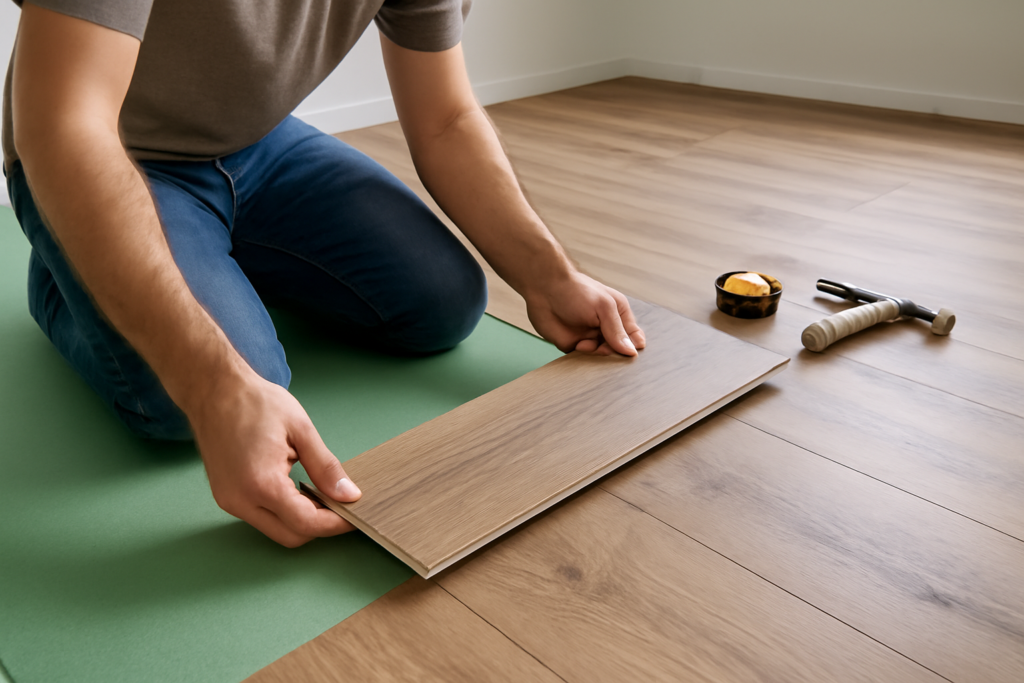
Each plank has a machined tongue on two sides and a matching groove on the other two. Two main joint styles dominate the market. The angle-angle system asks you to tilt the plank into the row, then tilt it down into the end joint. The angle-tap, or drop-lock, system lets you set the long side at an angle and tap the short end flat with a tapping block. Both create a mechanical seam that resists separation without any glue.
Because the floor is not fastened to the subfloor, it floats as one connected sheet on top of an underlayment pad. This lets the whole field expand and contract with seasonal humidity, which is why installers leave a 1/4-inch to 3/8-inch gap around every wall.
Pros of Click Lock Laminate Flooring
The advantages explain the category’s popularity:
- Fast, glueless installation: A motivated DIYer can lay 200 to 300 square feet in a day with basic tools.
- No drying time: You can walk on the floor and move furniture back the same day, unlike glued or nailed floors.
- Removable and reusable: Planks unclick in reverse, so you can replace a damaged board or take the floor with you when renting.
- Forgiving for beginners: If a seam is not seated, you can lift and reset it instead of fighting cured adhesive.
- Lower labor cost: Skipping professional installation can save $1 to $3 per square foot in labor.
The locking edges also tend to produce tight, even seams because the geometry self-aligns the planks. That precision is hard to match with a glued floor laid by an amateur.
Cons and Trade-Offs
No floor is perfect, and click lock has real limits. The joints depend on a flat subfloor. Most manufacturers specify no more than 3/16 inch of variation over a 10-foot span. On a wavy slab, the planks flex at the seams as you walk, and over time that movement can pop a joint or wear the locking edge. Self-leveling compound fixes the subfloor but adds cost and effort.
Moisture is the second weakness. Standard laminate has a fiberboard core that swells if water sits in a seam, and the click joint does nothing to keep water out. Kitchens and bathrooms call for a water-resistant or waterproof laminate rather than a basic product. Even then, standing water should be wiped up quickly.
Finally, cheaper planks use shallow or brittle locking profiles that can chip during installation or separate under heavy furniture. You usually get what you pay for in joint quality, so the bargain bin is a gamble.
Cost and What Affects Price
Click lock laminate generally runs $1 to $5 per square foot for the material, with most quality residential products landing between $2 and $4. Several factors push the number up or down: wear-layer thickness measured in mils, plank thickness from 7mm to 12mm, the realism of the printed surface, and water-resistance ratings. Thicker planks with deeper textures and tighter locking systems cost more but feel more solid underfoot and tolerate imperfect subfloors better. Budget another $0.30 to $0.60 per square foot for underlayment if it is not pre-attached.
How to Buy the Right Click Lock Laminate
Use these checkpoints when you compare products:
- AC rating: Choose AC3 for normal residential rooms and AC4 or higher for busy households with pets and kids.
- Thickness: Pick 10mm to 12mm if you want a quieter, more substantial feel, especially over a less-than-perfect subfloor.
- Water resistance: For kitchens, entryways, and baths, confirm a water-resistant or waterproof rating before you buy.
- Attached underlayment: Planks with a foam pad already bonded to the back save a step and reduce squeaks.
- Warranty: A long residential wear warranty signals confidence in the wear layer, though read the conditions carefully.
Order 7 to 10 percent extra to cover cutting waste and future repairs, and check that every box shares the same lot number so the color and finish match.
Installation Basics
Acclimate the planks in the room for 48 hours, then verify the subfloor is clean, dry, and flat. Roll out underlayment if needed, and start your first row along the longest straight wall with spacers holding the expansion gap. Stagger end joints by at least 8 to 12 inches from row to row so seams do not line up and weaken the field. Work in the direction the locking profile favors, and use a tapping block and pull bar to seat the final pieces. Reinstall baseboard or quarter round to hide the perimeter gap, but never pin it down through the laminate.
Is Click Lock Laminate Right for You
If you want an affordable, attractive floor you can install yourself in a weekend, click lock laminate is one of the strongest choices on the market. It rewards a flat subfloor and patient layout, and it lets you swap a damaged plank years later without tearing up the room. The main cautions are moisture and subfloor flatness, both of which you can plan around. For most living rooms, bedrooms, and offices, D and G Flooring considers click lock laminate a dependable, budget-friendly option that delivers a clean result without the mess of glue or the cost of a professional crew.
Prefer to explore on your own?
See how new flooring looks in your actual room in seconds — free, no signup.
Try the free Floor Studio →