Coastal backsplash tile turns an ordinary kitchen wall into a piece of the shoreline, trading sterile white subway for the soft blues, sandy neutrals, and iridescent sheen you feel on a good beach day. Choosing the right coastal backsplash tile is less about copying a catalog photo and more about layering color, texture, and light the way the coast itself does. I have installed everything from hand-glazed sea-glass mosaics to weathered whitewashed subway in oceanfront homes, and the projects that age gracefully all share a few smart material and design choices. Here is how to get the look without it feeling like a theme restaurant.
The Coastal Color Palette
Coastal style lives in a specific band of the color wheel. Think seafoam and aqua, deep marine blue, pale seaglass green, driftwood gray, sand beige, and crisp shell white. The trick is restraint: pick one hero color and let neutrals carry the rest. A wall of saturated cobalt reads bold and modern; the same cobalt used as a 20 percent accent among whites and grays reads breezy and timeless.
Watch your undertones. Warm sandy neutrals pair with greens and soft aquas for a Gulf Coast or Mediterranean feel, while cooler grays and steel blues lean New England or Pacific Northwest. Hold samples against your countertop and cabinets in daylight before committing, because coastal blues shift dramatically under warm LED bulbs.
Materials That Capture the Shoreline
Material does the heavy lifting in a coastal kitchen. A few standouts:
- Sea-glass tile: Recycled or cast glass with a frosted, tumbled finish that glows like beach glass. Runs $15 to $35 per sq ft.
- Mother-of-pearl (capiz) mosaic: Real iridescent shell on mesh sheets; shimmers and shifts with the light. Premium at $25 to $50 per sq ft.
- Fish-scale (mermaid) tile: Fan-shaped ceramic or glass that mimics scales and waves. About $12 to $28 per sq ft.
- Whitewashed or handmade subway: Ceramic with irregular glaze and visible brush texture for a weathered, driftwood vibe. $8 to $20 per sq ft.
- Pebble and stone mosaic: Smooth river or beach stones on mesh for a tactile, organic backsplash. $10 to $25 per sq ft.
Glass and shell reflect light and read airy, which suits coastal spaces. Matte ceramic and stone add grounding texture so the room does not feel glassy or cold.
Fish-Scale and Wave Patterns
Few shapes say “coast” faster than fish-scale, also sold as mermaid or scallop tile. Set in a graduated blue, from deep at the counter fading to pale near the upper cabinets, it mimics the way water lightens toward the surface. That ombre effect is stunning but demands planning: lay out the full run dry on the floor first, blending boxes so color transitions are gradual rather than blotchy.
Fish-scale tiles are usually 2 to 3 inches wide and interlock, so a wet saw with a glass blade handles the curved cuts at edges. Because the profile is busy, keep grout lines thin and color-matched so the scale shape, not the joints, carries the eye.
Making a Small Coastal Kitchen Feel Bigger
Light, reflective materials are a coastal designer’s secret weapon in tight kitchens. Glossy sea-glass and mother-of-pearl bounce daylight deep into the room, and a pale aqua or shell-white field visually pushes the walls back. Running a glossy subway horizontally widens a narrow galley; stacking it vertically lifts a low ceiling.
Keep the palette tight and the contrast gentle. High contrast between tile and grout chops a small wall into a grid; a soft, tonal grout lets the surface read as one calm plane, which is exactly the serene feeling coastal design chases.
Design Tips From the Field
A backsplash never stands alone, so tie it to the rest of the room. A handful of rules I lean on:
- Repeat a hardware or fixture finish. Brushed nickel or unlacquered brass reads nautical and links the tile to the sink and pulls.
- Balance shine. If the tile is glossy glass, ground it with a matte quartz or butcher-block counter so the space does not glare.
- Let one thing be the star. Reserve mother-of-pearl or an ombre fish-scale for a focal wall behind the range, and use plain subway elsewhere to control cost and busyness.
- Mind the grout. Bright white grout with blue tile screams beach cottage; a greige grout keeps it sophisticated.
Whitewashed Subway and the Weathered Look
Not every coastal kitchen wants shimmer. For a relaxed, sun-bleached cottage feel, whitewashed and handmade subway tile is the quiet workhorse of the style. The irregular glaze, visible brush marks, and slight color variation from tile to tile evoke weathered driftwood and salt-worn paint far better than a flat, machine-perfect white.
Look for tiles described as handmade, crackle-glaze, or “cottage” finish, usually 3 by 6 or 4 by 4 inches. Pair them with a soft gray or sandy grout rather than stark white to deepen the aged effect. This is also the budget-friendly heart of coastal design: you can cover a whole kitchen in convincing weathered subway for a fraction of what shell or glass costs, then add a small accent of something special.
Pairing Tile With Counters and Cabinets
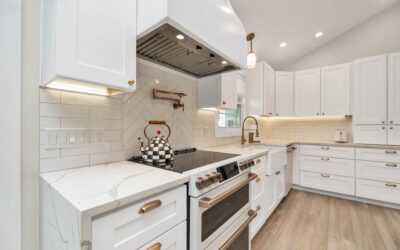
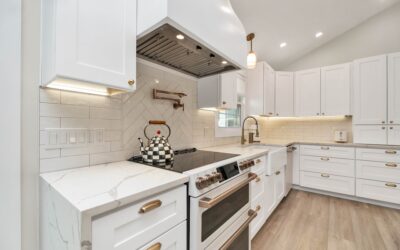
Coastal palettes fall apart when the finishes fight each other, so plan the whole surface story together. Weathered white or gray-painted cabinets are the classic base, letting a blue or sea-glass backsplash sing. Natural wood open shelving adds warmth and reads like driftwood. For counters, white quartz, honed marble, and light butcher block all keep the mood airy.
Bring in one metallic thread and repeat it. Unlacquered brass or aged bronze fixtures nod to ship hardware, while brushed nickel keeps things cool and modern. Whatever you choose, echo it in the cabinet pulls and faucet so the eye reads the room as one calm, cohesive coastal composition rather than a collection of beachy pieces.
Installation and Sealing Notes
Most coastal materials install like standard tile, but a few need extra care. Mother-of-pearl and natural stone are porous and stain, so seal them with a penetrating sealer before grouting and again after, and never clean them with vinegar or acidic products, which etch shell and marble. Glass mosaics need a white polymer-modified thinset that will not show through the translucent tile, spread with a 3/16-inch trowel and knocked flat to avoid trowel-line shadows.
Use unsanded grout on glass and polished shell to avoid scratching, and sanded grout only where joints exceed 1/8 inch on ceramic or stone. Let thinset cure a full 24 to 48 hours before grouting so trapped moisture does not fog glass tiles from behind.
What Coastal Backsplash Tile Costs
Budget flexes widely with material. A whitewashed ceramic subway backsplash can be done for $8 to $12 per square foot in materials, while mother-of-pearl and hand-cast sea glass push $50 per square foot. Professional installation adds $10 to $25 per square foot, with mosaics and shell at the higher end because they demand more careful setting and sealing.
For a typical 30-square-foot kitchen, expect anywhere from $600 for simple whitewashed subway to $2,800 for a premium shell-and-glass feature wall, installed. A smart middle path is a field of affordable coastal subway with a single accent band of sea glass, which delivers the shoreline feel for well under $1,000. However you mix it, coastal backsplash tile is one of the most reliable ways to make a kitchen feel bright, calm, and a little closer to the water.
Prefer to explore on your own?
See how new flooring looks in your actual room in seconds — free, no signup.
Try the free Floor Studio →