Walk any industrial park and you’re looking at the two competing philosophies of commercial metal roofing: screw-down R-panel roofs on the older warehouses, and clean-lined standing seam on everything built or re-roofed in the last fifteen years. Both are steel, both can run 40-plus years, and they behave completely differently at the details that matter — fasteners, thermal movement, slope limits, and lifetime maintenance cost. This guide covers the commercial-specific decisions: which panel system fits which building, what retrofit options exist over an existing roof, and what the numbers look like per square foot. For material basics that apply to any building — steel gauges, coatings, aluminum vs. steel — see our metal roofing guide; and for how metal stacks up against membrane systems on flat commercial buildings, our commercial roofing overview compares the full menu.
- Standing Seam: The Premium Commercial System
- R-Panel and Exposed-Fastener Systems: The Value Play
- Retrofit: Putting Metal Over the Roof You Already Have
- Energy, Wind, and Insurance Numbers That Sell Projects
- What Fails, and the Maintenance That Prevents It
- Insulation and Condensation: The Detail That Bites Metal Buildings
- Choosing: A Two-Minute Decision Tree
Standing Seam: The Premium Commercial System
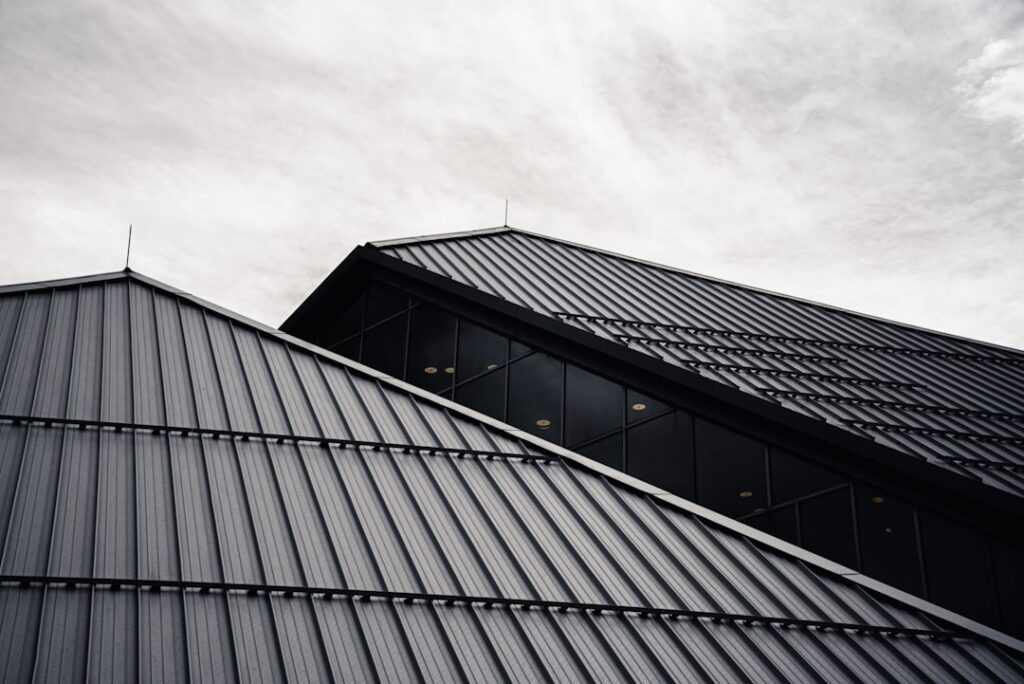
Standing seam panels join at raised vertical ribs, with clips or integral legs that fasten to the structure underneath the panel — no screw penetrates the weather surface anywhere in the field. Two consequences flow from that design. First, water has no fastener holes to find, which is why standing seam carries weathertightness warranties (20 years is standard on engineered systems) that exposed-fastener roofs can’t offer. Second, concealed clips let each panel float as it expands and contracts — a 100-foot steel panel moves close to an inch across a Midwest temperature year, and standing seam absorbs that movement instead of wallowing out screw holes.
Commercial specifiers split the category by seam type: snap-lock profiles (fast install, 3/12 minimum slope) and mechanically seamed profiles, field-crimped to 90 or 180 degrees, which are rated down to 1/2/12 and even 1/4/12 — low enough to replace membrane on many “flat-looking” commercial roofs. Panels run 24 to 22 gauge steel or 0.032 to 0.040 aluminum with PVDF (Kynar 500) finishes warrantied 30 to 40 years against chalk and fade. Installed cost: $9 to $16 per sq ft on typical commercial work, more with heavy gauge, complex penetrations, or high-rise staging.
R-Panel and Exposed-Fastener Systems: The Value Play
R-panel (and its cousins PBR panel and corrugated ag panel) is the 36-inch-wide ribbed sheet screwed straight through the panel face into purlins with gasketed self-drilling fasteners — the default skin on pre-engineered metal buildings from Butler, Nucor, and the like. Its virtues are real: $4.50 to $8 per sq ft installed, fast coverage on big simple rectangles, and easy panel replacement after forklift or hail damage. The liability is the fastener population. A 50,000 sq ft R-panel roof carries roughly 35,000 to 50,000 screws, every one a gasket that UV-ages and a hole that enlarges as panels thermally cycle against fixed fasteners. Plan on a fastener audit around year 10 to 15, replacing backed-out screws with oversized #14s, and understand that most chronic metal-building leaks are fastener and lap-seam leaks, not panel failures. Minimum slope for exposed-fastener systems is 3/12 by most manufacturers’ literature — 1/2/12 lap-sealed installs exist, and they keep repair crews employed.
The honest framing for an owner: R-panel buys the lowest first cost and accepts scheduled maintenance; standing seam buys the lowest 40-year cost and near-zero fastener liability. On buildings the owner intends to hold long-term, the spread usually favors the seam.
Retrofit: Putting Metal Over the Roof You Already Have
The fastest-growing slice of commercial metal work isn’t new construction — it’s recover, and it comes in two distinct forms.
Metal-over-metal recover
An aging R-panel roof can be re-covered without tear-off using sub-purlins or notched foam spacer blocks that bridge the old ribs, with new standing seam installed above and — the smart upgrade — new fiberglass or board insulation filling the cavity. The building stays dry and operational throughout, tear-off and disposal costs disappear, and the added insulation often cuts HVAC loads noticeably. Typical cost lands around $7 to $12 per sq ft, and engineering must verify the structure carries the extra 1 to 2 psf.
Slope-build-up over flat membrane
Retrofit framing systems (light-gauge stub columns and purlins) can convert a chronically leaking flat BUR or single-ply roof into a positively sloped standing seam roof — the permanent fix for buildings whose owners are tired of the membrane replacement cycle. It’s the most expensive path, $10 to $18 per sq ft, and on the right building it’s the last roof decision anyone makes for 40 years.
Either way, codes generally allow a maximum of two roofs on a structure, and a moisture survey of the existing assembly comes first — trapping saturated insulation under new metal locks the rot in.
Energy, Wind, and Insurance Numbers That Sell Projects
Three data points move commercial approvals. Cool-coated metal (high-reflectance PVDF colors, or bare Galvalume) meets cool-roof code requirements in most jurisdictions and trims summer cooling loads meaningfully on conditioned buildings. Engineered standing seam assemblies carry UL 580/1897 uplift ratings and hold up in design-wind zones where gravel BUR is uninsurable — coastal underwriters increasingly reward 26-gauge-plus systems with tested assemblies. And Class 4 impact-rated panels earn hail-region premium credits from many carriers, though owners should know cosmetic hail denting is usually excluded from both warranties and “functional damage” claims. Metal roofs are also the strongest solar platform in commercial roofing: S-5! style clamps attach arrays to seams with zero penetrations.
What Fails, and the Maintenance That Prevents It
Metal’s failure points are predictable and concentrated: fastener gaskets on exposed systems, sealant at laps, curbs, and ridge closures (butyl lasts decades; exposed urethane beads do not), cut-edge rust on unhemmed panel ends, dissimilar-metal contact (copper wire or treated lumber touching Galvalume), and clogged gutters holding water above lap lines. An annual walk — screws, sealant, closures, drainage, touch-up paint on scratches — costs a few hundred dollars per building and reliably converts a 40-year design life into an actual 40-year service life. When systems do reach the end, coating restoration over sound metal ($2.50 to $5 per sq ft) commonly buys another 10 to 15 years before the recover conversation starts.
Insulation and Condensation: The Detail That Bites Metal Buildings
Metal is a perfect vapor barrier at exactly the wrong temperature — panel undersides drop below dew point on clear nights, and an under-insulated metal building will literally rain indoors. New construction handles this with faced fiberglass blanket draped over purlins (R-19 to R-30 typical), rigid board above the deck on standing seam architectural systems, or a factory-laminated condensation-control fleece like DripStop on simpler structures. On recover projects, the cavity created by the retrofit framing is free real estate: filling it with unfaced fiberglass is often the cheapest R-19 a building will ever add, and it moves the condensing surface out of the occupied envelope entirely. Whatever the assembly, air-seal the ridge, eave, and panel laps against humid interior air reaching cold metal — in food processing, indoor pools, and even busy warehouses with propane forklifts (combustion makes water vapor), condensation control decides whether the roof is a success regardless of how well it sheds rain.
Choosing: A Two-Minute Decision Tree
Slope under 3/12 and staying that way? Mechanically seamed standing seam or stay with membrane. Simple big-box on a budget with in-house maintenance? R-panel, with a calendar reminder for the year-12 fastener audit. Leak-weary flat roof on a long-hold building? Price the retrofit slope build-up against the next two membrane cycles. Owner-occupied and holding 20-plus years? Standing seam wins the spreadsheet almost every time. And whichever branch you take, insist on a bidder who installs that specific system weekly — a great shingle roofer with a swaged seamer rented for your job is how 20-year metal roofs become 8-year metal roofs. The metal itself rarely disappoints; the system choice — and the details at every screw, seam, and curb — is where commercial roofs are won.