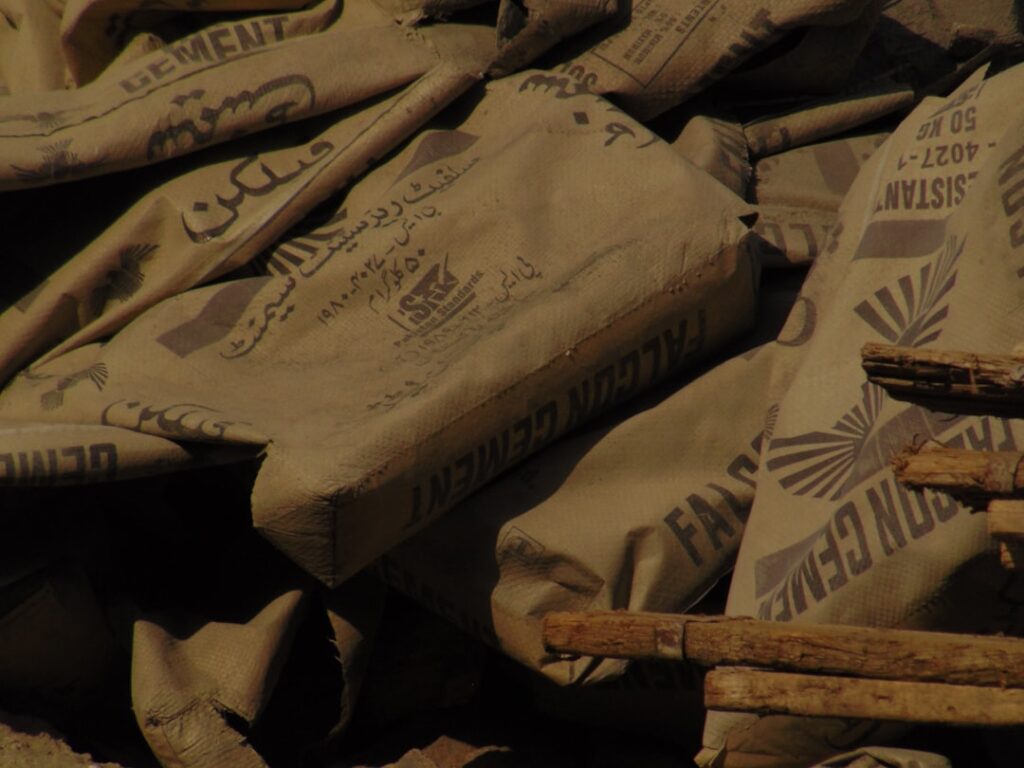
The number that matters most in the concrete aisle is printed in the fine print, not the big type: an 80-lb bag yields just 0.60 cubic feet of concrete, which means a modest 10×10 patio at 4 inches thick swallows 56 of them — over two tons of material through your truck’s suspension and your lower back. Understanding concrete bags — the types, the sizes, and above all the coverage math — is the difference between a smooth Saturday pour and a mid-project supply run with half your slab setting up. Here’s the full breakdown, with the yield tables worth screenshotting.
Bag Sizes and What Each Yields
Bagged concrete mix comes in four common sizes, and yield scales linearly at roughly 0.0075 cu ft per pound:
- 40 lb bag: 0.30 cu ft — easiest lifting, most expensive per cubic foot; 90 bags per cubic yard
- 50 lb bag: 0.375 cu ft — the common size for fast-setting mixes; 72 per yard
- 60 lb bag: 0.45 cu ft — the middle path many DIYers should choose; 60 per yard
- 80 lb bag: 0.60 cu ft — best value per cubic foot at $5–$8 a bag; 45 per yard
Price per bag at the big-box stores runs $4–$6 for a standard 60 lb, $5–$8 for an 80 lb, with specialty mixes 30 to 80 percent higher. The 80-pounder is cheapest per yield but brutal to handle in volume; if your crew is one person, the 60 lb bag costs slightly more and saves your back over a 40-bag day.
The Types on the Shelf
Quikrete and Sakrete dominate the aisle, and their lineups mirror each other. Standard gray concrete mix (cement, sand, gravel — 4,000 psi at 28 days) handles slabs, footings, and general work; the details of mix design have their own deep dive, but the bag formats sort like this:
- Fast-setting mix (Quikrete red bag, 50 lb): sets in 20–40 minutes, and for fence posts pours dry into the hole with water added on top — no mixing
- High-strength / 5000 mixes (Quikrete 5000, Sakrete 5000 Plus): 5,000 psi, more cement, workable colder — the pick for driveways, countertops, and anything structural
- Crack-resistant mix: synthetic fibers replace the need for wire mesh in 4-inch flatwork
- Sand/topping mix (no gravel): repairs and toppings under 2 inches thick where coarse aggregate won’t fit
- Mortar and masonry mixes: different animal entirely — for laying block and brick, never for slabs
Rule of thumb: match the bag to the thickness and the deadline. Under 2 inches, topping mix. Structural or cold weather, 5000. Posts, fast-setting. Everything else, the cheapest standard mix on the pallet.
Coverage Math You Can Do in the Parking Lot
Volume first: length x width x depth (in feet) = cubic feet. A 4-inch slab is 0.333 ft deep, so every square foot of 4-inch slab needs 1/3 cu ft — about one 60 lb bag per 1.35 sq ft, or one 80 lb bag per 1.8 sq ft. Worked examples:
- 3×6 ft sidewalk section, 4 in: 6 cu ft = 10 x 80 lb bags
- 10×10 patio, 4 in: 33.3 cu ft = 56 x 80 lb or 74 x 60 lb bags
- 12×20 driveway pad, 5 in: 100 cu ft = 3.7 cubic yards — that’s truck territory, not bags
- Fence post, 8 ft 4×4 in a 10-in x 30-in hole: about 1.5 cu ft after post displacement = two to three 50 lb fast-setting bags per post
Always add 10 percent for waste, spillage, and an uneven subgrade — running short mid-pour creates a cold joint, a permanent weak line where fresh concrete meets half-set concrete. Unopened bags return; missing concrete doesn’t. For odd shapes, break the footprint into rectangles and circles (a round pier is radius squared x 3.14 x depth) and total the pieces, or lean on the free bag calculators on the Quikrete and Sakrete sites, which handle slabs, posts, tubes, and curbs and output straight to bag counts by size.
Bags vs. the Ready-Mix Truck
Bags win small jobs decisively: no delivery minimums, mix at your pace, pour a post today and a step next month. But the crossover comes faster than most DIYers think. At $6 per 80 lb bag, a cubic yard costs about $270 in bags plus hours of mixing labor; ready-mix delivers a uniformly batched, plant-controlled yard for $150–$200 (plus a $75–$150 short-load fee on small orders). Past roughly one cubic yard — 45 eighty-pound bags — the truck is cheaper, faster, and stronger, since 45 separately mixed batches with eyeballed water never match plant consistency. The gray zone between half a yard and a yard comes down to site access and helpers. One more logistics note: a pallet of 42 x 80 lb bags weighs 3,360 pounds — a half-ton pickup handles about 25 bags per trip, so big bag orders should use store delivery ($20–$80) anyway.
Mixing Bags Right: Water Is the Whole Game
Bagged mix removes the proportioning guesswork but not the water discipline. An 80 lb bag of standard mix wants about 3 quarts of water — and every quart beyond spec measurably cuts final strength while increasing shrinkage cracking. Mix to a consistency that holds a ridge when you drag a hoe through it, not a soupy pancake batter that’s easier to spread. In a wheelbarrow, one person mixes about two bags per batch comfortably; a rented mixer triples the pace and improves consistency across a multi-bag pour, which is what keeps a slab uniform in strength and color. Batch identically every time — same bag count, same measured water in a marked bucket — because eyeballed water is the number-one reason DIY slabs cure blotchy. And temperature rules apply to bags exactly as to ready-mix: 40°F to 90°F for standard products, with high-early formulations extending the cold end.
Fast-Setting vs. Standard: When Each Earns Its Premium
Fast-setting mix costs a dollar or two more per bag and repays it only when time is the constraint. For fence posts and mailbox posts it’s unbeatable — pour dry, add water, plumb the post, and it’s holding in 20 to 40 minutes with no bracing overnight. For anything finished flat, it’s actively hostile: the working window is too short to screed, float, and edge properly, and a slab that sets while you’re still bull-floating is a slab you’ll be grinding later. The reverse holds for high-strength 5000-type mixes, which cost about 15 to 25 percent more than standard and are worth it anywhere the concrete works for a living — driveway aprons, footings for heavy posts, equipment pads, and any pour below 50°F, where the extra cement content helps the mix reach strength before cold stalls it. Standard mix remains right for the middle 80 percent of jobs; paying the specialty premium everywhere is just donating to the cement company.
Storage and Shelf Life
Cement is hygroscopic — it pulls moisture straight from humid air through the paper bag and hardens in place. Printed shelf life is about one year, but real-world life in a damp garage can be three months. Store bags off the concrete floor on a pallet or scrap lumber, wrapped in or covered by plastic sheeting, away from exterior walls. A bag with hard lumps that won’t crumble in your hand has partially hydrated: fine for backfill or a dog-proof fence post, unfit for anything structural. Buy for the project at hand, not for the someday pile — at $6 a bag, stockpiling saves nothing and the mix degrades while you wait. Get the count right with the math above, add the 10 percent, and the pallet of concrete bags you bring home will match the slab you finish — with two spares left over for the fence post that always comes next.