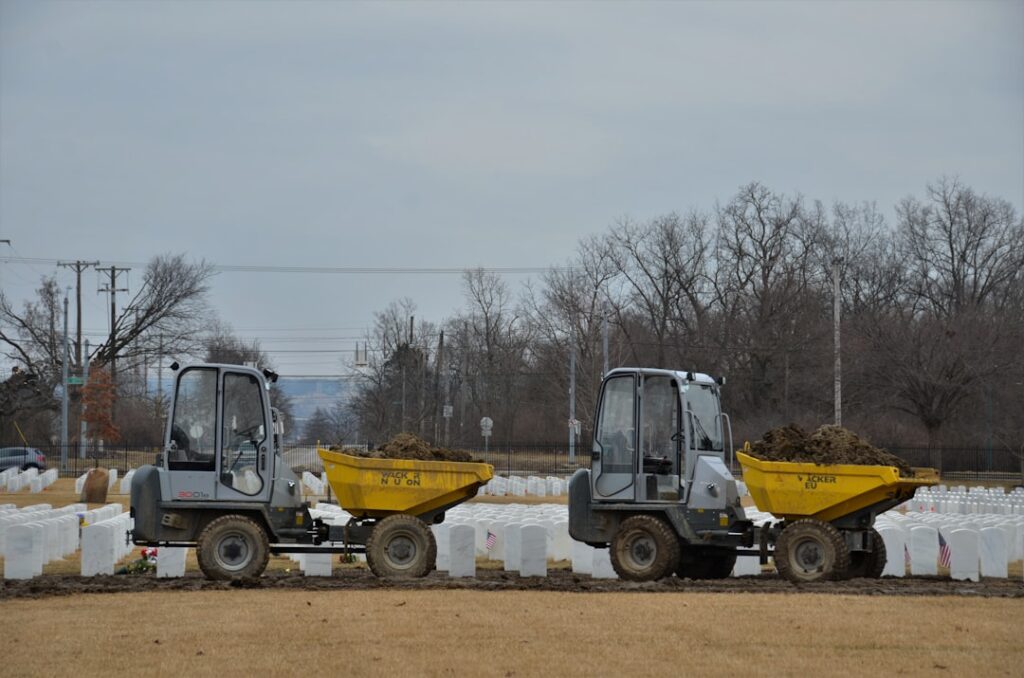
A crew of three pushing wheelbarrows can move about a yard of concrete in 25 minutes — and the ready-mix truck’s standby meter starts charging around minute 40. That gap is exactly why concrete buggy rental exists. A power buggy carries 6 to 12 times what a wheelbarrow holds, crosses 200 feet of rough ground in under a minute, and turns a brutal backyard pour into a manageable one. Rental rates run $150 to $350 per day depending on size and drive type, which is cheap insurance against overtime charges, a burned-out crew, and a slab that sets up before you can finish it. Here’s how to size one, what it costs, and when a buggy beats the alternatives.
What a Concrete Buggy Actually Is
A concrete buggy — also called a power buggy or georgia buggy — is a motorized tub on wheels or tracks built to shuttle wet concrete from the truck chute to the pour. The operator stands on a platform at the rear (ride-on models) or walks behind smaller units, steering with handlebar controls. Pull a lever and the tub hydraulically dumps forward, placing a third of a yard or more exactly where you need it.
Modern buggies come from a handful of dominant manufacturers: Toro’s MB TX 2500 tracked buggy, the Whiteman-Multiquip WBH-16 series, Terex, and Canycom’s tracked crawlers. Wheeled models ride on wide turf tires that are surprisingly gentle on finished lawns; tracked models spread weight even further and climb slopes up to about 20 degrees without losing footing. Gas engines in the 9 to 13 horsepower range power most units, though battery-electric buggies like the Toro eMB series have entered rental fleets for indoor and noise-restricted work.
Buggy Sizes and Capacities
Sizing matters more than any other rental decision, because an oversized buggy won’t fit through your gate and an undersized one turns the job into a relay race. Common classes:
- Walk-behind, 6-8 cubic feet: about a quarter yard per trip, fits a 30-inch doorway. Good for interior work and tight side yards
- Ride-on wheeled, 12-16 cubic feet: the workhorse class. A 16 cu ft unit hauls roughly 0.6 yards, or 2,500 pounds, per trip and needs a 36 to 44 inch opening
- Ride-on tracked, 16-25 cubic feet: up to nearly a full yard per trip. Best on mud, sand, slopes, and torn-up sites where wheels would trench
Run the trip math before you book. A 10-yard pour with a 16 cubic foot buggy is 17 round trips. At a 200-foot haul distance, each cycle — load, travel, dump, return — takes 3 to 4 minutes, so plan on an hour of hauling and keep two finishers working the slab while one operator runs the buggy. For pours above 15 yards or hauls beyond 400 feet, a second buggy or a pump starts to make more sense.
Concrete Buggy Rental Costs
Pricing follows size and drive type. Typical 2026 rates from national chains like Sunbelt, United Rentals, and Home Depot Tool Rental, plus independent yards:
- Walk-behind wheeled: $100-$180 per day, $400-$600 per week
- Ride-on wheeled (12-16 cu ft): $150-$250 per day, $500-$800 per week
- Ride-on tracked (16-25 cu ft): $220-$350 per day, $700-$1,100 per week
Four-hour half-day rates exist at many branches — usually 60 to 70 percent of the day rate — and they’re often all a residential pour needs. Budget for extras: a damage waiver adds 12 to 15 percent, delivery and pickup runs $75 to $150 each way if the buggy won’t fit in your truck bed or trailer, and you’ll return it with a full gas tank or pay a refueling premium. Always ask whether the rate includes cleaning; returning a buggy with concrete cured in the tub can trigger a $100 to $300 cleaning fee, which is pure profit for the store and pure carelessness on your part.
Buggy vs Wheelbarrow vs Pump
Every placement method has a break-even point. Wheelbarrows are free if you own them, but a 6 cubic foot contractor barrow moves only about 2 cubic feet of wet concrete per realistic load once you account for what a person can actually push — call it 350 pounds. Moving 5 yards means 65 to 70 barrow trips split among your crew. Under 2 yards with a short haul, wheelbarrows win. From 2 to 15 yards with hauls up to 300 feet, the buggy is the sweet spot: one operator replaces three barrow pushers and the truck empties before standby charges kick in.
Above that, look at a line pump. A trailer-mounted pump with 200 feet of hose costs $800 to $1,200 for a half day including the operator, places concrete continuously at 30 to 50 yards per hour, and reaches spots no buggy can — over fences, through the garage, down a slope to a walkout basement. If access requires crossing finished landscaping you can’t damage, or the pour exceeds 15 yards, the pump’s higher price usually buys you a better slab because the concrete goes down fast and gets finished on schedule.
Operating a Power Buggy Safely
Rental counters hand these machines to first-timers every weekend, and the same mistakes repeat. A loaded 16 cubic foot buggy weighs over 3,000 pounds and steers from the rear, which feels backwards for the first ten minutes — practice empty before the truck arrives. Keep the tub low and your speed down on turns; a top-heavy buggy with liquid load sloshing can tip on a surprisingly gentle side slope. Ride-on platforms flip up on most models so the machine can’t roll over onto a standing operator, but never jump off a moving unit.
Plan your haul road. Lay 3/4-inch plywood over finished concrete, soft lawn, and septic areas — turf tires are kind, but 17 loaded passes over the same wet ground will rut anything. Dump with the buggy square to the pour, not angled across a slope. And rinse the tub between loads on hot days; at 90°F, concrete builds up fast on the tub walls, robbing capacity and adding cured weight you’ll chip out later.
Renting Smart: Timing and Checklist
Reserve the buggy two to three days ahead in pour season — Saturday mornings clean out rental fleets from April through October. Pick it up the afternoon before if the store allows same-price overnight pickup, which many do; that gives you time to test controls and stage plywood before a 7 a.m. concrete delivery. Confirm gate and door widths against the machine’s spec sheet, not your memory. A “36-inch” gate is often 34 inches between hinge hardware, and the most common rental-day disaster is a buggy that doesn’t fit the access path.
At the counter, check four things: tub dumps smoothly through its full travel, tires or tracks hold pressure and tension, throttle and deadman controls respond, and the hour meter reading matches the contract. Photograph the machine from all four sides. When the pour ends, wash the tub immediately — cured concrete is a chisel job — and return it fueled. Treated this way, a buggy rental is the cheapest labor you’ll ever hire.
Transporting the Machine
Getting the buggy home is its own line item. Walk-behind units fit a full-size pickup bed with ramps and weigh 600 to 900 pounds empty; ride-on models run 1,100 to 1,900 pounds and want a landscape trailer with a 3,500-pound axle and solid ramps — check your hitch rating and strap the machine at four points, because a buggy rolling in transit is a totaled trailer. No trailer? The store’s $75-$150 each-way delivery starts looking cheap, and delivered machines arrive fueled and checked. Schedule delivery for the afternoon before the pour so a late truck can’t hold your concrete hostage.
Is a Buggy Rental Worth It?
For the classic homeowner scenario — a 6 to 10 yard backyard patio or shed slab, 150 feet from the street, one Saturday to get it done — concrete buggy rental at $150 to $250 is one of the best line items in the budget. It saves two laborers at $200 or more each, avoids $75 to $150 in truck standby, and gets the mud placed while it’s still workable. Skip it only when the chute reaches the forms, the pour is under 2 yards, or the site demands a pump. Everything in concrete work is a race against the set time, and the buggy is how small crews win that race.