Most people buy exactly the wrong blade for their material, and the blade punishes them for it — either by wearing out in twenty feet of cutting or by glazing over and refusing to cut at all. Concrete diamond blades are not interchangeable commodities; the bond hardness, rim style, and diamond concentration are engineered for specific materials and saw types. A $40 blade matched correctly to cured concrete will outperform a $150 blade matched wrong. Understanding a few core specs turns blade shopping from guesswork into a two-minute decision.
- How Diamond Blades Actually Cut
- The Golden Rule: Match Bond to Material Hardness
- Rim Styles: Segmented, Turbo, and Continuous
- Wet vs. Dry Cutting
- Sizing the Blade to Your Saw
- What to Pay and What You Get
- Cutting Technique That Preserves the Blade
- Renting vs. Buying the Saw Around the Blade
- When to Retire a Blade
How Diamond Blades Actually Cut
A diamond blade does not slice concrete the way a wood blade slices lumber. It grinds. Industrial diamonds are held in a metal bond matrix around the rim, and as the blade spins at 6,000 to 15,000 surface feet per minute, exposed diamond crystals scratch away material. As each diamond dulls and fractures, the bond wears back to expose fresh diamonds beneath. This controlled erosion is the whole trick: the bond must wear at the same rate the diamonds dull. Too hard a bond and dull diamonds stay trapped on the surface — the blade glazes and stops cutting. Too soft a bond and sharp diamonds fall out early — the blade cuts fast but dies young.
The Golden Rule: Match Bond to Material Hardness
The rule is counterintuitive but absolute: hard materials need soft bonds, and soft or abrasive materials need hard bonds. Cured concrete over 30 days old, especially with hard aggregate like quartz or trap rock, is hard on diamonds, so it needs a softer bond that releases fresh diamonds quickly. Green concrete less than 48 hours old, concrete block, and asphalt are soft but wildly abrasive — the sandy slurry they generate eats bond material — so they need a hard bond that resists erosion.
- Cured concrete, hard aggregate: soft bond blade
- Green concrete, block, brick, asphalt: hard bond blade
- Reinforced concrete with rebar: soft-to-medium bond with high diamond concentration
- Mixed or unknown materials: general-purpose medium bond
Manufacturers print the intended material on the blade or box. Trust that label over price. Running an asphalt blade in cured concrete glazes it in minutes; running a cured-concrete blade in asphalt can consume the entire rim in a single driveway job.
Rim Styles: Segmented, Turbo, and Continuous
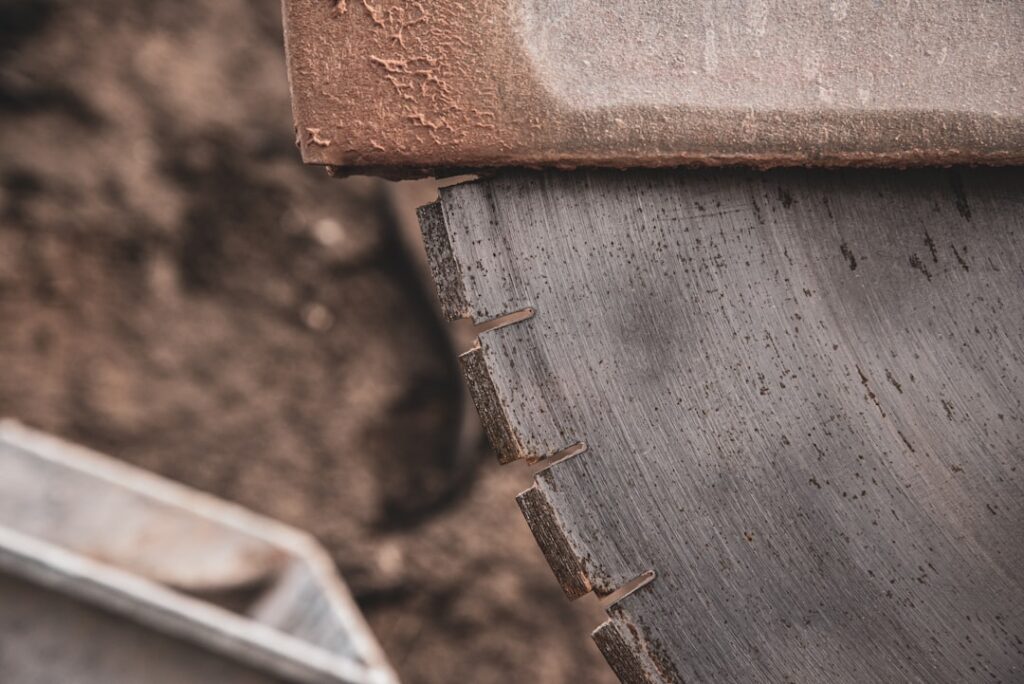
Segmented blades have distinct diamond segments separated by gullets — the slots that clear slurry and cool the core. They cut fastest, run coolest dry, and leave a slightly rougher cut. This is the default choice for slab cutting, footings, and demolition work. Turbo rim blades have a continuous, serrated rim that pushes air and debris out while cutting; they cut nearly as fast as segmented blades but noticeably smoother, which makes them the pick for visible cuts in patios, pavers, and decorative concrete. Continuous rim blades, common in tile work, cut slowest but chip-free; on concrete they only make sense for polished or architectural surfaces where edge quality trumps speed.
Segment height tells you how much blade life you are buying. Economy blades carry 7 to 8 mm segments; premium blades carry 10 to 12 mm and often list “12 mm segment” prominently. Roughly speaking, a 12 mm blade delivers 40 to 50 percent more cutting footage than an 8 mm blade of the same quality.
Wet vs. Dry Cutting
Water does three jobs: it cools the core, flushes slurry from the kerf, and kills silica dust at the source. Wet cutting extends blade life dramatically — often double — and is mandatory for walk-behind saws making deep cuts. Dry-rated blades use laser-welded segments and heat-resistant cores so they can run without water, but they still need to cut in short passes with free-spin breaks to shed heat. Never run a wet-only (silver-brazed) blade dry; the heat can debond a segment and turn it into shrapnel at 12,000 RPM.
Dust is the other reason to cut wet. OSHA’s silica rule (Table 1) effectively requires either water delivery or a shrouded vacuum with a HEPA filter when cutting concrete on the job. For a homeowner cutting a slab in the driveway, a $15 garden-hose attachment on a rented wet saw is cheaper and more pleasant than working in a respirator inside a dust cloud.
Sizing the Blade to Your Saw
Match blade diameter and arbor to the tool, and check the maximum RPM rating stamped on the blade against the saw’s spindle speed. Common setups:
- 4.5 in.: angle grinders — tuckpointing, small notches, up to about 1.5 in. deep
- 7 in.: larger grinders and circular saws — cuts to about 2.5 in.
- 12 to 14 in.: gas cut-off saws (Stihl, Husqvarna) — cuts to 4 or 5 in.
- 14 to 20 in.: walk-behind saws — control joints and full-depth slab cuts
Cutting depth maxes out at just under the blade radius minus the arbor flange, so a 14-inch blade realistically gives you 4.5 to 5 inches. Cutting a 6-inch slab means flipping the slab logic: score full-depth passes from one side, then break the web with a sledge, or step up to a bigger saw.
What to Pay and What You Get
A 7-inch economy segmented blade costs $15 to $25 and suits a homeowner making a handful of cuts. Mid-grade 14-inch blades from Diablo, Makita, or DeWalt run $50 to $90 and handle a full residential project — a driveway section, a trench for plumbing, a set of control joints. Professional blades from Husqvarna, Hilti, or MK Diamond at $120 to $250 buy laser-welded 12 mm segments, tensioned cores that track straight, and cutting life measured in thousands of linear feet. If you cut concrete monthly or more, cost per foot strongly favors the premium blade; the economy blade only wins for one-off jobs.
Cutting Technique That Preserves the Blade
Let the blade’s weight and RPM do the work. Forcing the cut overheats the core, wears the bond unevenly, and can warp the blade so it wobbles — a warped blade is scrap. Make deep cuts in multiple passes of 1 to 2 inches rather than burying the blade in one plunge. Keep the saw moving; dwelling in one spot builds heat fast. On dry cuts, back the blade out every 30 to 45 seconds and let it free-spin for ten seconds to cool. If a blade stops cutting and starts skating, it has glazed: dress it by making a few cuts into an abrasive material like a cinder block or a dressing stone, which erodes the bond and exposes fresh diamond.
Renting vs. Buying the Saw Around the Blade
For most homeowners, the blade decision travels with a rental decision. A 14-inch gas cut-off saw rents for $50 to $80 per day, and a walk-behind saw for $90 to $150, but pay attention to how the rental house handles blades. Some include a house blade and charge for measured wear — often by the 1/32 inch of rim consumed — which can quietly add $20 to $60 to the ticket on a long cutting day. Others rent the saw bare and let you bring your own blade. Buying your own $60 mid-grade blade and mounting it on a rented saw is frequently the cheapest path for a big one-time project, and you keep the remaining rim life for the next job. Check arbor compatibility before you leave the counter: most 14-inch saws use a 1-inch arbor with a 20 mm bushing option, and a blade that flops on the wrong arbor will wobble and self-destruct.
If you own an angle grinder, a $20 to $30 quality 4.5-inch segmented blade belongs in your kit permanently. It handles the small jobs that never justify a rental — trimming a paver, notching a block, opening a crack for repair caulk, cutting a drainage kerf — and diamond blades have no shelf-life; the rim you do not use this year cuts just as well in five.
When to Retire a Blade
Replace a blade when the segments wear down close to the core, when you spot cracks in the gullets or core, when any segment is missing, or when it develops a wobble you can see at speed. Cutting on a blade with cracked gullets risks segment loss, and a thrown segment from a 14-inch blade at full RPM is a genuine injury hazard. Check the wear line most manufacturers stamp near the rim, do a visual and flex inspection before every session, and store blades flat, dry, and off the concrete floor. A blade treated this way gives you every foot of cutting its bond was engineered to deliver.