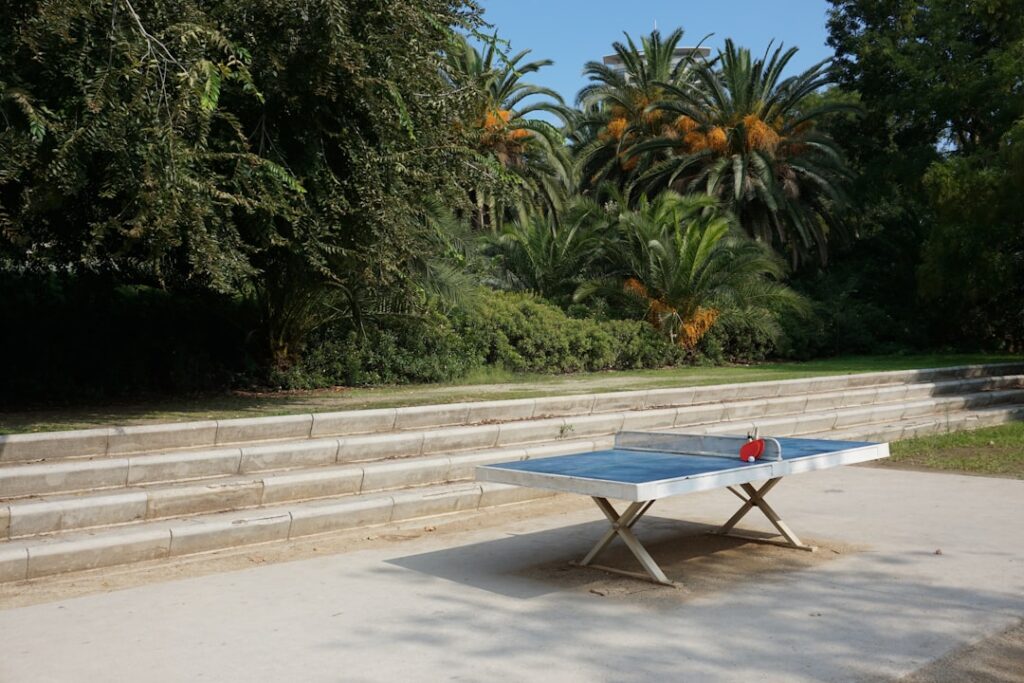
Every folding outdoor table tennis set eventually meets the same fate: warped tops, rusted wheels, and a tarp that never quite stayed on. A concrete ping pong table ends that cycle for good — it lives outside year-round, ignores rain and UV, and doubles as a dining table, buffet, or workbench when the paddles are put away. These tables have jumped from public parks into backyards, and the market now runs from $2,000 park-grade slabs to $10,000 designer pieces. Here is what actually matters when you buy one, what delivery really involves, and whether casting your own is a sane weekend project.
Why Concrete Beats Every Other Outdoor Table
Outdoor table tennis tables fail at the surface. Weatherproof folding tables use aluminum-composite or melamine tops 4 to 6 millimeters thick, and even the good ones (Cornilleau, Kettler) develop dead spots, delamination, or frame wobble after years of temperature cycling. Concrete has none of those failure modes. A sealed concrete top is dimensionally stable from 0°F to 110°F, cannot warp, and shrugs off hail, sprinklers, and the occasional kid standing on it.
Play quality is surprisingly good. A properly ground and sealed concrete surface gives a consistent, slightly faster bounce than a tournament wood table — the ITTF requires a 23-centimeter bounce from a 30-centimeter drop, and quality concrete tables meet or exceed it uniformly across the surface because there is no hollow core to create dead zones. The trade-offs are equally simple: a concrete table weighs 600 to 1,500 pounds, never folds, and never moves. You are buying a permanent piece of your landscape, not sports equipment you store.
GFRC vs. Traditional Cast Concrete
Nearly every quality table sold today uses one of two constructions, and the difference drives both price and logistics.
Traditional precast tables — the style you see in European parks and NYC playgrounds — are steel-reinforced wet-cast concrete. They are massively durable and usually cheapest, but brutally heavy: tops alone can run 900-plus pounds, and total weights of 1,200 to 1,500 pounds are common. Park suppliers like Doty Concrete Products and Wausau Tile serve this segment, typically $2,000 to $4,500.
GFRC (glass fiber reinforced concrete) changed the residential market. Alkali-resistant glass fibers replace steel rebar, letting makers cast tops just 1 to 1.5 inches thick at a fraction of the weight — complete tables of 600 to 900 pounds with crisper edges and smoother finishes. GFRC also resists cracking better because the fiber matrix distributes stress throughout the piece. Almost all designer tables (James de Wulf, Modloft-style pieces) are GFRC, priced $4,500 to $12,000. For a backyard on a deck-adjacent patio, GFRC’s lower weight is often the deciding factor.
What to Look For Before You Order
- Regulation dimensions: 9 feet by 5 feet, 30 inches tall. Some designer tables shrink to 8 feet for dual dining use — fine for casual play, wrong for anyone serious.
- Net design: The best tables use a fixed powder-coated steel or aluminum net (park style) or embedded anchors for a removable net. A fixed metal net never sags and survives weather; a removable net converts the table to dining. Avoid tables with no net provision that rely on clamp-ons — clamps chip sealed edges.
- Sealer: Ask specifically what topcoat is used. A quality urethane or reactive sealer resists red wine, ketchup, and freeze-thaw. Unsealed or cheaply sealed tops stain and dust.
- Surface finish: You want honed-smooth, not glossy. High-gloss sealers create glare and skiddy ball behavior; rough broom finishes chew up balls.
- Base configuration: Pedestal bases (one or two plinths) give knee room for dining; four-leg or slab-end bases are more park-like. Confirm the base ships separately from the top — one-piece tables are nearly impossible to place.
Prices and Who Makes Them
Budget realistically across three tiers. Park and municipal tables run $2,000 to $4,500 — utilitarian, indestructible, often with integrated bench options, offered in gray or a handful of pigmented colors. Mid-market residential GFRC tables run $4,500 to $7,000 from specialty concrete fabricators, many of whom customize color (charcoal, white, sand tones are standard) and cast in your choice of fixed or removable net. Designer tables run $7,000 to $12,000-plus; James de Wulf’s ping pong dining table, arguably the category’s icon, sits at the top of that band and includes a net that stows so the table serves as a 10-seat dining piece.
Do not forget the line items beyond the table. Freight on a half-ton crated table runs $400 to $900 curbside. White-glove placement — the part where four strong people carry concrete across your lawn — adds $300 to $800 more, and many buyers hire a landscape crew or use an engine hoist instead. Custom pigment, logo engraving, and matching benches each add hundreds.
Site Prep: Where You Put It Matters More Than You Think
A 900-pound table concentrated on two pedestals will sink into lawn or settle unevenly on loose pavers, and even a 1/4-inch tilt is enough to change ball behavior at the net. Give it a genuinely flat, hard surface: a 4-inch concrete patio slab is ideal, and large-format pavers on a compacted base work if they are dead level. Check with a 4-foot level in both directions before delivery day, and shim the base plinths with composite shims if needed — never wood, which rots and compresses.
Leave room to actually play. The table is 9 by 5 feet, but competitive swings need a playing envelope of at least 19 by 11 feet; 24 by 13 feet is comfortable for a family. Site it away from low-hanging branches, and think about sun angle — an east-west orientation at your usual playing hour keeps the sun out of one player’s eyes. Under a pergola is the dream setup, and the concrete top does not care about the drip line.
Maintenance: Almost None, but Not Zero
Concrete’s pitch is the no-maintenance lifestyle, and it mostly delivers. Hose or wipe the top as needed; a squeegee clears rain in seconds and the surface is playable immediately. Twice a year, wash with mild soap and inspect the sealer. Depending on the product used, plan to renew the sealer every 3 to 7 years — a $30 quart of concrete countertop sealer and an afternoon. Treat chips at edges promptly with a concrete patch epoxy so water cannot enter and freeze-spall the area. In hard-freeze climates a breathable cover extends sealer life, but it is optional, not required. That is the entire maintenance program for a table that will outlast the house’s roof.
The DIY Route: Feasible, Heavy, and Cheap
Casting your own table is a legitimate advanced-DIY project that lands around $400 to $800 in materials. The standard approach: build a melamine form 9 feet by 5 feet, cast a 1.5- to 2-inch GFRC or fiber-reinforced countertop-mix top (Quikrete 5000 with added fiber and plasticizer works; bagged GFRC blends like Surecrete Xtreme Series work better), and pour or block up two masonry plinth bases. Cast the top as two 4.5 by 5 foot halves unless you have six people and rigging — a single 9 by 5 slab at 2 inches weighs roughly 1,100 pounds, while halves are a manageable 550 each and the seam hides under the net line.
Grind the cured surface with a 200- then 400-grit diamond pad, seal with a food-safe urethane countertop sealer, and mount a park-style steel net ($60 to $150) into cast-in anchor sleeves. Budget two weekends plus cure time. The result will not have a designer table’s crisp edges, but it plays true, and you will have built the last outdoor game table you ever need.
Final Buying Checklist
Before you place an order, run through the short list that separates happy owners from regretful ones. Confirm the delivery path — measure gates, side yards, and any stairs, because a crated table on a pallet jack needs 36 inches of clear width and cannot climb steps without extra crew. Get the total weight in writing and decide who lifts it; many suppliers deliver curbside only. Verify the surface you are placing it on is level within 1/8 inch and rated for a half-ton point load. Ask for the sealer specification and the resealing interval, and buy a set of outdoor-rated balls and weatherproof paddles at the same time — standard celluloid balls and glued wooden paddles degrade fast if they live outside with the table. Finally, think about lighting: a permanent table earns a permanent fixture, and a pair of downlights or a string-light frame turns it into the yard’s evening centerpiece. Budget honestly, prep the pad, and a concrete ping pong table becomes the rare purchase that your grandchildren will still be playing on.