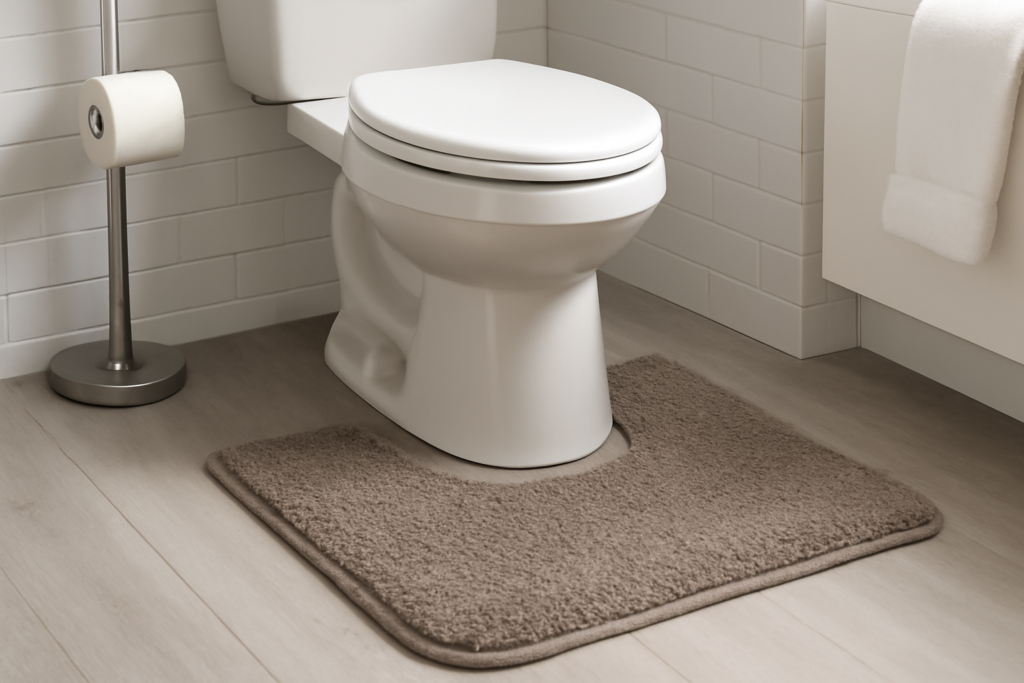
Most people buy a bathroom rug, drop it in front of the sink, and never think about the cold, awkward gap of tile around the toilet. That gap is exactly what a contour bath rug is built to solve. Shaped with a U-shaped cutout that wraps around the base of the toilet, it delivers warmth and slip protection in the one spot a rectangular mat can’t reach. Get the sizing and material right and it disappears into the room; get it wrong and it curls, slides, or looks like an afterthought. This guide walks through every decision so yours fits like it was made for the space.
What a Contour Bath Rug Actually Is
A contour rug is a small bathroom rug with a rounded notch cut into one edge. That notch fits snugly around the porcelain base of a toilet, so the rug hugs the fixture instead of stopping short in front of it. You’ll often see these sold as a two-piece set paired with a standard rectangular mat, but they’re widely available on their own for anyone who already owns a front-of-vanity rug and just needs coverage at the commode.
The point is coverage where you stand and pivot. Bare feet on cold ceramic tile at 6 a.m. is unpleasant, and wet feet on a hard surface is a genuine slip risk. A contour piece puts cushioning and grip in the exact footprint you use most in a bathroom, which is why it remains a fixture in homes with tile or vinyl floors.
Standard Contour Bath Rug Sizes
Dimensions vary by brand, but the category clusters tightly around a few numbers. Knowing them before you shop saves you a return.
- Standard contour: roughly 20 inches wide by 20 to 24 inches deep. This is the most common size and fits the typical residential toilet.
- Large/oversized contour: about 24 inches wide by 24 to 25 inches deep, for larger master baths or elongated bowls.
- Cutout depth: the U-shaped notch is usually 8 to 10 inches deep and 8 to 9 inches wide at the opening — enough to clear a standard toilet base.
Before ordering, measure the width of your toilet base at floor level and the distance from the wall behind the tank to the front of the bowl. Compare those against the cutout, not the overall rug. A notch that’s too shallow leaves the rug riding up on the porcelain; too deep and you lose usable standing surface in front of the bowl.
Choosing the Right Material
Material drives how the rug feels underfoot, how fast it dries, and how well it survives the washing machine. The bathroom is a humid, high-traffic zone, so this matters more than in a bedroom.
Cotton
Soft, absorbent, and machine-washable. Cotton is the traditional choice and handles frequent laundering well, though it holds moisture longer and can stay damp in a poorly ventilated bath. Look for combed or looped cotton in the 1,500 to 2,000 GSM range for a plush feel.
Microfiber and Chenille
Microfiber shag and chenille “feather” rugs have taken over the budget and mid-range market for good reason. They’re extremely soft, dry faster than cotton, and typically run $15 to $30 for a contour piece. The trade-off is that dense shag can trap hair and take longer to shake clean.
Memory Foam
Memory-foam contour rugs add a cushioned core under a plush top layer, which is a real comfort upgrade if you stand at the vanity for grooming. Expect to pay $20 to $40. Check that the specific model is machine-washable, as some foam cores are hand-wash only.
Fit and Slip Safety
A rug that slides is a rug that fails at its one safety job. Nearly all contour bath rugs ship with a latex or TPR (thermoplastic rubber) backing molded into the underside. That backing grips smooth tile, vinyl, and sealed stone, but it wears down over repeated hot-water washes, so plan to replace a heavily used rug every 12 to 24 months.
If your floor has textured or matte tile where the factory backing doesn’t bite, add a thin non-slip rug pad cut to shape, or use a few strips of double-sided rug tape at the corners. Never place a contour rug on top of a smooth bath mat — layering defeats the grip and creates a trip hazard. Keep the cutout snug against the toilet base so the rug can’t creep forward when you step on the leading edge.
Matching a Contour Rug to Your Bathroom
Because the piece frames a focal fixture, color and pile height read strongly in a small room. A few guidelines keep it cohesive rather than dated:
- Match, don’t clash: pull the rug color from your towels or a tile accent rather than introducing a third palette.
- Mind the door swing: high-pile shag can catch under a door that clears the floor by less than an inch. Measure your door gap before buying a plush rug.
- Two-piece sets: a matching contour and rectangular mat give a finished, hotel-like look, but you can mix a solid contour with a patterned front mat for a less matchy feel.
- Scale the pile to the room: deep shag suits a spacious master bath; a low-profile loop or flatweave keeps a tiny powder room from feeling crowded.
How to Wash a Contour Bath Rug
Regular washing is non-negotiable — these rugs collect skin cells, hair, and humidity, and a damp rug against porcelain is a mildew magnet. Wash every one to two weeks in a busy household.
- Shake the rug outdoors first to remove loose hair and grit that would otherwise clog your machine.
- Wash on a warm or cold gentle cycle with a mild detergent. Avoid bleach and fabric softener — bleach degrades the rubber backing and softener coats fibers so they absorb less.
- Wash rugs separately or with towels, never with delicate garments that snag.
- Air-dry when possible, or tumble dry on low or no heat. High heat is the fastest way to crack and crumble the non-slip backing.
- Hang or lay flat to finish drying, and make sure the rug is fully dry before returning it under the toilet.
Check the care tag first — memory-foam and some chenille models specify air-dry only, and following that instruction is the difference between a rug lasting one year or three.
Contour Rug vs. Standard Bath Mat
People often ask whether they need both a contour piece and a rectangular mat. The honest answer is that they do different jobs. A standard rectangular bath mat lives in front of the tub or shower to catch drips as you step out, and in front of the vanity for grooming. A contour rug covers the pivot zone at the toilet, where a rectangle physically can’t wrap. In a full bathroom, both pieces earn their place; in a compact half-bath or powder room with no tub, a single contour rug at the toilet is often all you need.
There’s also a practical hygiene angle. Because the toilet area sees more airborne moisture and splash than the rest of the floor, that zone benefits from a rug you can strip out and launder frequently without disturbing the rest of your setup. A dedicated contour piece makes that easy — you toss it in the wash on its own schedule and leave the front mat in place.
Common Mistakes to Avoid
A few recurring errors turn a good rug into a daily annoyance. Steer clear of these:
- Buying by overall size, not cutout. The rug can be the right width and still fit poorly if the notch is too shallow or too deep for your toilet base. Measure the base first.
- Skipping the rug pad on textured floors. Factory rubber backing grips smooth tile but slides on matte or slate-look surfaces. Add grip rather than living with a creeping rug.
- Washing on hot and drying on high. This is the fastest way to crack the backing and shrink the notch out of shape. Warm-or-cold wash, low-or-no heat dry.
- Leaving it damp against porcelain. A rug pressed to the toilet base that never fully dries breeds mildew and odor within weeks. Give it airflow and rotate in a spare between washes.
- Choosing shag under a low-clearance door. Deep pile that drags under the door frays fast and jams the swing. Match pile height to your door gap.
When to Replace It
A contour rug is a low-cost item, so don’t nurse a failing one. Replace it when the backing sheds crumbs onto the floor, when the pile stays matted after washing, or when the notch has stretched and no longer sits tight against the toilet. Persistent odor that survives laundering signals mildew deep in the pile — at that point a fresh $20 rug beats another wash.
Final Thoughts
A well-chosen contour bath rug is one of the cheapest comfort and safety upgrades in the house. Match the cutout to your toilet base, pick a washable material suited to your bathroom’s humidity, confirm the backing grips your specific floor, and launder it on a regular schedule. Do those four things and you get warm, secure footing exactly where you need it — with a rug that looks intentional instead of improvised.