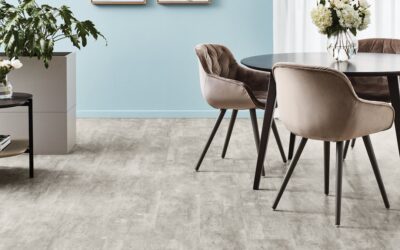
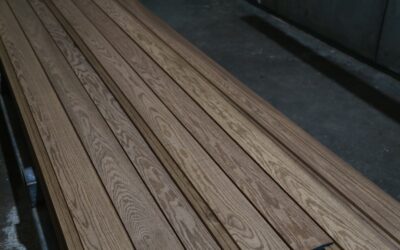
Modern luxury vinyl has come a long way from the peel-and-stick squares in your grandmother’s kitchen, and the most striking patterns now rival hand-laid tile and reclaimed hardwood in showrooms. Cool vinyl flooring covers the design-forward end of the category: dramatic herringbone LVP, oversized concrete-look tile, bold cement patterns, and weathered wood looks with deep registered embossing. The right pick adds character to a room while keeping the waterproof, kid-proof, dog-proof performance that made LVP the fastest-growing floor in the US. This guide walks through the most interesting product categories, fair pricing, what separates a premium product from a knockoff, and how to install it cleanly.
What Makes Vinyl Flooring Look Cool
Three design features push LVP from generic to genuinely striking. Registered embossing (EIR) means the surface texture aligns precisely with the printed pattern, so a knot in the wood image is also a knot you can feel. Beveled edges deepen the line between planks or tiles, creating real shadow lines instead of fake printed seams. Larger plank and tile formats (8×60 inch planks, 18×36 inch tiles) read more like custom installations than mass-market product.
High-quality print films also matter. Premium products use 20 to 30 unique pattern variations per pallet versus 8 to 12 in budget products. That repeats less and avoids the obvious pattern-matching that gives cheap LVP its plastic vibe.
Pros of Premium Designer Vinyl
Performance is the bedrock argument. Rigid-core LVP from Coretec Pro Plus, Karndean Korlok, and Mannington Adura Apex resists scratches from dog claws, dents from dropped pans, and water damage from leaky dishwashers. A 22-mil wear layer can absorb 15 to 20 years of family abuse without showing the route from kitchen to back door.
Design flexibility is the second win. The same product line typically ships in 20 to 40 colors, from bleached oak to charred fumed walnut to industrial concrete. That makes whole-home installs in one product line dramatically easier than mixing hardwood, tile, and laminate across rooms.
Cons and Honest Trade-Offs
It is still plastic. Premium LVP feels closer to wood and tile every year, but no vinyl product develops the patina that real wood does over decades. Resale buyers who specifically want hardwood are not fooled by a top-tier LVP, no matter how good the embossing.
Heat sensitivity is a quiet limitation. Direct sun through south-facing windows can warp some LVP products even when they are rated for high temperatures. Read the manufacturer’s UV and heat specifications before installing under skylights, sliding glass doors, or sunrooms with single-pane glass.
Cool Pattern Categories to Consider
- Herringbone and chevron planks: dramatic pattern, 5 to 8 percent material waste, $4 to $8 per sq ft material
- Large-format concrete tile: 18×36 or 24×48, modern industrial look, $3.50 to $6 per sq ft
- Encaustic and cement-pattern tile: bold geometric prints, $4 to $7 per sq ft
- Whitewashed and limewashed wood: $3 to $5.50 per sq ft, light and airy modern look
- Reclaimed barnwood replicas: heavy texture, mixed widths, $4.50 to $7.50 per sq ft
Top Brands Worth Considering
Karndean Designflooring sits at the top of the residential market with thick wear layers, premium embossing, and a 25-year residential warranty. Coretec Pro Plus and Pro Plus HD remain the volume leader for waterproof rigid-core builds. Mohawk SolidTech and Mannington Adura Apex run a close second with strong design libraries.
For genuinely bold geometric patterns, Amtico in the UK and Forbo Marmoleum on the natural-product side outpace anything from US mass-market brands. Lead times run 4 to 10 weeks on imported product, so order early.
Wear Layer Math That Matters
Wear layer thickness measured in mils (1/1000 of an inch) drives durability and warranty length. Look for 12 mil minimum in low-traffic bedrooms, 20 mil in kitchens and family rooms, and 28 to 30 mil in mudrooms, retail spaces, or homes with multiple dogs. Below 6 mil, the product belongs in rental flips, not your forever home.
Total plank thickness also matters but matters less. A 5 to 8 mm rigid core handles minor subfloor imperfections, while a 2 to 3 mm flexible LVP telegraphs every bump. Skip flexible glue-down LVP unless your subfloor is perfectly flat.
Installation Tips for Pattern Layouts
Herringbone and chevron require two SKUs (left and right planks) or a single SKU cut precisely on a chop saw at 45 degrees. Order 15 to 20 percent extra material for these patterns versus the 7 to 10 percent waste factor on standard straight-lay layouts.
Dry-lay the first 100 sq ft before clicking anything together. Patterns repeat every 6 to 12 boards, and you want to spread color and grain variation across the room to avoid obvious clumping. A 10-minute dry-lay saves a 4-hour reinstall.
Fair Installed Pricing
Mid-range cool LVP in straight-lay typically lands at $5.50 to $8 per sq ft installed including underlayment and transitions. Herringbone and chevron patterns push installed pricing to $7 to $11 per sq ft due to the slower install speed and increased waste. Premium imports run $10 to $16 per sq ft installed.
Subfloor leveling adds $1 to $3 per sq ft when slab or plywood readings exceed 3/16 inch over 10 feet. Skip this step and you will see hollow spots and click-joint failures within 6 to 18 months. The cheap fix at the start is always cheaper than the warranty fight later.
Long-Term Care
Dry vacuum or sweep two to three times per week in busy zones. Damp mop with a pH-neutral cleaner like Bona LVT Floor Cleaner; skip steam mops, bleach, and oil soaps. Furniture felt pads prevent dragging marks, and walk-off mats at exterior doors trap the grit that causes 80 percent of long-term wear-layer damage.
Prefer to explore on your own?
See how new flooring looks in your actual room in seconds — free, no signup.
Try the free Floor Studio →