
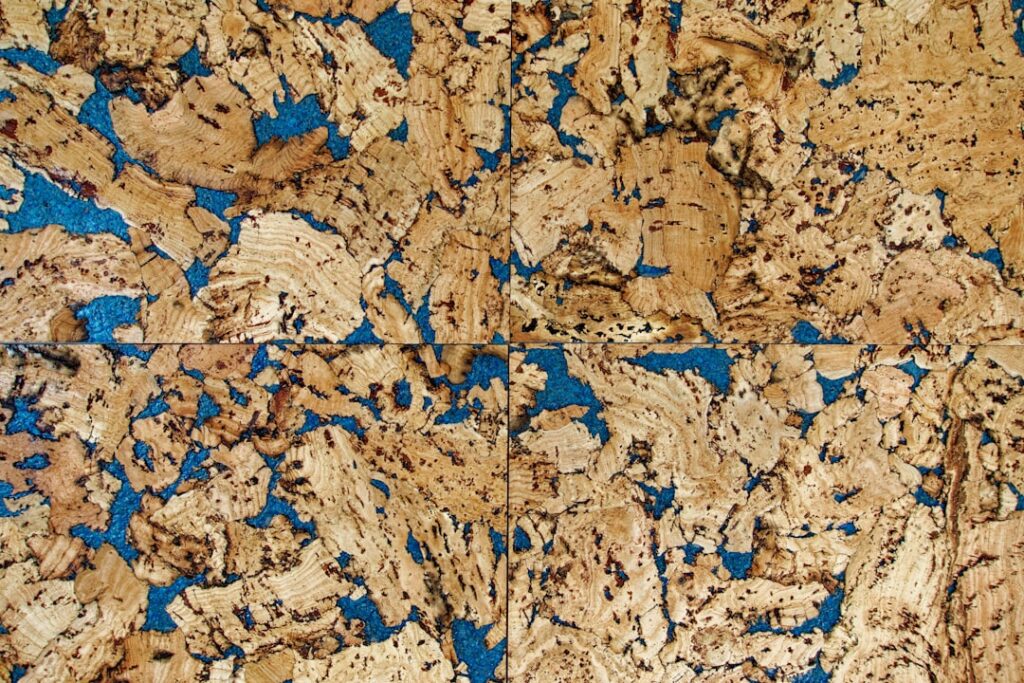
Walk barefoot onto a cork floor in February and you understand instantly why this material has quietly become the choice of architects designing primary bathrooms in the Pacific Northwest. Cork bathroom flooring stays roughly 10 degrees warmer than tile, naturally repels mold and bacteria thanks to a compound called suberin, and absorbs sound to the point that your shower no longer echoes through the house. The catch — and there is a catch — is that cork in a wet room only works if it is sealed correctly and installed with the right substrate.
Done right, a cork bathroom floor lasts 25 to 40 years. Done wrong, you are tearing it out in 18 months. Here is how to land on the right side of that line.
Why Cork Works in Bathrooms
Cork is harvested from the bark of the Quercus suber oak, primarily in Portugal. The bark regrows every nine years, making it one of the few truly renewable hard surfaces. Suberin, the waxy substance in cork cell walls, repels water, resists mold and mildew, and keeps dust mites away. The cellular structure is roughly 50% air, which gives cork its insulating R-value (about 0.95 per inch) and the soft, springy feel underfoot.
For bathrooms, the relevant traits are warmth, slip resistance when wet (cork has a higher coefficient of friction wet than dry), and the suberin antimicrobial effect. The downsides are the same as wood — cork can swell with prolonged water exposure and stain from standing puddles if the surface seal fails.
The Two Cork Construction Types
You will choose between glue-down tiles and floating click-lock planks. Each behaves differently in a bathroom environment.
- Glue-down cork tiles — solid cork, 4-6mm thick, 12×12 or 12×24 inches. Bonded to the subfloor with cork-specific adhesive. The seams are minimal, and the floor is the most water-resistant of the two when properly sealed. Runs $4-$8 per sq ft material.
- Floating cork planks — engineered with an HDF core sandwiched between cork veneer top and cork backing, click-lock edges. Faster install and DIY-friendly. The HDF core swells if water reaches it, so seam sealing is critical. Runs $5-$10 per sq ft material.
For bathrooms, glue-down tiles are the safer bet. Wicanders, Globus, and APC Cork all make bathroom-rated glue-down lines. Torlys CorkPlus is the leading floating system rated for bathrooms.
The Sealing Step You Cannot Skip
Pre-finished cork from the factory comes with 4-6 coats of polyurethane or UV-cured acrylic. That works for living rooms. For a bathroom, you add 2-3 additional topcoats of waterborne polyurethane like Bona Mega ONE or Loba Easy 2K after installation, paying particular attention to seams, edges around the toilet flange, and the transition at the tub. This creates a nearly continuous waterproof membrane on top of the cork.
Plan to re-coat every 5-7 years in a primary bathroom, every 8-10 in a powder room. Budget about $1 per square foot in materials and a Saturday for the recoat. Skip this maintenance and water eventually finds the cork.
Subfloor Requirements
Cork is forgiving on most subfloors but unforgiving about moisture from below. Concrete slabs need a vapor barrier — 6-mil polyethylene under a glue-down install, or a built-in cork underlayment with vapor protection like Cork Heat under floating planks. Plywood subfloors over a crawl space need a vented crawl space with a ground vapor barrier and humidity below 50%.
Level the subfloor to within 3/16 inch over 10 feet. Cork is forgiving compared to tile but still telegraphs major dips. Fill low spots with a self-leveling compound like Mapei Ultraplan 1 Plus.
Installation Walkthrough
Acclimate the cork in the bathroom for 72 hours at 65-75°F and 35-65% humidity before install. Set the toilet flange height to match the new floor before starting. For glue-down tiles, trowel the cork-specific contact adhesive (W.F. Taylor 2073 or comparable) and roll the tiles with a 75-lb roller after setting. For floating planks, leave a 3/8-inch expansion gap at all walls and fixtures, fill the gap at fixed obstacles with color-matched silicone after install.
The key bathroom-specific details: silicone caulk every transition (tub, shower curb, toilet base, vanity toe-kick) instead of using rigid trim. Silicone flexes and stays watertight. Apply the post-install topcoat the same day if possible.
Real-World Performance
In a primary bathroom used twice daily, expect minor surface wear at the high-traffic path between the door and shower within 5-7 years. The wear is localized and a recoat brings it back. A toilet leak that goes unnoticed overnight will stain the cork around the flange and may require pulling that tile or plank for replacement. Standing puddles from a soaked bath mat are fine if you pick them up within a few hours.
Cork bathroom flooring shines under bare feet. The surface registers about 70°F when ambient is 68°F, compared to porcelain tile that sits closer to 60°F. Owners with heated tile floors say cork feels warmer without electricity than radiant tile does turned on.
Cost Compared to Alternatives
Material plus install lands at $9-$16 per square foot for cork. That sits between mid-range LVP ($6-$10) and natural stone tile ($14-$22). It costs more than ceramic tile ($8-$13 installed) but less than radiant-heated tile ($16-$25). The maintenance recoat adds about $1.50 per sq ft every 6-7 years.
If your priority is feel underfoot and a quiet bathroom, cork is the comfort winner. If your priority is bulletproof water resistance and zero maintenance, porcelain tile still wins. Choose accordingly.
Prefer to explore on your own?
See how new flooring looks in your actual room in seconds — free, no signup.
Try the free Floor Studio →

