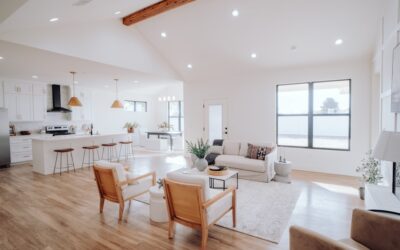
Original Craftsman bungalows from 1905 to 1929 were almost always floored in quartersawn white oak with shellac or hand-rubbed linseed oil finishes, and that detail is the single biggest reason restoration buyers will walk away from a remodel that ignored it. Craftsman flooring in 2026 means more than a stain color — it is a specific cut of lumber, a narrow plank width, and a low-sheen finish that reads as period-correct under both incandescent and LED lighting. Expect $6.99 to $14.99 per square foot for authentic 3-inch quartersawn oak, with full installation landing between $11 and $19 per square foot depending on subfloor prep.
What Defines Authentic Craftsman Flooring
Quartersawn cut is the giveaway. When white oak is sawn at a 60° to 90° angle to the growth rings, you get the medullary ray flecks — those silver, ribbon-like figures that flash under raking light. Plainsawn oak shows cathedral grain and never produces those flecks no matter the stain. Original Greene and Greene homes used quartered white oak almost exclusively; lesser bungalows used quartersawn red oak, which is slightly pinker and shows less dramatic ray fleck.
Plank width matters too. Pre-1925 floors ran 2 1/4 inch to 3 inch face widths, never the 5 inch and 7 inch wide planks that read as modern farmhouse. A few high-end homes used 3 1/4 inch quartersawn oak with a contrasting 1-inch border in walnut or mahogany, but the standard floor was field-only in narrow strip.
Best Species for a Craftsman Look
White oak leads because it shows the most ray fleck and accepts the warm amber tones bungalow owners want. Red oak is the budget alternative at $4.99 to $7.99 per square foot in quartersawn cut, and it ages to a similar honey color under shellac. Avoid maple, birch, and hickory — none of them belong in a period-correct restoration, even though contractors will push them as cheaper substitutes.
Reclaimed heart pine from 1880 to 1920 industrial buildings is the wildcard option. Mills like Pioneer Millworks and Goodwin Heart Pine sell remilled antique pine in 3-inch and 4-inch widths for $9.99 to $16.99 per square foot. The dense grain and natural patina hit the Craftsman aesthetic without staining, though the wood is harder on saw blades and dulls a chop saw within 200 linear feet.
Stain and Finish Choices
- Amber shellac hand-rubbed in three to five coats — the most historically accurate finish, repairable but requires re-coating every 7 to 10 years
- Tung oil with citrus solvent applied in two flood coats then buffed — natural penetrating finish that develops patina over time
- Bona Craft Oil 2K in Umbra or Frost — modern hardwax oil that mimics shellac depth with 5x the wear resistance
- Waterborne urethane in matte (3 to 8 sheen) tinted with Mission Brown or Provincial — durable but reads slightly plasticky under direct sun
- Fumed white oak using ammonia tents — turns the wood deep mocha brown through tannin reaction without surface stain
Pros That Justify the Premium
Period accuracy adds 3% to 7% to the resale value of certified Craftsman, Prairie, and Mission-style homes in markets like Pasadena, Berkeley, Asheville, and Madison, according to 2025 sales data from Old House Online. Buyers pay for original quartersawn oak the same way they pay for original hardware and built-ins — it is non-replicable once gone.
Quartersawn oak is also dimensionally stable. The ring orientation reduces cupping and crowning by roughly 60% compared to plainsawn boards of the same species, which matters in older homes with marginal insulation and seasonal humidity swings from 25% to 65% relative humidity.
Cons You Should Know
Cost is the obvious drawback. Quartersawn white oak is roughly twice the price of plainsawn because mills only get 30% to 40% yield from each log when cutting on the quarter. Long boards over 8 feet are especially scarce and command another 15% premium when available through suppliers like Sutherland Welles and Hull Forest Products.
Site-finished installations also add time. A traditional shellac job takes 5 to 8 days for a 600 square foot living room and dining room because each of three to five coats needs 24 hours to cure and a screen-and-recoat between coats. Prefinished options exist from manufacturers like Hallmark Floors and Mullican, but the factory urethane never reads as authentic next to original trim.
Cost Per Square Foot in 2026
- Quartersawn red oak unfinished, 2 1/4 inch strip: $4.99 to $7.99
- Quartersawn white oak unfinished, 3 inch strip: $6.99 to $11.99
- Quartersawn white oak unfinished, 4 inch and wider plank: $9.99 to $14.99
- Reclaimed antique heart pine: $9.99 to $16.99
- Site finishing labor (sand, stain, three coats shellac): $4.49 to $6.99
- Site finishing labor (sand, three coats waterborne urethane): $3.99 to $5.49
Installation Notes for Period Homes
Original Craftsman subfloors are typically 1 inch by 6 inch tongue-and-groove pine laid diagonally over 2×10 joists at 16 inch centers. Check joist deflection before installing — anything over L/360 will telegraph through new oak within five years. Add 3/4 inch plywood underlayment if the original subfloor is bouncy, and screw it on a 12 inch grid with #8 by 2 inch screws rather than nails.
Lay the new flooring perpendicular to the joists, blind-nail through the tongue with 2-inch cleats at 8-inch intervals, and stagger end joints at least 12 inches between rows. Keep the new field running the long direction of the room as original installers did. Plan a 3/4 inch expansion gap at all walls and cover with quarter-round in matching oak rather than modern shoe molding.
Where to Source Authentic Materials
Carlisle Wide Plank Floors, Pioneer Millworks, and Hull Forest Products all stock genuine quartersawn white oak with verifiable cut documentation. Local hardwood dealers can special-order from mills like Allegheny Mountain Hardwood Flooring at 10% to 20% over big-box prices. Avoid online sellers that advertise “rift and quartered” — that mix only delivers ray fleck on 40% of the boards, which spoils the visual once installed. Craftsman flooring done correctly will outlast three more generations in the house and reward the next restoration buyer who walks the floor with a flashlight.
Prefer to explore on your own?
See how new flooring looks in your actual room in seconds — free, no signup.
Try the free Floor Studio →