
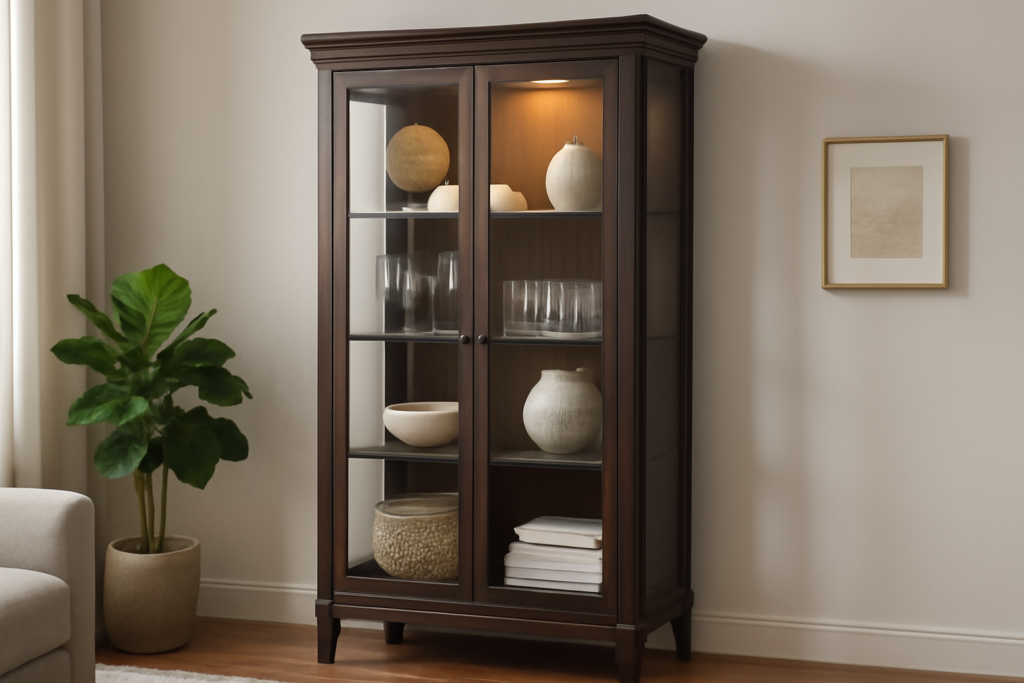
A curio cabinet with glass doors turns a stack of forgotten keepsakes into a lit, museum-style display you actually walk past and admire. The glass does the heavy lifting here, letting you protect fragile pieces from dust and curious hands while keeping every angle visible.
- What a Curio Cabinet Actually Does
- Glass Shelves vs. Wood Shelves
- Lighting Makes or Breaks the Display
- Materials, Finishes, and What They Cost
- Locks, Safety, and Anti-Tip Hardware
- Styling Your Curio Cabinet with Glass Doors
- Placement and Room Ideas
- Building or Retrofitting Your Own
- Care and Cleaning
Whether you inherited a set of hand-painted teacups or you collect die-cast cars, the right cabinet frames the story. Below is everything you need to pick a size, wire up lighting, load the shelves, and keep the whole thing looking sharp for years.
What a Curio Cabinet Actually Does
A curio is a display case built for viewing, not storage. Unlike a solid-front hutch, its sides and doors are glass, so light passes through and your objects read from across the room. Most models stand between 68 and 78 inches tall, 28 to 34 inches wide, and 12 to 16 inches deep, which fits a standard 8-foot ceiling with clearance to spare.
Three broad shapes dominate the market:
- Corner curios — five-sided cabinets that tuck into a 90-degree wall junction and reclaim dead space in a dining room. Footprint is usually 24 to 30 inches per wall.
- Wall (flat-back) curios — rectangular cases that sit flush against a single wall, best for larger collections and wider rooms.
- Console and tabletop curios — low, waist-height cases (around 36 inches tall) that double as a surface and work well under a window or in an entry.
Glass Shelves vs. Wood Shelves
Glass shelves are the reason to buy this kind of cabinet. Because they are transparent, light from a top fixture travels straight down through every level instead of stopping at the first shelf. That top-to-bottom glow is what makes crystal and glassware sparkle.
Look for tempered glass at least 3/16 inch (about 5 mm) thick, with polished or beveled edges so nothing chips your fingers or your figurines. Each shelf should be rated for the load you plan to set on it; most factory shelves handle 15 to 25 pounds spread evenly, which is plenty for china but marginal for a row of solid brass. If you collect heavy metal or stone pieces, ask about 1/4-inch glass or add wood shelves on the bottom tier for ballast.
Adjustable shelf pins matter more than people expect. Spacing set on a 2-inch grid lets you fit a 14-inch vase on one level and a tray of thimbles on the next without wasting vertical room.
Lighting Makes or Breaks the Display
Lighting is the single biggest upgrade you can make. A dark cabinet reads as clutter; a lit one reads as a gallery. You have three practical options:
- Top-down puck or panel LEDs — the most common built-in system. A single warm-white panel in the crown throws light down through glass shelves. Look for 2700K to 3000K color temperature for warm woods and gold accents, or 3500K to 4000K to keep crystal and silver looking crisp.
- Perimeter LED strips — thin adhesive tape lights run up the interior corners or along each shelf lip for even, shadow-free coverage. Retrofit kits run $15 to $40 and are the cheapest way to modernize an older cabinet.
- Mirror-backed glow — a mirrored back panel bounces light forward and visually doubles your collection. Combine it with edge strips for a jewelry-store effect.
Put the lights on a dimmer or a simple inline switch. Full brightness is great for dusting; a lower setting turns the cabinet into ambient evening lighting for the room. If your cabinet sits near a window, position it so direct afternoon sun does not hit painted or photographic items, which fade over months of exposure.
Materials, Finishes, and What They Cost
Frame material drives both looks and price. Here is the usual range:
- MDF with wood-grain laminate — the budget tier at $120 to $300. Fine for light collections, but avoid humid rooms since laminate edges can lift.
- Solid oak, cherry, or maple — heirloom-grade cabinets from $500 to $1,500. Oak takes a golden to fumed finish, cherry deepens to a red-brown over time, and maple stays pale and even.
- Metal and glass (steel or aluminum frame) — modern cases from $250 to $900, ideal for contemporary rooms where you want the glass, not the wood, to be the story.
Popular finishes include natural oak, espresso, cherry, and painted white or black. A satin or semi-gloss topcoat wipes clean more easily than a flat finish, which matters when a cabinet lives in a dining room near cooking splatter.
Locks, Safety, and Anti-Tip Hardware
Any tall, glass-front cabinet needs to be anchored. A loaded curio can weigh 90 to 140 pounds and becomes a tipping hazard around kids and pets. Every unit should ship with an anti-tip strap or L-bracket that screws into a wall stud. Install it before you add a single piece of glassware.
If you display anything valuable or fragile, choose a model with a keyed or magnetic door lock. It keeps toddlers out and stops doors from drifting open on an uneven floor. For earthquake-prone areas, museum putty under each object holds figurines to the shelf during a tremor.
Styling Your Curio Cabinet with Glass Doors
A great display follows a few rules that professional merchandisers use every day:
- Group by theme or color. A shelf of all blue-and-white porcelain reads as a collection; a shelf of random items reads as storage.
- Vary the height. Set taller pieces at the back and stagger shorter ones in front, or use small clear risers to lift back-row items into view.
- Leave breathing room. Fill each shelf to about 70 percent. Crowding kills the gallery feel and blocks light.
- Anchor the top shelf. Place your single best piece where the light is strongest, roughly at eye level, between 55 and 65 inches off the floor.
- Face labels out. For collectibles with maker’s marks, angle a couple so the mark shows through the glass.
Placement and Room Ideas
Dining rooms remain the classic home for a curio, where it stores and shows off china within arm’s reach of the table. But the cabinet earns its keep in other rooms too. A corner unit in a living room displays travel souvenirs; a lit case in a home office frames awards and signed baseballs; a narrow console curio in an entry greets guests with a curated first impression.
Keep at least 3 feet of walking clearance in front of the doors so they open fully without you shuffling around furniture. On hardwood or tile, felt pads under the feet stop scratches and let you nudge the cabinet for cleaning.
Building or Retrofitting Your Own
If you already own a solid wood hutch or a plain display case, you can convert it into a proper lit curio for far less than buying new. Swap the wood door panels for tempered glass inserts, which a local glass shop cuts to size for $30 to $60 per panel. Add a mirrored back panel and a strip of warm LED tape, and an $80 cabinet suddenly performs like a $500 one.
For a full build, cabinetmakers charge $600 to $2,000 depending on wood species and glass. Ask for soft-close glass doors, at least four adjustable glass shelves, and a hidden wire channel so the LED transformer tucks out of sight behind the crown. A concealed low-voltage driver keeps the whole thing UL-listed and safe to leave on for hours.
One detail worth specifying: dust seals. A thin brush strip or gasket where the doors meet keeps dust out, so you clean the interior twice a year instead of monthly. For collectors of anything that tarnishes, such as sterling silver, a small anti-tarnish strip inside the case slows oxidation dramatically.
Care and Cleaning
Glass shows every fingerprint, so plan on a quick wipe every week or two. Use a microfiber cloth with a vinegar-and-water mix or an ammonia-free glass cleaner; spray the cloth, not the cabinet, so liquid never runs down into the wood joints. Twice a year, remove the objects, lift out the glass shelves, and clean both faces. Dust the LED fixture at the same time, since a filmed-over light loses noticeable brightness.
Chosen well, a curio cabinet with glass doors is one of the few pieces of furniture that makes your belongings look more valuable simply by holding them. Pick the right size for your wall, insist on real lighting and tempered glass shelves, anchor it to a stud, and style it with restraint. Do that, and the cabinet stops being furniture and starts being the reason people stop and look.


