White gutters are the default on American homes for one reason — they’re what’s on the truck — not because they look best. Dark bronze gutters have quietly become the designer’s pick instead: a deep brown-black with warm undertones that frames a roofline the way eyeliner frames an eye, disappearing against dark trim and outlining light siding without the harshness of pure black. Bronze is now a stocked color for nearly every seamless gutter operation, typically at little or no upcharge over white. Here’s what the color pairs with, how it’s offered in aluminum, steel, and copper-look finishes, and what installation actually costs.
What “Dark Bronze” Actually Is
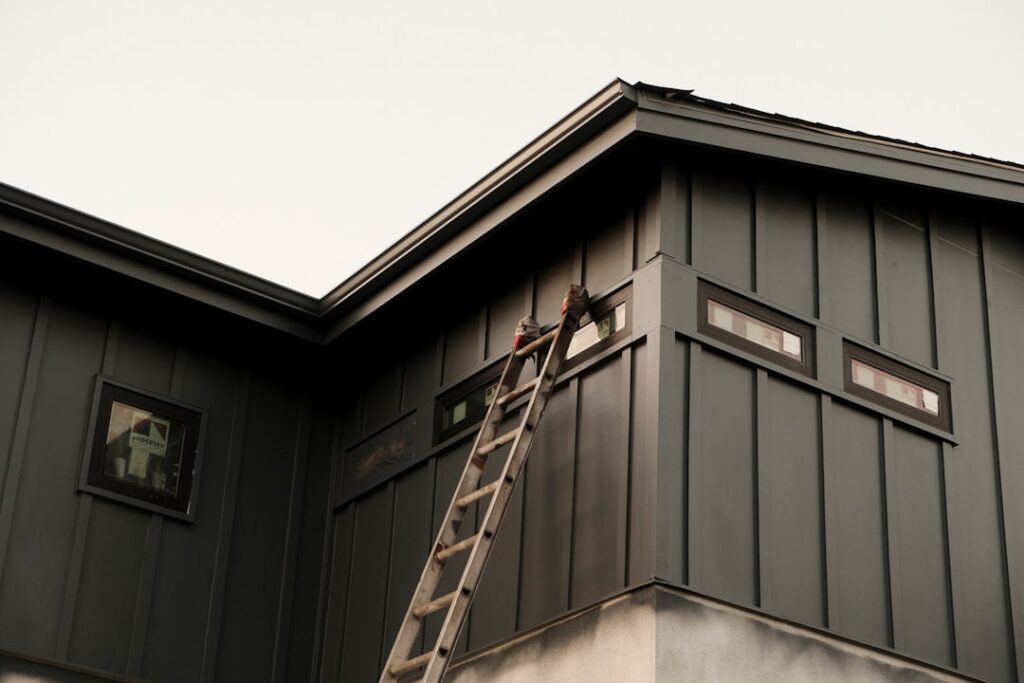
In the gutter world, dark bronze (sometimes “Musket Brown’s” deeper sibling, or “Bronze” on color cards from coil suppliers like Mastic, Spectra, and Berger) is a very dark brown with black depth and a faint warm-metallic cast — think the color of aged architectural bronze on bank doors. It reads nearly black in shade and warm charcoal-brown in sun. That dual behavior is its superpower: black gutters can look stark and blue-cold against warm palettes, while bronze harmonizes with both warm and cool schemes. Most manufacturers produce it in a low-gloss baked-on finish; matte versions hide dents and oil-canning better than glossier coats.
Don’t confuse painted dark bronze aluminum with real bronze or copper. Actual copper gutters cost $25 to $50 per linear foot installed and patinate green over decades; painted bronze aluminum gives you the dark metal look at a fifth the price and holds its color instead of changing.
What Dark Bronze Gutters Pair With
- White, cream, and beige siding: the strongest use case. Bronze traces a crisp architectural line around light walls — the modern farmhouse and transitional look — without black’s severity. Especially good under brown, weathered-wood, or bronze metal roofs.
- Earth tones — tan, khaki, sage, olive: bronze belongs to the same warm family and vanishes gracefully into the trim.
- Brick and stone: the best gutter color for red, brown, and blended brick, where white gutters look taped-on. Bronze echoes the mortar-shadow tones.
- Bronze or black windows: if your window frames are dark, bronze gutters complete the set; mixing white gutters with black windows is the most common exterior mismatch going.
- Metal roofs: pair with dark bronze, brown, burnished slate, or copper-tone panels for a monolithic edge; most metal roofing coil lines offer a matching Dark Bronze so gutters, fascia trim, and panels can align exactly.
Where bronze struggles: cool blue-gray houses with bright white trim sometimes want black or white instead, since bronze’s warmth can read muddy against icy palettes. Sample a foot of coil stock against your trim before ordering — any gutter shop will hand you an offcut.
Material Options and Prices
Dark bronze comes in every mainstream gutter material:
- Seamless aluminum (.027 or .032 gauge), K-style: the standard — $7 to $14 per linear foot installed in bronze. Choose .032 gauge in snow and ladder-leaning country; the dollar-per-foot upcharge buys real dent resistance.
- Half-round aluminum: $9 to $18 per foot; bronze half-rounds with round downspouts nail the historic and European look.
- Galvanized or Galvalume steel: $9 to $16; stiffer than aluminum for heavy snow, offered in bronze from commercial suppliers.
- Vinyl: rarely available in true dark bronze, and dark vinyl fades and gets brittle — skip it.
- Oversized 6-inch K-style: add $1 to $3 per foot over 5-inch; worth it under metal roofs and big roof planes, which shed water faster than shingles.
A typical home needs 120 to 200 linear feet of gutter plus 4 to 8 downspouts, putting a full seamless bronze system at $1,100 to $2,800 installed for most houses. Color upcharge over white: usually $0 to $0.50 per foot, since bronze coil is now a stocked standard almost everywhere. Matching accessories matter for the finished look — order downspouts, elbows, end caps, and fascia/drip-edge touches in the same bronze, and ask for color-matched touch-up paint ($10 to $20 a can) for scratches at install.
Practical Performance: Heat, Fade, and Maintenance
Dark colors absorb heat, and a bronze gutter in July sun gets hot enough to notice — but aluminum sheds heat fast and thermal movement is handled by proper hanger spacing (every 24 inches, 18 in snow zones), so heat is a non-issue functionally. One genuine winter advantage: dark gutters absorb solar gain and can shed ice and snowmelt marginally faster than white on sunny winter days.
Fade is the honest concern with any dark finish. Quality gutter coil uses baked polyester or PVDF-class coatings warrantied 20-plus years against chalking; cheap coil fades toward gray-brown in 8 to 10 hard-sun years. Ask your installer whose coil they run (Mastic, Quality Edge, Spectra Metals are common) and for the finish warranty in writing. Maintenance is the same as any gutter — clean twice yearly, resecure any pulled hangers — with one cosmetic note: dried white water-staining and grime show more on dark finishes up close, so an annual rinse with a hose and soft brush keeps curb appeal crisp. Bronze hides tiger-striping (the vertical drip staining that plagues white gutters) far better than light colors, which is half the reason designers spec it.
Bronze vs. Black vs. White: Choosing Fast
Use this shorthand. White: right when fascia and trim are white and staying white — cheapest, most available, shows every streak. Black: right for modern homes, cool gray palettes, and black-window schemes — maximum contrast, slightly harsh on warm traditional exteriors. Dark bronze: right for warm palettes, brick, stone, earth tones, dark-trim schemes, and almost every metal roof — the most forgiving dark option and the one that photographs best on traditional architecture. If you’re torn between black and bronze, hold samples in afternoon sun: black stays flat while bronze picks up warmth, and one of them will obviously belong to your house.
DIY Sectional vs. Professional Seamless in Bronze
Big-box stores carry sectional aluminum gutters in a bronze or dark brown finish at $4 to $8 per 10-foot section, and a handy homeowner can hang a small house for $300 to $600 in parts. The trade-offs are real, though: sectional systems have a seam every 10 feet, and seams are where gutters leak and where dark finishes show sealant smears most plainly. Color matching across sections, elbows, and end caps from different production runs can also drift visibly in dark tones — a mismatch that white forgives and bronze broadcasts.
Seamless machines roll each run as one continuous piece on-site, custom cut to your fascia, with joints only at corners and outlets. For dark colors specifically, that continuity is worth the professional premium: fewer sealed joints, uniform coil color, and factory-crimped end caps. If you do go DIY sectional in bronze, buy every component from one manufacturer in one order, seal joints with a color-compatible gutter sealant (OSI or GeoCel, about $8 a tube — clear beats mismatched brown), assemble seams on the ground where you can rivet and seal cleanly, and dry-fit the whole run before the first screw. Either route, hang with hidden hangers and structural screws; spike-and-ferrule fastening loosens in a few seasons and nothing spoils a sharp bronze line like a sagging run.
Buying Checklist
- Get two or three quotes for seamless .032 aluminum in dark bronze, 5-inch K-style (6-inch under metal roofs), hangers 24 inches on center with structural screws — not spikes.
- Confirm color-matched downspouts, elbows, and end caps, plus touch-up paint left on site.
- Ask for the coil brand and finish warranty; 20 years-plus on the paint is the bar.
- Consider gutter guards in matching bronze ($6 to $12 per foot for quality micro-mesh) while the crew is there.
- Photograph the fascia condition before install — rotted fascia should be replaced first, and bronze gutters on fresh bronze or dark fascia is the detail that makes the whole roofline look custom.
Dark bronze gutters are one of the rare exterior upgrades that cost roughly nothing extra and change how finished a house looks. Match them to dark windows or a warm roof, spec the heavier gauge, and the roofline goes from builder-grade to deliberate in an afternoon’s install.