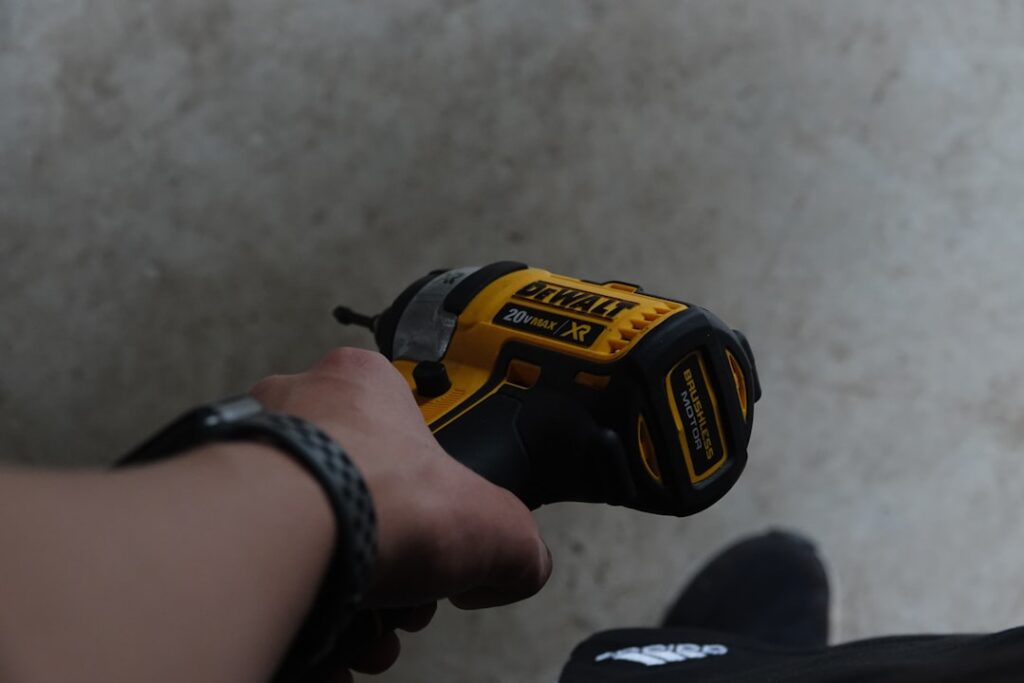
Cutting the hose changed roofing the way it changed framing, and the dewalt roofing nailer 20v — the DCN45RN — is the tool that did it. It remains the only cordless coil roofing nailer from a major brand, which makes the buying question less “which cordless” and more “cordless or compressor.” I have run the dewalt roofing nailer 20v on repair calls and small tear-offs for several seasons; here is the honest report — specs, real-world speed, quirks, and where a pneumatic still wins.
DCN45RN Specs at a Glance
The numbers from the spec sheet, confirmed by tape measure and scale in my shop:
- Model: DCN45RN (kit DCN45RND1 with a 2Ah battery and charger)
- Nail compatibility: 15-degree wire-weld coil roofing nails, 3/4 inch to 1-3/4 inch, 0.120-inch shank
- Magazine capacity: 120 nails (one standard coil)
- Power source: 20V MAX battery, brushless motor, flywheel drive — no gas cartridges, no compressor
- Weight: about 7.2 lb bare, roughly 8.5 lb with a 2Ah pack; a pneumatic roofing gun runs 5 to 5.5 lb plus hose drag
- Firing modes: sequential and bump (contact) via selector
- Depth adjustment: tool-free thumb wheel
- Speed: rated to around 10 nails per second capability in bump mode bursts
- Shots per charge: DeWalt claims up to about 500 nails per Ah — figure roughly 1,000 nails on a 2Ah pack, 2,500+ on a 5Ah, real-world
- Street price: about $399 bare, $450 to $500 kitted; add roughly $100 to $150 per spare 5Ah battery
What It Is Like on the Roof
Freedom is the review in one word. No compressor to haul up a ladder or leave screaming in the driveway, no 100-foot hose sweeping shingles or hooking on vents, no cold-morning wait while the tank builds pressure. On a second-story repair, being on the roof 90 seconds after opening the truck is a genuine workflow change. Balance is good despite the weight — the battery sits low and back — and the flywheel spins up fast enough that sequential-mode single shots feel instant. Sound is different too: a whir-thunk instead of the compressor cycle, quiet enough that occupied-home repair calls appreciate it. The rafter hook is stout, the shingle guide works for exposure spacing, and depth-of-drive stays put once set — flush drives in 90°F afternoon shingles and cold morning mat both, after one thumb-wheel tweak each way.
Speed and Capacity: The Honest Limits
Nail-for-nail in bump mode, the DCN45RN keeps pace with air for repair work and short courses; a production roofer laying architectural shingles flat-out will notice the flywheel’s rhythm ceiling before a pneumatic’s. Where the math matters more is logistics. A square of architectural shingles takes roughly 320 to 380 nails (four to six nails per shingle at about 64 to 80 shingles per square). A 2Ah pack’s ~1,000 nails covers about 3 squares; a 5Ah roughly 7 to 8. A two-battery rotation with the fast charger keeps a solo roofer running all day, but a three-man crew shingling 20 squares is swapping and charging constantly — that job still belongs to a compressor and three air guns. Magazine capacity is the standard 120-nail coil either way, so reload cadence feels familiar.
Nails and Consumables
Feed it any brand of 15-degree wire-collated coil roofing nails — Metabo HPT, Bostitch, Grip-Rite, Maze — in the 3/4 to 1-3/4-inch range. Practical selections: 1-1/4 inch covers new architectural shingles over 1/2-inch decking with proper 3/4-inch penetration; 1-1/2 to 1-3/4 inch for ridge caps, thick designer shingles, or re-nailing through old material. Use hot-dipped galvanized or stainless in coastal air; electro-galvanized coils are fine inland and run $45 to $65 per 7,200-nail box (that is about $0.007 per nail — consumable cost is a rounding error next to labor). The gun also earns off-roof keep: 3/4-inch coil nails make it a fast cap-less felt and synthetic-underlayment tacker where cap nails are not required, and it drives vinyl siding coil nails in a pinch, though a true siding gun holds looser depth for the required loose-nailing.
Quirks and Complaints
Honest gripes from time on the tool. Weight is the big one — 8.5 lb held at arm’s length for 200 squares a year is a physical tax, and pneumatic loyalists are not wrong about it. Dry-fire lockout stops around the last few nails, but the window between “low coil” and lockout occasionally eats a beat of rhythm. The flywheel’s spin-up means the first bump-mode nail after a pause lags a hair; you learn the cadence. Cold weather trims battery yield like every cordless platform — keep the spare pack inside your jacket in winter. And at $400-plus bare, it costs what a very good pneumatic gun plus a decent compressor costs together; you are paying for the missing hose. Reliability-wise, mine has digested well over 20,000 nails with nothing but a blown-off dust cap; DeWalt backs it with a 3-year limited warranty, 1-year free service, and 90-day money-back.
Cordless vs Pneumatic: Who Wins Where
The decision grid I give crews:
- Repair and service roofers: cordless, no contest. Ladder up, fix, gone — the setup time saved pays for the tool inside a season.
- Solo and two-person re-roof outfits: cordless works with a four-battery rotation; weigh the ergonomics against the logistics you shed.
- Production crews (15+ squares a day, multiple guns): pneumatic still rules on gun weight, unlimited runtime, and $120 replacement guns like the Metabo HPT NV45AB2 versus $400 a position.
- Homeowners and remodelers who roof occasionally: cordless if you already own 20V MAX batteries — skipping compressor ownership entirely is the whole value case.
There is no gas-cartridge middle ground here the way Paslode offers in framing; DeWalt’s flywheel is the only hoseless roofing option on the market.
Setup, Care, and Getting Full Battery Yield
A few habits keep the DCN45RN shooting straight. Set depth-of-drive on scrap or the first hidden course: start shallow, dial the thumb wheel until heads sit flush without cutting the shingle mat, and re-check when the sun changes the shingle temperature — soft afternoon shingles need a hair less drive than stiff morning ones. Load coils with the first nail indexed at the driver channel and close the canister until it clicks; half of reported “jams” are mis-indexed first nails. Actual jams clear tool-free through the front latch in under a minute. Maintenance is almost embarrassingly light compared to air guns — no daily oiling (oil actually attracts dust into the flywheel assembly; keep it dry), just blow out the nose and magazine weekly and check the no-mar pad and rafter hook bolts monthly. Battery strategy determines whether the tool feels great or frustrating: run two 5Ah packs in rotation with the DCB118 fast charger (a 5Ah recharges in about 60 minutes, well under the time a pack lasts on the roof), store packs at room temperature in winter, and retire any pack that suddenly drops a third of its shot count — flywheel drivers expose tired batteries faster than drills do. Registered tools get DeWalt’s 3-year warranty; keep the receipt photo in your phone.
Verdict and Buying Notes
The DCN45RN is a specialist’s convenience tool that happens to be built like a production tool. For repairs, small roofs, sheds, and any job where compressor logistics outweigh gun weight, it is the best roofing nailer you can buy — not because it drives nails better than air, but because it deletes everything between you and the first nail. Buy the bare tool if you are already on the 20V MAX/FlexVolt battery ecosystem and pair it with 5Ah packs (the 2Ah kit battery is a starter, not a workhorse). Keep a pneumatic backup on the truck for the day a full re-roof lands. And whatever gun drives them, put the nails where code wants them: four to six per shingle in the nail zone, flush, never overdriven through the mat — the gun is only as good as the depth wheel setting you check on the first course.