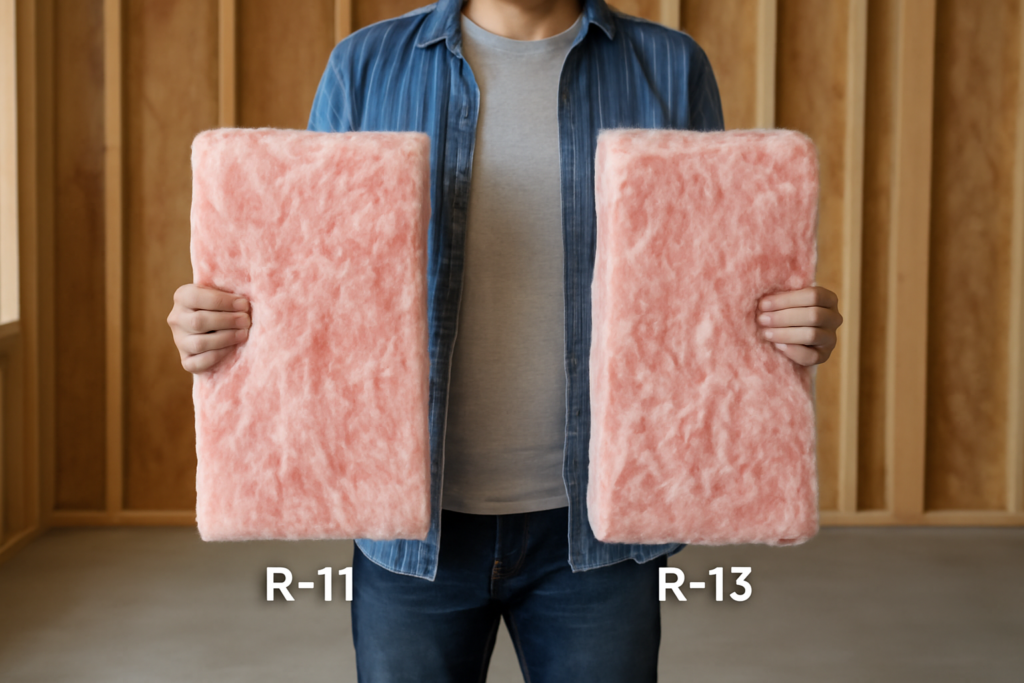
Stand in the insulation aisle and the two products look identical: same pink or yellow batts, same 3.5-inch thickness, same 15-inch width for standard stud bays. The difference between R11 and R13 insulation comes down to density — R13 packs more fiber into the exact same space, delivering about 18 percent more thermal resistance for roughly 10 to 20 percent more money. That sounds like a small decision, but multiplied across every exterior wall of a house, and filtered through modern energy codes that have quietly made R11 obsolete for most uses, it’s worth getting right. Here’s exactly how the two compare and which one belongs in your walls.
What the R-Numbers Actually Mean
R-value measures resistance to conductive heat flow — higher numbers slow heat better. An R13 batt resists heat flow 13/11ths as well as an R11 batt, an 18 percent improvement. Both products are engineered for the same cavity: a nominal 2×4 wall with 3.5 inches of depth. The manufacturers get more R into the same space by increasing fiber density; an R13 fiberglass batt simply contains more glass per cubic foot (and feels noticeably stiffer and heavier in hand) than an R11.
Because heat loss through an assembly is proportional to 1/R, the real-world energy difference is smaller than 18 percent: going from R11 to R13 cuts heat flow through the insulated cavity by about 15 percent. Frame that against the whole wall — studs, plates, windows, and headers bypass the insulation entirely, and framing typically occupies about 25 percent of a wall — and the whole-wall improvement is smaller still, on the order of 5 to 8 percent of wall losses. Meaningful, cheap, and permanent, but not transformative. Keep that honest math in mind when a salesman implies R13 will slash your bills.
Side-by-Side Comparison
The practical differences, product to product:
- Thermal resistance: R11 vs R13 — 18 percent more resistance, roughly 15 percent less heat flow through the cavity
- Thickness: identical at 3.5 inches; both fit a 2×4 wall without compression
- Density and feel: R13 is denser and stiffer; it friction-fits more securely and slumps less over time
- Sound: R13’s extra density buys a small acoustic edge — about 1-2 STC points in a typical wall, minor but real
- Price: R11 runs about $0.45-$0.65 per sq ft, R13 about $0.55-$0.80 per sq ft in 2026 — a difference of $0.10-$0.15 per square foot
- Availability: R13 dominates shelf space; R11 increasingly survives as a specialty and sound-control product
On a whole house with 2,000 square feet of exterior wall, upgrading from R11 to R13 costs roughly $200 to $300 more in materials. Typical energy modeling puts the resulting savings at $20 to $50 per year in a heating climate — a 5 to 10 year simple payback that then keeps paying for the life of the house. Since labor is identical, the upgrade is nearly always worth it when insulating anyway.
What the Energy Code Says
Here’s the fact that settles most R11-vs-R13 debates: modern code has already chosen. The IECC requires a minimum of R-13 in 2×4 exterior walls in climate zones 3 and up (zones 4-8 additionally push toward R-20 walls or R-13 plus continuous exterior foam), and even zone 2 jurisdictions along the Gulf commonly require R-13. R11 no longer meets code for new exterior walls in the vast majority of the country. Inspectors will fail an R11 wall where R13 is the prescribed minimum, and the fix — pulling drywall to reinsulate — costs vastly more than the batts ever would have.
Where does R11 remain legitimate? Interior partition walls insulated for sound rather than heat, where code sets no thermal minimum; floors over garages in mild climates under some older codes; and repair work matching existing insulation in walls that won’t otherwise be upgraded. If you’re buying insulation for any exterior application, treat R13 as the floor, not the choice.
When R11 Still Makes Sense
Sound control is R11’s honest niche. For interior walls — bedrooms against living rooms, laundry closets, home offices — the goal is absorbing airborne sound in the cavity, and the difference between R11 and R13 density is acoustically trivial; either turns a hollow drum of a wall into a reasonably quiet one. Since thermal performance is irrelevant indoors, buying whichever is cheaper per square foot is rational, and R11 (or purpose-made sound batts like Rockwool Safe’n’Sound, which outperform both) frequently wins on price during sales.
A second modest case: unconditioned outbuildings — sheds, workshops heated occasionally by a space heater — where code doesn’t apply and every dollar counts. Even there, though, the small price gap argues for R13 if the building will be heated regularly. And one clarification worth making: never choose R11 hoping to “leave room” in the cavity — both products are designed to fill 3.5 inches fully, and gaps or compression hurt performance far more than the R11/R13 delta. A poorly installed R13 batt with voids performs worse than a perfectly fitted R11.
Installation Quality Beats the Label
The dirty secret of batt insulation is that installation grade swings performance more than the number on the bag. Energy-rating protocols (RESNET) grade installations I through III, and a Grade III job — compressed batts, unfilled corners, gaps around wiring — can degrade effective performance by 15 to 30 percent, more than erasing the R11-to-R13 upgrade. To get what you paid for: split batts around wires rather than stuffing behind them, cut batts to fit around outlet boxes, fill narrow bays with cut pieces rather than jamming full-width batts, and fluff each batt to full loft touching all six sides of the cavity.
Kraft facing follows the same rules for both products: facing toward the warm-in-winter side (interior in most of the US), stapled to the stud faces or inset, never left exposed in living space (it’s flammable), and never doubled up with poly sheeting in mixed climates. If you’re paying an installer, ask what installation grade they’ll certify — it’s the single best question for separating pros from crews in a hurry.
Reading the Label: Facings, Widths, and Coverage
Both ratings come in the same configurations, and matching them to the job avoids returns. Kraft-faced batts suit standard exterior walls in most climates; unfaced batts serve interior sound walls and layered applications. Widths run 15 inches for 16-on-center framing and 23 inches for 24-on-center — buying the wrong width is the most common insulation-aisle mistake, since a 15-inch batt in a 24-inch bay leaves a permanent thermal gap no R-value can overcome. Coverage per bag differs with density: a typical R13 bag covers about 40 square feet less than the equivalent R11 count, so estimate off the printed coverage, not bag count. For a standard 8-foot wall, figure one batt per stud bay and round up a bag; leftover insulation always finds a use around rim joists and attic hatches.
Beyond Both: When to Skip the Question Entirely
If you’re already at the decision point with open walls, consider whether either batt is the right answer. For about double the material cost, R15 high-density batts extract the maximum from a 2×4 cavity (R-4.3 per inch) and are the code-smart pick where “R-13+” appears in local amendments. Damp-spray cellulose and blow-in blanket fiberglass fill the same walls void-free at R-13 to R-15 for competitive installed prices. And in cold zones, one inch of continuous exterior foam sheathing (R-5) added during residing beats any cavity upgrade because it blankets the studs themselves. The R11-vs-R13 question usually has a cheap right answer — R13 — but the wall as a system deserves a moment’s thought before the drywall goes on.
The Verdict
The difference between R11 and R13 insulation is 18 percent more thermal resistance at identical thickness for about a dime more per square foot — and a code landscape that has made R13 the effective minimum for exterior walls almost everywhere. Buy R13 (or better) for anything touching outdoor temperatures; save R11 for interior sound walls when it’s the cheaper option on the shelf. Then spend your real attention on installation quality, because a carefully fitted batt of either rating will quietly outperform a sloppy install of the other for the next fifty years.