Most flooring pros will quietly talk you out of carpet under a dining table, and they are not always right. A well-chosen dining room carpet softens the acoustics of a hard-surfaced home, warms cold feet on winter mornings, and turns a formal room into a place people actually want to linger. The catch is that the dining room is a war zone of red wine, gravy, and chair legs dragged across the same eight square feet every night. Pick the wrong fiber and you will regret it by Thanksgiving. Pick the right one, and you get a room that feels finished instead of echoey.
Should You Even Put Carpet in a Dining Room?
Plenty of homeowners assume carpet and dining simply do not mix. That belief comes from decades of plush, light-colored builder carpet that showed every drip. Modern stain-resistant fibers have changed the math. If your household is careful, or your dining room is more for holidays than for toddlers eating spaghetti, carpet is a reasonable and cozy choice.
Consider the room’s role honestly. A formal dining room used a dozen times a year can handle a softer, more luxurious carpet. An everyday eat-in space that doubles as homework central and the dog’s favorite nap spot needs something far more rugged, or arguably a large washable rug over a hard floor instead. There is no shame in choosing a low-pile commercial-grade carpet for a busy family.
Best Carpet Fibers for a Dining Space
Fiber choice matters more than color, price, or brand. Each material trades off stain resistance, durability, and softness differently.
- Solution-dyed nylon — the workhorse. Color runs all the way through each fiber, so it resists fading and bleaching. It cleans up well and bounces back under chair legs. Expect roughly $3 to $7 per square foot installed.
- Polyester (PET) — naturally stain-resistant and budget-friendly at $2 to $4 per square foot, but it crushes under traffic faster than nylon. Fine for a low-use formal room.
- Triexta (often sold as SmartStrand) — built-in stain protection that does not wash out over time, plus solid durability. A strong dining-room pick at around $4 to $6 per square foot.
- Wool — beautiful and resilient, but it stains more easily and runs $8 to $15 per square foot. Reserve it for low-spill formal rooms only.
For most dining rooms, triexta or solution-dyed nylon hits the sweet spot of cleanability and longevity. Skip anything marketed purely on softness without a stain-resistance rating.
Pile Height and Style: Why Low and Dense Wins
Deep, fluffy pile feels wonderful under bare feet but is a nightmare around a table. Chair legs sink in and snag, crumbs disappear into the depths, and spills wick down where you cannot reach them. A dense, low-pile loop or a tight cut-pile carpet is far smarter here.
Look for a pile height under half an inch and a high face weight, which measures how much fiber is packed in. A face weight of 40 ounces or more signals a dense, durable construction. Berber-style loop carpets shrug off foot traffic and hide dirt, though pets with claws can pull loops, so weigh that if you have cats. Patterned or multi-tonal carpets are your friend because they camouflage the inevitable small stains and dropped crumbs between cleanings.
Stain Defense: Your Real Concern
Wine, balsamic, turmeric, and grape juice are the enemies. Two layers of protection keep them from becoming permanent.
First, buy carpet with stain protection built into the fiber rather than sprayed on at the factory. Topical treatments wear off within a couple of years; integrated protection in triexta or solution-dyed nylon lasts the life of the carpet. Second, treat spills within minutes. Blot, never rub, working from the outside of the spill inward with a clean white cloth and cool water. Keep a bottle of mild dish soap solution nearby, and avoid bleach-based cleaners that can strip color from anything but solution-dyed fibers.
For a deeper routine, hot-water extraction once a year, sometimes called steam cleaning, lifts ground-in food residue that vacuuming misses. Renting a machine costs around $35 to $50 a day and is worth it before holiday entertaining.
Color and Pattern Choices That Hide Trouble
White carpet under a dining table is asking for heartbreak. Mid-tone colors and subtle patterns are the practical sweet spot. Warm grays, taupes, soft browns, and flecked multicolor weaves disguise crumbs and minor stains until your next cleaning.
That said, do not go so dark that every speck of lint and pet hair stands out. A medium-value, slightly textured carpet threads the needle. If you love a lighter look, choose a tight loop with a heathered blend of two or three tones rather than a solid cream.
Carpet vs. an Area Rug Over Hard Flooring
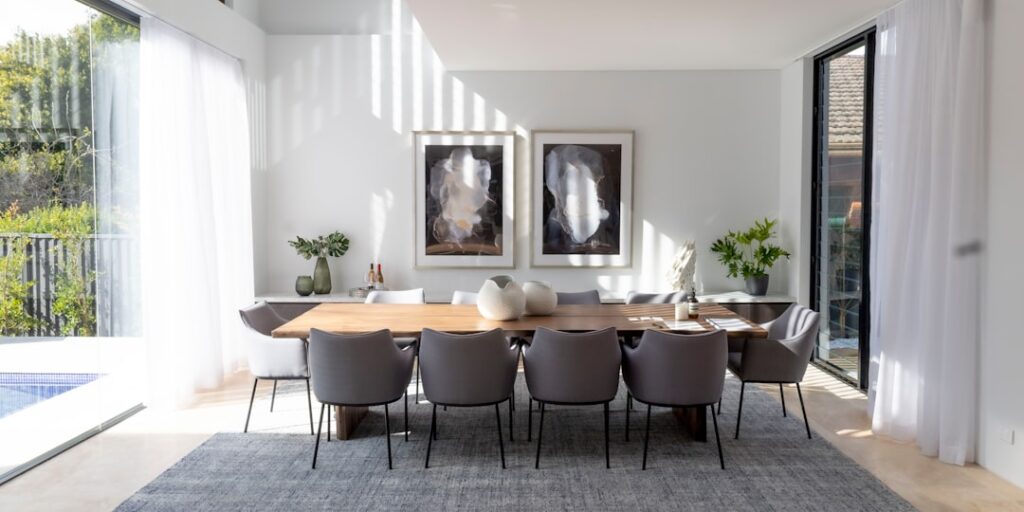
Wall-to-wall carpet is not your only option, and for many homes a large area rug over hardwood, laminate, or luxury vinyl is the better call. A rug can be rolled up, professionally cleaned, or replaced entirely without touching the floor beneath. Washable flatweave rugs and indoor-outdoor styles have made this even easier.
Size the rug correctly: it should extend at least 24 inches beyond the table on all sides so chairs stay on the rug even when pulled out. For a standard six-seat table, that usually means an 8-by-10-foot rug. Wall-to-wall carpet still wins on warmth and sound dampening, so the choice comes down to how much you value easy cleanup versus a fully soft floor.
Installation and Padding Notes
If you commit to wall-to-wall, the pad matters as much as the carpet. Use a firm, low-profile pad rated for dining and high-traffic areas, typically 7/16-inch thick at 6 to 8 pounds density. A thick, soft pad lets the carpet flex and wear out faster under constant chair movement.
Professional installation runs roughly $1 to $2 per square foot on top of materials and includes stretching the carpet tight so it does not ripple. Ask the installer to use a power stretcher, not just a knee kicker, for a tight, long-lasting result. Acclimate the carpet in the room for a day before installation so it settles to the home’s temperature and humidity.
The Bottom Line
Carpet in a dining room is not the mistake older homeowners remember, provided you choose deliberately. Lean toward a dense, low-pile triexta or solution-dyed nylon in a mid-tone, patterned color, set it over a firm pad, and keep a spill kit close. Do that, and your dining room gets the warmth and quiet of carpet without the constant anxiety of the next dropped fork. When the day comes that you want a change, you will know exactly which fibers and pile heights served you best, and you can repeat the formula with confidence.