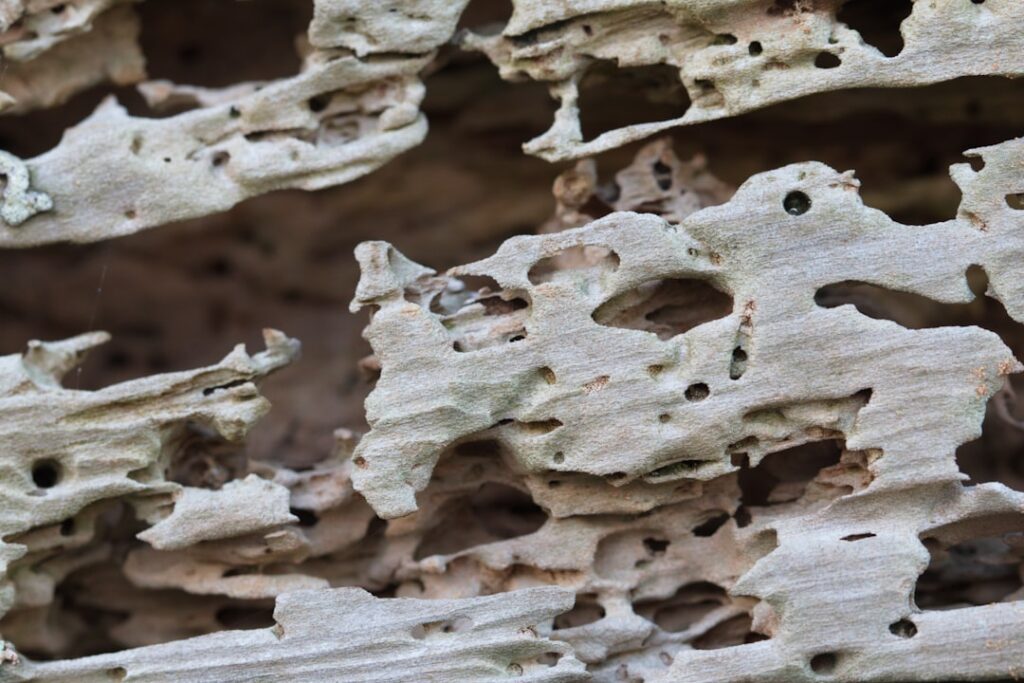
Homeowners tend to assume termites only threaten lumber, then discover pinholes and rippled paint marching across a bedroom wall. So, do termites eat drywall? Yes — readily. Drywall is a gypsum core sandwiched between two sheets of paper, and that paper is nearly pure cellulose, the only food termites actually want. The gypsum itself holds no nutrition, so termites tunnel through it or behind it while stripping the paper facings from the inside, which is why drywall damage so often stays invisible until a vacuum handle punches through a wall that looked painted and solid the day before. Understanding how termites use drywall — as food, highway, and cover all at once — is the difference between catching an infestation at the $500 stage and finding it at the $5,000 stage.
What Termites Actually Consume in a Wall
Termites digest cellulose with the help of gut microbes, and a sheet of 1/2-inch drywall offers it in two layers: the smooth face paper you paint and the gray backing paper against the studs. Subterranean termites — responsible for the overwhelming majority of US structural damage — typically enter from soil through the sill plate or slab cracks, travel up inside wall cavities, and graze the backing paper first, often hollowing the paper away in irregular sheets while leaving the painted face intact until the very end. Drywood termites, common in Florida, the Gulf Coast, and coastal California, live entirely inside wood and drywall with no soil contact, carving galleries and pushing out telltale piles of pellet-like frass.
The gypsum core is mineral and inedible, but it is soft enough that termites bore through it to reach more paper or wood, leaving pin-size holes they often plug with soil. That combination — eaten paper, tunneled core, mud speckling — is the drywall-specific signature that separates termites from every other wall problem.
The Warning Signs, Ranked by Reliability
Learn these in order of how definitive they are:
- Mud tubes: pencil-width earthen tunnels running up foundations, along baseboards, or inside cavities — subterranean termites’ protected highways, and essentially proof of infestation.
- Pinholes with soil specks: tiny (1/16-inch) holes in drywall, frequently rimmed or plugged with dried mud. Termites seal breaches to protect their humidity; nail pops and dart holes do not come with mud.
- Hollow-stripped paper: paint that bubbles, ripples, or looks water-damaged with no plumbing or roof anywhere nearby; pressing gently may crackle or break through where backing paper is gone.
- Frass piles: drywood termites eject six-sided pellets resembling coarse sand or coffee grounds from kick-out holes — find a small cone of it under a wall or windowsill and you have located a gallery.
- Swarmers and wings: winged reproductives emerging indoors (spring for most subterraneans, late summer for drywoods) or piles of shed wings on sills mean a mature colony is in or immediately under the structure.
- Sound cues: a faint papery rustling in walls, or trim that sounds dull and papery when tapped, corroborates but never diagnoses alone.
Termite Damage vs Moisture Damage: Telling Them Apart
Because both produce bubbled paint and soft spots, the confusion is universal — and consequential, since the fixes differ completely. Water damage stains in tide-ring patterns of tan and brown, feels damp or chalky, sags downward with gravity, and clusters below plumbing, windows, or roof planes. Termite damage shows no water staining, follows vertical and diagonal paths that track hidden framing, includes mud flecks and pinholes, and often reveals rippled, mazelike channeling in the paper when you shine a flashlight across the surface at a raking angle. The definitive check costs nothing: cut a small inspection hole in the suspect area and look at the back of the drywall — stripped paper with soil deposits settles the question in seconds. A $30 moisture meter helps too; termite galleries in an otherwise dry wall read dry, while a leak reads wet.
One overlap trap: termites are drawn to moisture, so chronic leaks and termite entry frequently share an address. Finding one justifies checking for the other.
What to Do the Day You Find Evidence
Resist the two instinctive mistakes. Do not spray the visible termites with household insecticide — you will kill a few dozen workers, scatter the rest deeper into the structure, and complicate professional treatment. Do not rip out all the damaged drywall immediately, either; inspectors and treatment techs read the damage pattern to map the colony’s routes, and demolition erases the map. Instead: photograph everything, note locations, and book inspections — most reputable pest control companies (Terminix, Orkin, and quality regional independents) inspect free or for $75 to $150, and getting two opinions on treatment scope is standard advice.
Verify the species identification in the report, because it drives everything: subterranean treatment attacks the soil connection, while drywood treatment attacks the wood itself.
Treatment Options and Realistic Costs
For subterranean termites, two proven approaches dominate. Liquid soil treatments — trenching and injecting a non-repellent termiticide such as fipronil (Termidor) around the foundation — run $3 to $16 per linear foot, typically $1,200 to $2,500 for an average home, and protect for 8 to 10 years. Bait systems (Sentricon and similar) place growth-inhibitor stations around the perimeter for $1,500 to $3,000 installed plus $250 to $400 annual monitoring, and excel where slabs, wells, or drainage make trenching impractical. For drywood termites, localized gallery injection handles small confirmed infestations ($300 to $1,500), while widespread activity means whole-structure fumigation — tenting — at $1,200 to $4,000 for a typical house, the only method that reaches every gallery.
Drywall repair follows only after treatment: cut damaged board back to sound material on stud centers, verify studs behind (termite-grazed framing may need sistering or replacement — this is where costs escalate), then patch, tape, and finish. Small repairs run $200 to $500 done professionally; a room’s worth of walls plus framing repair can reach several thousand. Homeowners insurance almost never covers termite damage, which insurers classify as preventable — a fact that reframes the annual inspection as very cheap coverage.
Prevention: Making Drywall a Dead End
Every effective prevention measure attacks the same three termite needs — soil access, moisture, and undisturbed cover. Keep soil and mulch at least 6 inches below siding and never piled against stucco or foundation weep screeds. Fix grade and gutters so the foundation perimeter stays dry, and repair plumbing drips promptly, especially in slab homes where a warm, moist bathroom trap area is a subterranean magnet. Store firewood and lumber scraps off the ground and away from the house. Seal foundation cracks and utility penetrations. In high-pressure regions — the Southeast above all — an annual professional inspection ($75 to $150) or a maintained bait system is simply part of owning a home; termites cause an estimated $5 billion-plus in US damage yearly, nearly all of it uninsured.
Building or remodeling? Ask about borate-treated framing and paperless drywall. Fiberglass-faced boards like DensArmor Plus remove the paper food source entirely — originally a mold product, but an equally elegant termite countermeasure for basements and slab-adjacent walls.
The Bottom Line
Termites eat drywall enthusiastically — the paper, not the gypsum — and use the board’s hollow anatomy to stay hidden while they do it. Pinholes with mud, rippled paint with no water source, mud tubes, and frass are the tells; a flashlight held at a raking angle and one small inspection cut will confirm what a glance cannot. When evidence appears, skip the spray can, get professional eyes on the pattern, treat the colony with soil chemistry, bait, or fumigation as the species dictates, and only then rebuild the wall. Drywall is cheap and endlessly patchable. The framing behind it is neither — which is exactly why the paper-thin early warnings on the wall surface deserve to be taken seriously the week you notice them.
If you are buying a home in termite country, extend the same logic to the transaction: order a dedicated wood-destroying organism inspection (the WDO or “termite letter,” $75 to $150) rather than relying on the general home inspection, ask whether the property carries a transferable termite bond, and treat fresh paint on a single interior wall of an otherwise dated house as a question worth asking. Sellers patch what they can see; the inspection exists to find what they could not.