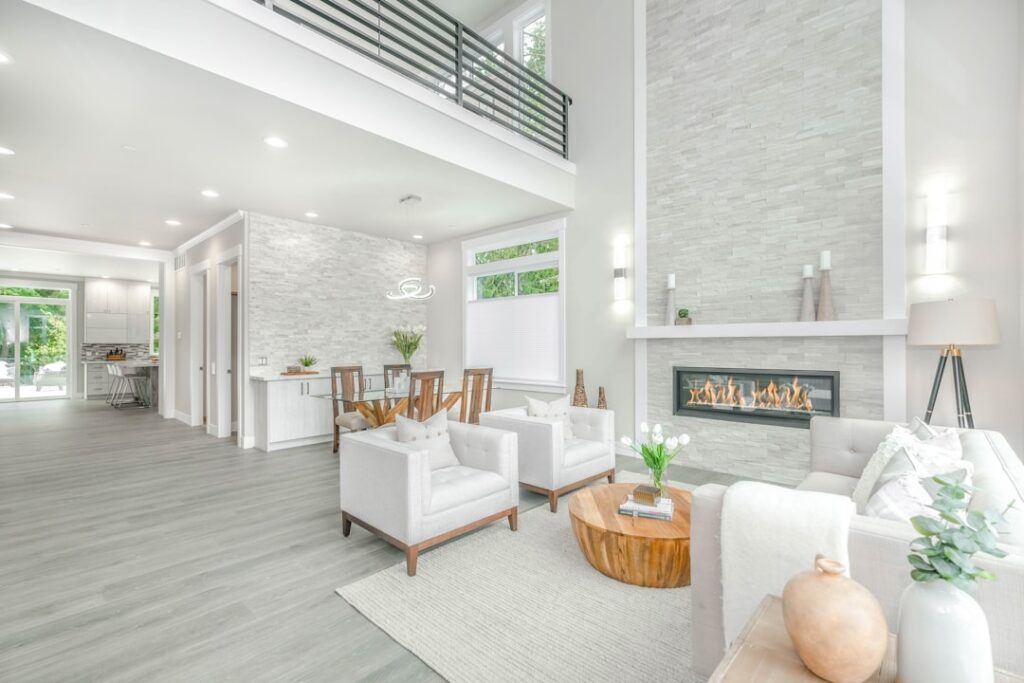
A single ceiling fan moves air in a roughly circular footprint, which is why long, narrow rooms end up with a cool spot in the middle and stagnant air at both ends. A double ceiling fan solves that by putting two fan heads on one fixture, spreading airflow across a much wider area from a single mounting point. For great rooms, covered patios, and open floor plans, it delivers even comfort that one fan simply cannot.
What a Double Ceiling Fan Is
A double, or dual, ceiling fan mounts two rotating fan heads on a single horizontal bar or frame. The heads can sit at the ends of a rod that hangs from one ceiling mount, or on an assembly that connects to a shared motor. Either way, you cover twice the linear space of a standard fan while drilling just one hole in the ceiling. Many models let each head oscillate or tilt, directing air where you want it.
Dual-Motor Versus Belt-Driven Styles
There are two mechanical approaches, and they behave differently.
- Dual-motor: Each fan head has its own motor. Heads often adjust independently and can sometimes run at different speeds, offering the most flexible airflow.
- Single-motor belt-driven: One central motor spins both heads through a belt or gear system. These evoke a vintage, industrial look and run with a distinctive slow, sweeping motion.
Dual-motor units are the practical choice for maximizing airflow in a modern room, while belt-driven designs are chosen as much for style as for performance.
Where a Double Fan Makes Sense
These fans are not for every room. They earn their place in specific layouts:
- Long rectangular rooms: Great rooms and open-concept living-dining spaces
- Covered porches and patios: Wide outdoor spaces that need broad air movement
- Sunrooms and enclosed porches: Long, glassy rooms that heat up unevenly
- Home gyms and workshops: Large spaces where one fan leaves dead zones
In a standard square bedroom, a single well-sized fan is cheaper and looks more proportional. Save the double fan for spaces where a single unit genuinely leaves air stagnant.
Sizing for the Space
Blade span drives coverage, and a double fan is measured by its total width, the tip-to-tip distance across both heads. A double fan can span 60 inches, 72 inches, or more, covering rooms that would otherwise need two separate fans. As a rough guide, a room longer than 18 feet or wider than one fan can comfortably serve is a candidate. Measure the length you need to cover and pick a total span that reaches within a few feet of both ends.
Ceiling Height and Clearance
Airflow and safety both depend on hanging height. Blades should sit at least 7 feet above the floor and ideally 8 to 9 feet for best circulation. Keep the tips of both heads at least 18 to 24 inches from the nearest wall or obstruction so air can circulate freely. For a room with an 8-foot ceiling, use a flush or short downrod mount. For vaulted or high ceilings, a longer downrod brings the fan down into the occupied zone where you feel the breeze.
Airflow and Performance
The whole reason to buy a double fan is moving more air, so check the airflow rating, measured in cubic feet per minute, or CFM. Two efficient heads together should push a high combined CFM. Look for a DC motor if you want quiet operation and lower energy use, since DC fans draw a fraction of the power of older AC models while delivering strong airflow. In summer, both heads should spin counterclockwise to push cooling air down; in winter, reverse them to gently recirculate warm air trapped near the ceiling.
Installation Considerations
A double fan weighs more than a standard fan and creates more torque, so mounting is not something to improvise. It must hang from an electrical box rated and labeled for ceiling fan support, secured to a joist or a proper fan-rated brace, never a standard light-fixture box. Because these units are heavy and awkward, an extra set of hands makes the job far safer. If the existing box is not fan-rated, replace it before hanging the fan. For outdoor installation, confirm the fan is wet-rated or damp-rated to match its exposure.
Controls and Smart Features
How you operate a double fan matters more than on a single unit, because you may want the two heads behaving differently. Most models include a handheld remote or a wall control that manages speed, direction, and the light kit. On dual-motor fans, look for controls that let each head run independently, so you can angle and speed them to suit how the room is used.
Smart double fans add another layer, connecting to Wi-Fi so you can control them by app or voice assistant and set schedules. In a great room, that means the fan can ramp up in the afternoon heat and idle overnight without anyone touching a switch. If you choose a smart model, confirm any dimmable light kit uses LED-compatible controls to avoid flicker. For a large or high-ceiling room where reaching a pull chain is impractical, remote or smart control is less a luxury than a necessity.
Is a Double Ceiling Fan Right for You
For the right room, a double ceiling fan delivers balanced, whole-space cooling from a single fixture, often at less cost and visual clutter than installing two separate fans. Expect to pay $150 to $500 or more depending on size, motor type, and finish. Confirm your ceiling height, measure the span you need to cover, and verify a fan-rated mount, and you will get even airflow across a space that a single fan would always leave partly stagnant.