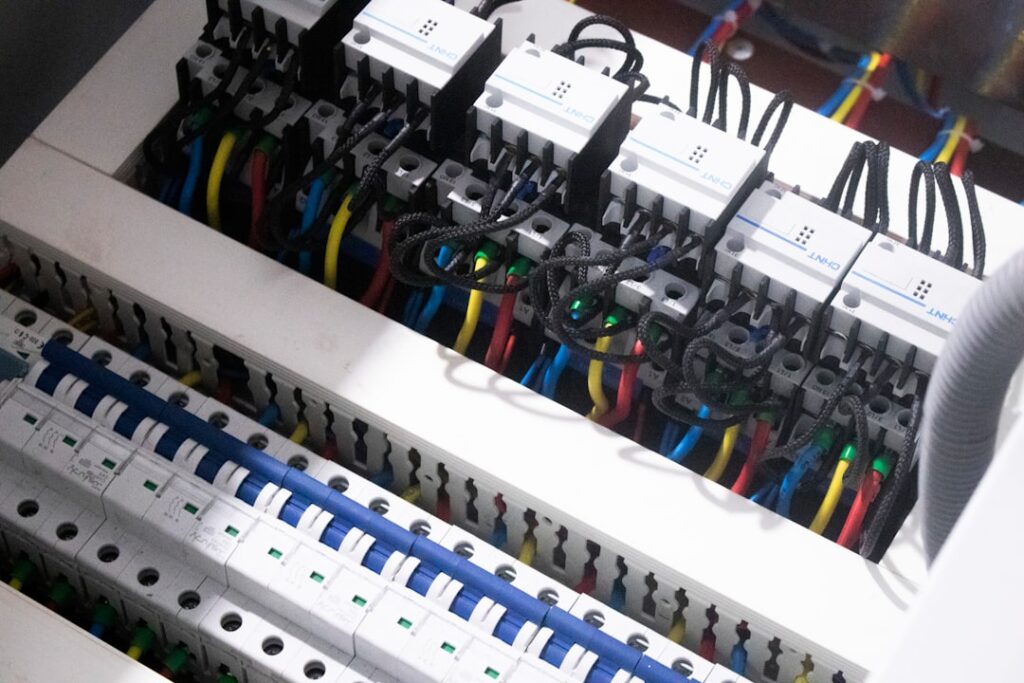
Most DIYers discover pigtails the first time they try to install an outlet in a middle-of-run box and realize the existing wires will not reach the terminals. An electrical pigtail is a short jumper wire that connects multiple conductors to a single device terminal, and it solves wiring problems that would otherwise require pulling new cable. This guide covers when pigtails are required by code, how to make them correctly, and the mistakes that cause loose connections and fire hazards.
- What an Electrical Pigtail Actually Is
- When the NEC Requires a Pigtail
- Tools You Need to Make a Pigtail
- How to Make a Wire Nut Pigtail
- How to Make a Wago Lever Nut Pigtail
- Connecting the Pigtail to the Device
- Pigtailing for Aluminum Wiring
- Common Pigtail Mistakes
- Pigtailing Grounds and Neutrals Correctly
What an Electrical Pigtail Actually Is
A pigtail is a 6-inch piece of wire with one end spliced to two or more incoming conductors using a wire nut or push-in connector, and the other end landed on a device screw terminal. The splice is made inside the electrical box. The pigtail lets three, four, or five wires effectively connect to a single screw, since most device terminals accept only one conductor each.
The wire used for a pigtail must match the gauge of the existing circuit. A 15-amp circuit uses 14-gauge wire, so the pigtail is 14-gauge. A 20-amp circuit uses 12-gauge. Mixing gauges creates a weak point that heats up under load.
When the NEC Requires a Pigtail
The National Electrical Code requires pigtails for the neutral wire on multi-wire branch circuits. If a single cable feeds two circuits that share a neutral, that neutral must be pigtailed so removing the outlet does not break the neutral path for the upstream circuit. Section 300.13(B) of the NEC covers this requirement specifically.
Pigtails are also the safest method anytime more than two wires land on a device. Backstab holes on the rear of outlets technically allow multiple connections, but those push-in connections fail at roughly 3x the rate of screw terminals over a 20-year span. Pigtailing to a single screw connection eliminates that failure point.
Tools You Need to Make a Pigtail
Wire strippers rated for both 14 and 12 gauge are essential. Klein Tools 11061 at $22 handles both sizes cleanly. You also need lineman pliers for twisting wire splices tight, a pair of needle-nose pliers for forming the hook on the device end, and a voltage tester to confirm power is off before you start.
Wire nuts come color-coded by capacity. Yellow nuts handle 2 to 4 wires of 14 or 12 gauge. Red nuts take larger bundles up to 5 wires of 12 gauge. Push-in connectors like Wago 221 series cost about $0.35 each but provide faster, more reliable splices than wire nuts in many cases.
How to Make a Wire Nut Pigtail
Turn off the breaker and confirm power is dead with a non-contact tester. Strip 3/4 inch of insulation from the ends of the incoming conductors and one end of your 6-inch pigtail. Hold all the stripped ends parallel, aligned at the tips.
Pre-twist the wires clockwise with lineman pliers for 3 to 4 twists. Twist the wire nut on clockwise until it is firmly seated and the wires turn together under the nut. Tug each wire individually to check. If any wire pulls free, start over. A proper splice never has wires visible below the nut skirt.
How to Make a Wago Lever Nut Pigtail
Wago 221 lever nuts have transparent housings that let you see the wire insertion depth. Lift the lever on each port. Insert a stripped wire (5/8 inch of bare copper) fully until it bottoms out. Close the lever. The internal spring bar clamps the conductor against a busbar.
Wago connectors accept mixed conductor types, including solid copper, stranded, and even aluminum-to-copper with the appropriate model. They also allow you to disassemble and redo a splice without cutting wire, which saves conductor length in tight boxes. For a pigtail with three incoming wires and one outgoing, use a 4-port Wago 221-414.
Connecting the Pigtail to the Device
Strip the device end of the pigtail 3/4 inch. Form a tight J-hook with needle-nose pliers that wraps about 2/3 of the way around the screw. The hook must curve clockwise so tightening the screw pulls the hook closed, not open.
Tighten the screw to the torque spec printed on the device, usually 12 to 14 inch-pounds for receptacles. A torque screwdriver like the Klein 6-in-1 with torque indicator ensures you do not undertighten (loose connection, arcing) or overtighten (stripped threads, broken screw head). This small detail matters because loose device connections are a leading cause of residential electrical fires.
Pigtailing for Aluminum Wiring
Homes built between 1965 and 1973 often have aluminum branch circuits, which fail at connection points due to oxidation and thermal expansion. Pigtailing aluminum to a copper jumper with a COPALUM crimp or Alumiconn connector is the accepted remediation, and many insurance companies require it on aluminum-wired homes.
Alumiconn connectors cost $2 to $3 each and require the addition of antioxidant compound like NoAlox on the aluminum conductor before insertion. A licensed electrician typically does this work, but the product is available at electrical supply houses for DIYers who understand the risks. Never use standard wire nuts on aluminum-to-copper splices.
Common Pigtail Mistakes
Using scrap wire of the wrong gauge is the top error. A 14-gauge pigtail on a 20-amp circuit becomes the weak link that overheats under load. Always match or exceed the circuit gauge. Another mistake is making pigtails too short. Six inches is the minimum. Any less and you cannot fold the splice neatly back into the box.
Skipping pre-twisting before installing a wire nut causes splice failures. The nut alone cannot reliably pull random wires into contact. Finally, stuffing splices into an undersized box violates fill requirements. Each wire nut counts as a device in box-fill calculations, so three splices and an outlet in a standard 18-cubic-inch box often exceeds limits.
Pigtailing Grounds and Neutrals Correctly
All ground wires in a box must be pigtailed together, including the ground screw on a metal box. Green wire nuts with a hole in the top are designed specifically for ground splices and allow one conductor to pass through to the box screw without stripping.
Neutrals on multi-wire branch circuits must be pigtailed as noted earlier. For standard single circuits, pigtailing neutrals is not code-required but is still best practice when more than two neutrals share a device. Current on a broken neutral at a mid-run outlet can make downstream loads see 240 volts, destroying electronics. A pigtail prevents that failure mode entirely.