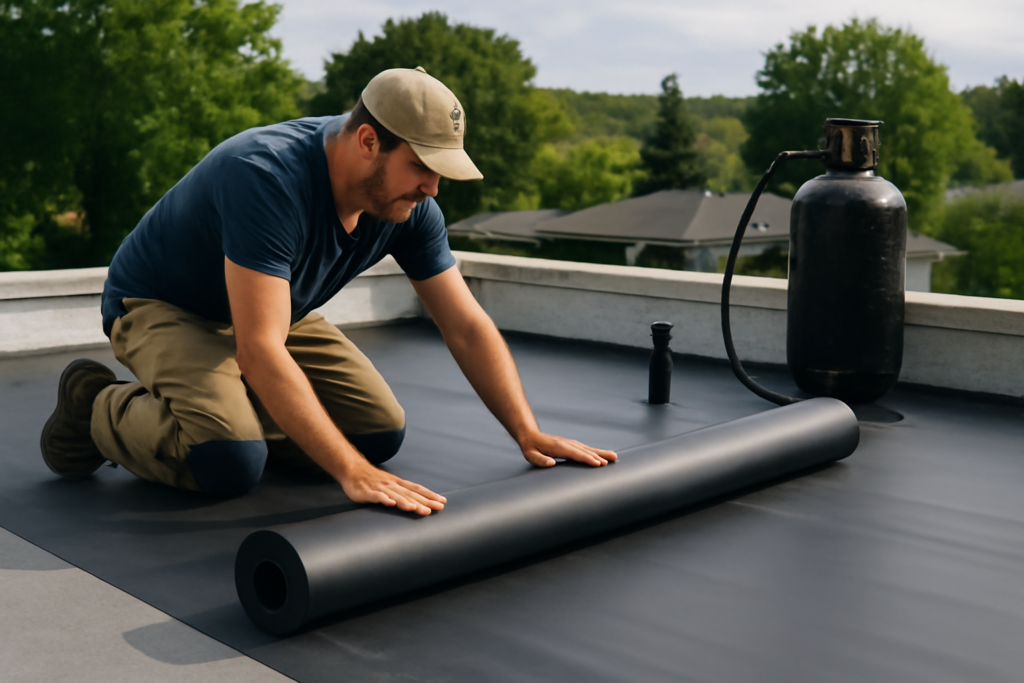
If you have a flat or low-slope roof, over a garage, an addition, a modern home, or a commercial building, odds are good the answer is a rubber membrane. An EPDM roof system is a single-ply synthetic rubber membrane that has covered low-slope roofs for more than 40 years because it is durable, affordable, and forgiving of the ponding water that destroys other flat-roof materials. Understanding how an EPDM roof system works, and how it is installed, helps you judge a contractor’s quote and get a roof that lasts three decades.
What an EPDM Roof System Actually Is
EPDM stands for ethylene propylene diene monomer, a synthetic rubber. The material arrives as large sheets, commonly in widths from 10 to 50 feet and thicknesses of 45, 60, or 90 mils (thousandths of an inch), that roll out to cover the roof with very few seams. That is a key advantage: fewer seams mean fewer places to leak.
It comes in black or white. Black EPDM is the traditional, lowest-cost version and absorbs heat, which helps melt snow in cold climates. White EPDM, or a white-coated version, reflects sunlight and reduces cooling loads in hot regions, functioning as a cool roof. The material stays flexible in extreme cold and resists UV, ozone, and weathering, which is why a properly installed rubber roof routinely lasts 25 to 30 years or more.
The Three Installation Methods
How the membrane attaches to the roof deck defines the system, and each method suits different situations:
- Fully adhered: The membrane is glued to the substrate with bonding adhesive across the whole surface. It lies flat and clean, handles high wind well, and looks best, but costs the most in labor.
- Mechanically fastened: The membrane is held down with plates and screws along the seams, then covered by the next sheet. Faster and cheaper, though the fasteners can telegraph and it relies on strong seams.
- Ballasted: The membrane lies loose and is held down by a layer of smooth river rock or concrete pavers. Cheapest to install, but the weight requires a structure that can carry it, and the ballast hides leaks.
For most residential low-slope roofs, fully adhered is the preferred method because it looks clean, resists wind, and makes future leak-tracing straightforward. Ask which method a quote is based on, since the price differences are significant.
Seams: Where EPDM Roofs Succeed or Fail
Because EPDM comes in wide sheets, a residential roof may have only a few seams, but those seams are the make-or-break detail. Older EPDM used a liquid seam adhesive that degraded over time and was the leading cause of leaks. Modern systems use factory-applied seam tape, a self-adhering splice tape that creates a far stronger, more durable bond.
Insist on tape-seamed construction rather than the old glued laps. The seams should be clean, fully rolled, and sealed with lap sealant at the exposed edges. Penetrations, vents, pipes, and curbs, are flashed with pre-molded EPDM boots and uncured flashing that molds around irregular shapes. Sloppy flashing at penetrations, not the field of the membrane, is where most rubber roofs eventually leak, so this detailing is worth scrutinizing.
What an EPDM Roof System Costs
EPDM is one of the most economical flat-roof options, which is a big part of its popularity. Installed pricing generally runs $4 to $9 per square foot depending on membrane thickness, installation method, insulation, and access. Thicker 60-mil membrane costs a bit more than 45-mil but resists punctures and hail better and is worth the small upcharge on a roof you will walk on.
For a typical 1,500-square-foot flat roof, expect roughly $6,000 to $13,500 installed. The price includes tearing off the old roof if needed, installing insulation board to build the required slope and R-value, and the membrane itself. White EPDM and fully adhered installs sit at the higher end. Compared with alternatives like TPO or PVC, EPDM is usually cheaper per square foot, though the reflective single-plies can edge it out on energy in hot climates.
How It Compares to TPO and PVC
EPDM is not the only single-ply membrane, and the choice depends on climate and priorities. TPO (thermoplastic polyolefin) and PVC are white, heat-welded membranes whose seams are fused with hot air rather than taped, creating a monolithic bond many contractors prefer. Both reflect heat well, making them strong choices in hot, sunny regions.
EPDM’s edge is longevity and cold-weather flexibility; the rubber stays pliable in deep cold where some thermoplastics can get brittle, and it has the longest field track record. TPO and PVC’s edge is the welded seam and reflectivity. For a shaded northern roof or one where budget rules, EPDM is often the smart pick; for a sun-baked cooling-driven roof, a white welded membrane may pay back in energy. All three, installed well, are solid; installation quality matters far more than the brand of membrane.
Maintenance and Repairs
One of EPDM’s best traits is how easy it is to maintain and repair. Inspect the roof twice a year and after storms, looking at the seams, the flashing around penetrations, and any spots where debris collects. Clear leaves and branches, since standing debris holds moisture and can abrade the membrane over years.
Small punctures and tears are simple to patch: clean the area, apply primer, and press on an EPDM patch with seam tape, a repair a handy owner can do or a roofer can knock out in an hour. Reseal the lap edges with fresh lap sealant if the old bead cracks. Every 10 to 15 years, a black EPDM roof can be recoated with a reflective acrylic coating to extend its life and cut heat. This repairability is a major reason building owners stick with rubber roofs.
Is an EPDM Roof Right for You?
An EPDM roof system is an excellent choice when you have a flat or low-slope roof, want a proven material at a reasonable price, and value long life and easy repair over maximum reflectivity. It shines on residential additions, detached garages, porch roofs, and modern flat-roofed homes, especially in cold and mixed climates.
Look elsewhere only if energy reflectivity in an intensely hot climate is your top priority, where a white TPO or PVC may nudge ahead, or if you dislike the look of black rubber and do not want to pay for white. Whatever you choose, the installer matters more than the material. Hire a contractor with a real portfolio of single-ply roofs, insist on taped seams and proper penetration flashing, and get an itemized quote that specifies membrane thickness and attachment method. Do that, and a rubber roof will quietly protect the building for a quarter century or more.
The Role of Insulation and Slope
An EPDM roof is only as good as what sits beneath it, and on a flat roof the insulation layer does double duty. Rigid polyiso insulation board goes down over the deck before the membrane, providing the R-value the building needs and, critically, building the slight slope that keeps water moving. A truly flat roof ponds water, and while EPDM tolerates ponding better than most materials, standing water accelerates aging and finds any weak seam. Tapered insulation, cut at a slight pitch, creates positive drainage toward the drains or scuppers, usually a minimum of 1/4 inch of fall per foot.
Do not let a contractor skip or skimp on this layer. Ask what R-value the insulation provides and whether tapered board is being used to direct drainage, because a code-compliant flat roof in most regions needs both adequate insulation and positive slope. On a re-roof, the crew may add insulation over the old roof to improve both energy performance and drainage at once. Proper drainage design is the difference between a rubber roof that lasts its full 25 to 30 years and one that develops chronic leaks at the low spots within a decade. It is invisible once the membrane is down, which is exactly why it is worth specifying clearly in the contract before work begins.
Two edge details round out a durable rubber roof and deserve a mention in any quote. The first is termination and edge metal: the membrane must be properly fastened and sealed where it meets the roof perimeter, with a metal drip edge or coping that locks the edge down against wind uplift and directs runoff into the gutters rather than behind the fascia. The second is the drainage outlets themselves, whether interior drains, scuppers, or gutters, which must be sized and positioned at the true low points so water actually leaves the roof. A rubber membrane can be flawless in the field and still fail if wind peels a poorly terminated edge or water backs up at an undersized drain. When you review a proposal, confirm it names the edge metal, the termination method, and the drainage outlets, not just the membrane. Those perimeter and drainage details, combined with taped seams and good penetration flashing, are what carry an EPDM roof through decades of weather with only routine care.