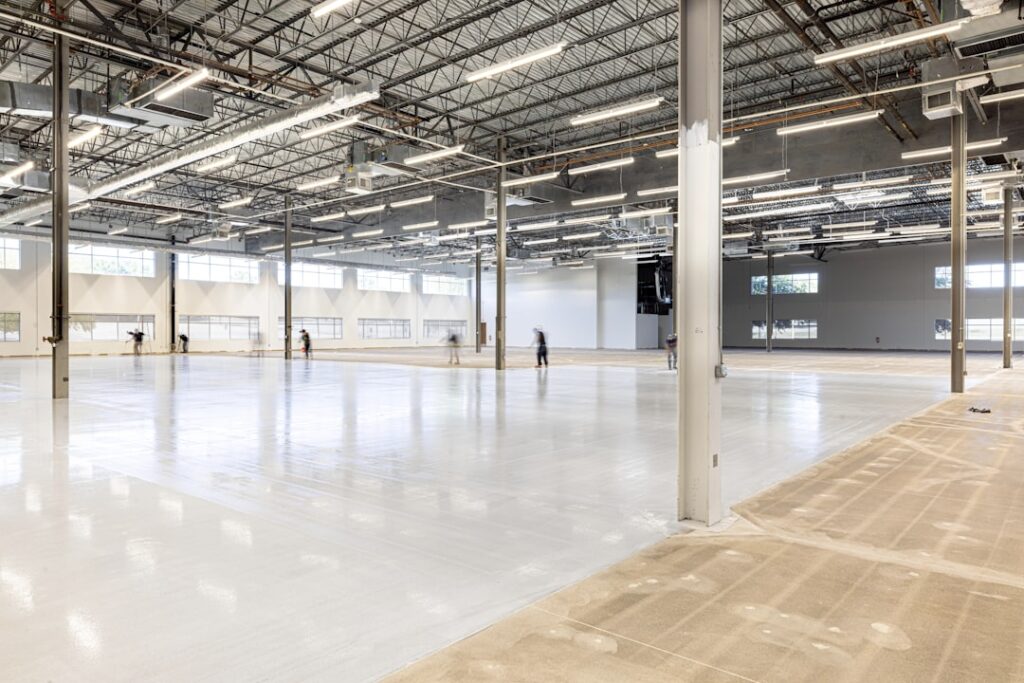
A person walking across ordinary vinyl tile on a dry winter day can build up 12,000 volts or more of static charge — and it takes as little as 20 volts to damage a modern semiconductor. That gap is the entire reason esd conductive flooring exists. ESD (electrostatic discharge) flooring is engineered to drain static electricity out of people and equipment through the floor to ground, instead of letting it accumulate and discharge into a $4,000 circuit board, a data center rack, or an operating-room instrument. I’ve specified and installed static-control floors in electronics plants, server rooms, and labs, and the category is full of jargon that gets misused even by people selling it. Here’s the working knowledge: what these floors are, who genuinely needs them, the conductive-versus-dissipative distinction, the resistance numbers that define everything, and what installation really involves.
How ESD Flooring Works
Three things have to happen for a static-control floor to do its job. First, the flooring material itself must be conductive enough to move charge — manufacturers achieve this with carbon veins, carbon-loaded backings, conductive polymers, or metallized fibers running through vinyl, rubber, epoxy, or carpet tile. Second, the installation must create a path to ground: conductive adhesive spread beneath the flooring connects to copper grounding strips, which tie to the building’s electrical ground — typically one ground point per 1,000 square feet or so, per manufacturer spec. Third, the person standing on it must be part of the circuit, which is why true ESD programs pair the floor with ESD footwear or heel straps; a static-control floor under ordinary sneakers is largely wasted, because rubber soles insulate the body from the beautifully grounded floor below. Floor, ground path, footwear — miss any leg of that triangle and the system fails audits.
Conductive vs Dissipative: The Distinction Everyone Fumbles
Both are “ESD flooring,” and the difference is simply how fast they drain charge, defined by electrical resistance ranges measured under ANSI/ESD S7.1 test methods:
| Classification | Resistance Range | Drain Speed | Typical Use |
|---|---|---|---|
| Conductive (ECF) | 2.5 × 10⁴ to 1 × 10⁶ ohms | Fastest | Electronics manufacturing, munitions, cleanrooms |
| Static-dissipative (DIF) | 1 × 10⁶ to 1 × 10⁹ ohms | Controlled, slower | Server rooms, labs, offices with electronics |
| Anti-static (label only) | Often unspecified | Reduces generation only | Marketing term — not a grounding floor |
Conductive flooring sits at the low-resistance end: charge drains almost instantly, which is what electronics assembly demands. Static-dissipative flooring drains charge in a slower, more controlled way. Counterintuitively, more conductive is not automatically better — in spaces with live electrical work or where personnel safety around energized equipment matters, extremely low resistance raises shock-path concerns, which is why many end-of-range specs (and most data centers) land in the dissipative band, and why the industry benchmark ANSI/ESD S20.20 evaluates the total system (floor plus footwear plus person) rather than the floor alone. The critical spec there: the complete system must keep body voltage generation under 100 volts, with system resistance to ground below 1 × 10⁹ ohms. And treat “anti-static” on a consumer product as a red flag masquerading as a credential — it usually means the material generates less static than standard flooring, not that it grounds anything.
Who Actually Needs ESD Flooring
Legitimate use cases, roughly in order of stringency: electronics manufacturing and assembly — PCB lines, semiconductor fabs, repair benches — where S20.20 compliance is contractual and conductive floors are standard; defense, aerospace, and munitions handling, where a spark is a safety event, not just a warranty claim; data centers and server rooms, protecting racks during maintenance (dissipative is the norm); healthcare and labs — operating suites with sensitive instrumentation, MRI areas, flammable-anesthetic legacy specs; cleanrooms in pharma and optics, where ESD tile often doubles as the particle-control surface; and 911 call centers, flight control, and telecom switch rooms, where uptime is the whole business. Who doesn’t need it: the home office. A humidifier, a grounded wrist strap at the workbench, and an ESD mat cover hobby-electronics needs for under $50 — a genuine ESD floor is a system purchase, not a plank you click together.
Material Options and Real Costs
ESD vinyl tile and sheet (the workhorse): conductive or dissipative homogeneous vinyl with carbon pathways, glue-down over conductive adhesive. Durable, cleanable, the default in electronics plants. Material runs roughly $4 to $8 per square foot, installed $8 to $15. ESD rubber: quieter, more comfortable underfoot, naturally lower static generation, ergonomically the best for standing operators; installed around $10 to $18 per square foot. ESD epoxy and urethane coatings: seamless conductive systems over concrete, great for forklifts and heavy manufacturing; $5 to $12 per square foot applied, but performance depends heavily on installer skill and slab condition. ESD carpet tile: conductive fibers plus carbon-loaded backing — the office-friendly option for control rooms and data-adjacent spaces; $5 to $10 per square foot installed. Raised access floor panels: data-center standard, with dissipative laminate surfaces on grounded pedestals. Across every category, add the system components people forget to budget: conductive adhesive (a meaningful upcharge over standard), copper grounding strips and straps, and post-install resistance testing.
Installation: Where ESD Floors Pass or Fail
An ESD floor is an electrical system that happens to be walked on, and it fails like an electrical system — at the connections. The non-negotiables I hold every install to: concrete moisture testing first, since glue-down conductive systems inherit every slab-moisture problem ordinary glue-downs have; full-spread conductive adhesive, never standard adhesive “because it was on the truck” — standard glue electrically isolates a conductive tile and turns it into expensive ordinary vinyl; grounding strips placed per manufacturer layout and physically bonded to electrical ground by a qualified electrician; and verification testing after cure — resistance-to-ground readings at multiple points across the floor documented against ANSI/ESD S7.1, because an untested ESD floor is an unproven ESD floor. For facilities chasing S20.20 certification, that documentation is the audit trail. Expect a competent commercial crew, not a general handyman; the price difference is real and so is the performance difference.
Maintenance: The Part That Quietly Breaks Compliance
More ESD floors fail in year three than on install day, and the culprit is almost always cleaning. Ordinary floor finishes and waxes are insulators — one well-intentioned coat of standard acrylic finish can push a conductive floor’s surface resistance out of spec entirely. The rules: clean with neutral or manufacturer-approved ESD cleaners only; if a finish is used at all, it must be a certified conductive/dissipative finish; no standard “mop and glow” products, ever; and re-test resistance annually (quarterly in certified facilities) plus after any change of cleaning contractor — a sentence I include in specs because I’ve watched a new janitorial vendor wax a lab out of compliance in a single weekend. Humidity control helps the whole program: static generation soars below about 30 percent relative humidity, so HVAC setpoints are part of ESD strategy, though never a substitute for a grounded floor since low-humidity winter days are precisely when protection matters most.
Specifying: The Questions That Get You the Right Floor
If you’re the one writing the purchase order, get answers to five questions. What standard governs — S20.20 certification, a customer flow-down spec, or general best practice? What resistance band does the process require — conductive for assembly, dissipative for occupied IT space? What footwear program will exist — because floor-plus-footwear is the tested system? What are the traffic and chemical exposures — forklifts point to epoxy, standing operators to rubber, offices to carpet tile? And who tests and documents post-install and annually? Bring those five answers to any reputable manufacturer — the established names in conductive vinyl and rubber all publish system specs — and the product selection largely makes itself.
The honest summary from the installation side: ESD conductive flooring is cheap insurance in any building where static costs real money — a full system for a 2,000-square-foot lab might run $20,000 to $30,000, less than the value of the components it protects in a single quarter. But it only works as a system: the right resistance class for the job, conductive adhesive and real grounding underneath, footwear on the people, approved chemistry in the mop bucket, and a meter on the floor once a year. Buy it that way, maintain it that way, and static quietly stops being one of your failure modes.
Prefer to explore on your own?
See how new flooring looks in your actual room in seconds — free, no signup.
Try the free Floor Studio →