
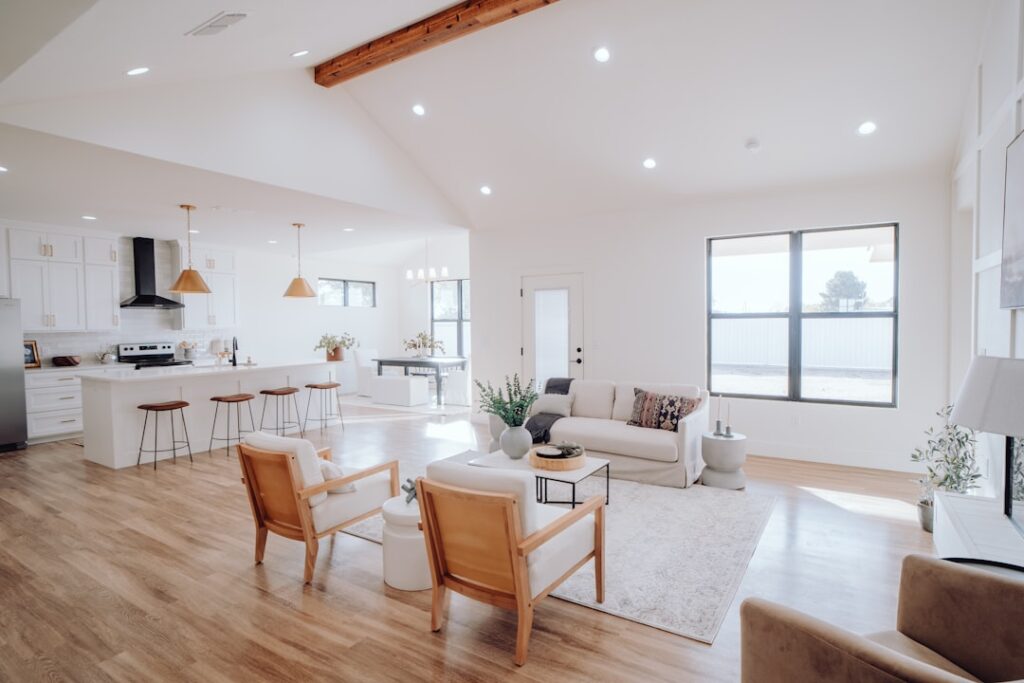
Most homeowners spend more on flooring across a lifetime than on any other interior finish, yet the typical buying decision happens in 90 minutes at a showroom with sample swatches under fluorescent light. Picking flooring for home use room by room — not whole house at once — produces better-looking spaces and longer-lasting installations than the all-one-product approach. After running flooring spec for hundreds of single-family renovations from starter homes to estate-level remodels, I can tell you the matching big-box flyer is almost never the right answer for an entire house.
- Match the Floor to the Room’s Job
- Engineered Hardwood Across Most Living Spaces
- Luxury Vinyl Plank: The High-Volume Workhorse
- Porcelain Tile for Wet Areas
- Carpet for Bedrooms and Family Rooms
- Mixing Materials Without It Looking Chopped Up
- Budget Allocation Across the House
- Installer Selection Affects Outcome More Than Brand
Match the Floor to the Room’s Job
Rooms have different demands. A kitchen takes 50 spilled glasses of water a year, a bathroom hits 90 percent humidity twice daily, and a bedroom needs to be quiet underfoot at 3 a.m. The right flooring for home use changes accordingly:
- Entry and mudroom: Porcelain tile or stone. Salt, snow, sand, and tracked rain destroy wood and laminate within a few seasons
- Kitchen: Porcelain tile or premium SPC-core LVP. Avoid laminate and engineered hardwood under sink and dishwasher
- Living and dining rooms: Engineered hardwood or premium LVP. Both handle furniture, foot traffic, and aesthetic demand
- Bedrooms: Carpet or engineered hardwood with area rugs. Sound dampening and underfoot comfort matter most
- Bathrooms: Porcelain tile or waterproof LVP. Never solid hardwood, regardless of finish quality
- Basements: SPC-core LVP or porcelain tile. Slab moisture and flooding risk rule out most other options
Engineered Hardwood Across Most Living Spaces
For 60 to 70 percent of a typical American home, engineered hardwood is the right answer. The cross-laminated plywood core handles slab and crawlspace moisture better than solid wood, the 4 to 6mm wear layer accepts two or three full refinishes, and the visual quality matches solid in every meaningful way.
Top brands for residential use include Mirage Engineered (Canadian-made, exceptional QC), Kahrs (Swedish manufacturer with 160+ year heritage), Lauzon Pure Genius (formaldehyde-free), and Hallmark Floors (US-made wide-plank specialist). Plan on $10 to $18 per sq ft installed for premium 5 to 7-inch wide plank in a white oak rift-and-quarter-sawn finish.
Luxury Vinyl Plank: The High-Volume Workhorse
LVP now accounts for over 40 percent of US residential floor installations. SPC-core products in particular have closed the visual gap with hardwood — embossed-in-register textures, beveled edges, and printed graining now fool nearly everyone at conversation distance.
For a budget-conscious whole-house install at $5 to $7 per sq ft installed, mid-tier LVP delivers consistent appearance, true waterproof construction, and 15 to 20 year wear ratings. COREtec Plus, Mohawk RevWood Plus, and Shaw Floorte Pro are the volume leaders. The visual compromise is mainly underfoot feel — LVP rings hollow under bare feet versus the dampened sound of real wood or tile.
Porcelain Tile for Wet Areas
Bathrooms, kitchens, mudrooms, and laundry rooms call for porcelain tile in nearly every home. Modern wood-look porcelain in 9×48 or 12×48 plank format gives the same visual as a hardwood floor while delivering true waterproof performance and 50+ year lifespan.
Plan on $6 to $12 per sq ft installed for quality wood-look porcelain plank. Add electric radiant heat (Schluter DITRA-HEAT or WarmlyYours TempZone) for $5 to $8 per sq ft extra — almost mandatory for bathroom tile, since cold tile underfoot is the single most common complaint after installation.
Carpet for Bedrooms and Family Rooms
Despite the LVP wave, carpet remains the right answer for bedrooms and play-focused family rooms. Sound dampening, foot comfort, and child safety on a fall all favor carpet over hard surfaces in those spaces.
Modern stain-resistant nylon and triexta fibers handle pet accidents and food spills far better than the carpets from a decade ago. Mohawk SmartStrand (triexta) and Shaw Anso (nylon) both carry meaningful pet warranties. Plan on $4.50 to $7.50 per sq ft installed including eight-pound rebond pad.
Mixing Materials Without It Looking Chopped Up
The trick to a multi-material home is transitions and color flow. Three rules govern this well:
First, pick one wood look and run it across all hard-surface main living areas. Whether that is real engineered hardwood or wood-look porcelain or LVP, keep the color, plank width, and direction consistent through the kitchen, dining, and living room. Second, use 1.5 to 2-inch wide T-molding or flush metal transitions at doorways — anything wider reads as a hard break. Third, choose bathroom and entry tile in a color that complements the main wood; gray-on-gray pairs well with most oak tones.
Budget Allocation Across the House
Spend the most per sq ft where you stand the most. Kitchen, entry, and primary bath get the premium spec; secondary bedrooms and basements get the value tier. A representative 2,200 sq ft single-family home budget breaks down something like this:
Kitchen and entry porcelain tile (350 sq ft): $4,200 installed. Living, dining, and hallways in engineered hardwood (650 sq ft): $9,750 installed. Three bedrooms in carpet (650 sq ft): $4,000 installed. Two bathrooms in porcelain plank (180 sq ft): $1,800 installed. Basement in SPC-core LVP (370 sq ft): $2,200 installed. All-in budget around $22,000 for high-quality flooring throughout the home.
Installer Selection Affects Outcome More Than Brand
The difference between a $22,000 floor installation that lasts 30 years and one that fails in 5 is rarely the product — it is the installer. Ask any candidate for a list of last year’s jobs, two or three of which you can drive past. Insist on a written subfloor moisture report and a documented acclimation schedule for wood products.
Pay no more than 30 percent down at contract signing, with progress payments tied to specific phase completions. Hold 10 percent as final retention until 30 days after installation for any callbacks. Good installers welcome this structure; ones who refuse it are usually the ones who disappear when problems surface.
Prefer to explore on your own?
See how new flooring looks in your actual room in seconds — free, no signup.
Try the free Floor Studio →

